



Poseable-Core Curved Dildo with Wide Suction Base
August 14, 2026
Three-Roller Helical-Track Automatic Stroker with Guarded Windows, Twist-Lock Collar and Vent Dial
August 14, 2026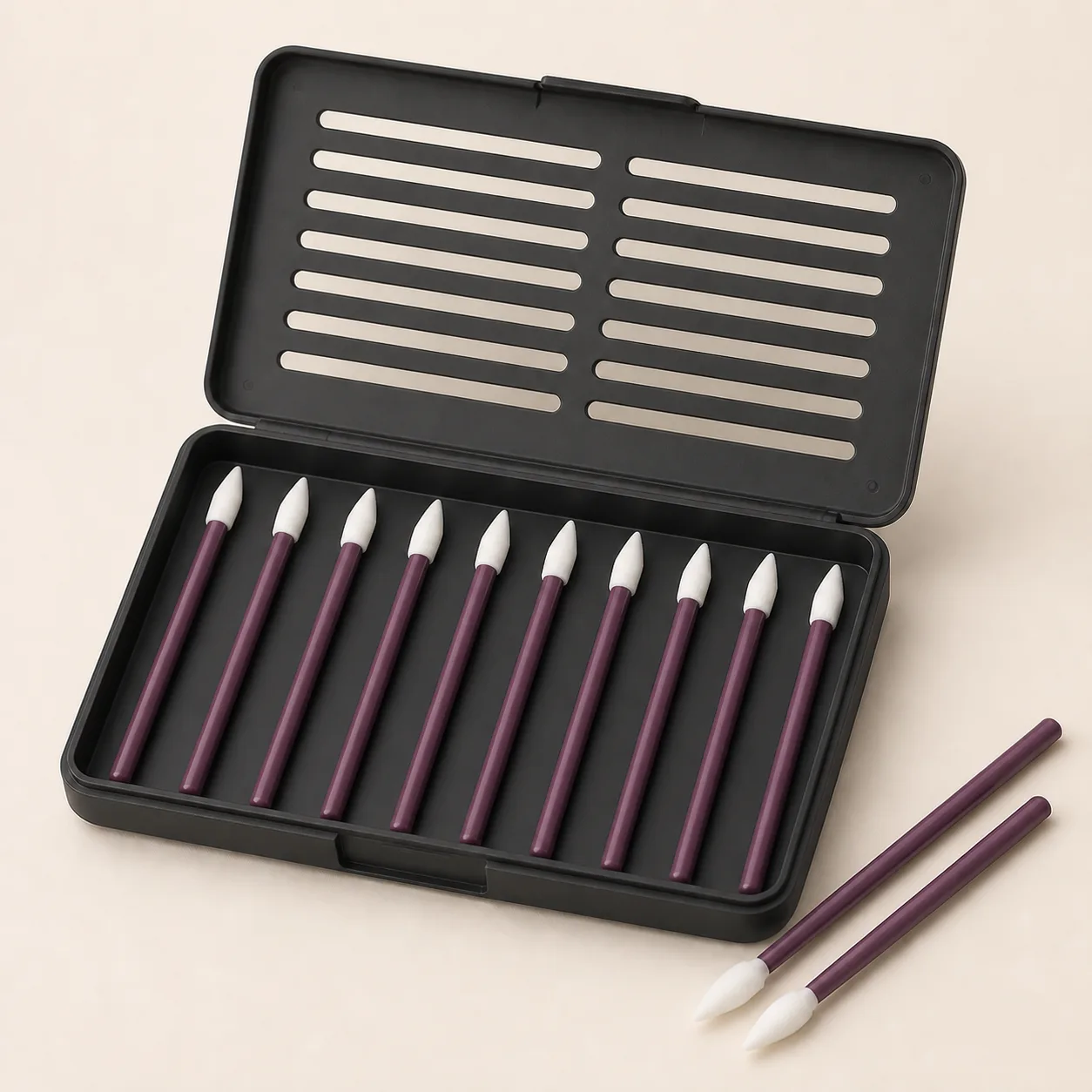
Pointed Foam Detail Swabs with Vented Case, 12-Pack
Twelve pointed foam detail swabs with a ventilated case for controlled care of visible, maker-approved exterior seams and edges.
9,99 $
200 in stock
A pointed foam tip can reach a visible care detail
The pointed foam detail swabs concept gives an adult-product owner a narrow, disposable tool for dry dust or maker-approved cleaner residue on accessible exterior seams. Its tapered wedge can present a small flat face, an angled edge or a fine point without the loose loops associated with a household cotton bud.

This is a precision care accessory, not proof that every recess should be entered.
Keep the tool outside the body and outside the product
Do not use these swabs in ears, noses, mouths, genitals, wounds or any other body opening. They are not sampling tools, applicators or medical devices. Do not push a tip through charging ports, valves, speaker grilles, motors, battery compartments or openings that the product maker says must stay untouched.
Work only on a clearly visible external area that can be reached without force.
Start with the product maker’s care instructions
Confirm whether the product surface, seam and finish may be wiped, which formula is allowed and whether any gap must remain dry. A waterproof rating for the main shell does not automatically cover switches, magnetic contacts, decorative bonds or charging interfaces.
If the instructions are missing or ambiguous, pause and ask the maker rather than testing an unknown liquid on the product.
Inspect the foam-to-handle joint under good light
Before use, rotate the swab and look for a split tip, exposed core, uneven cells, hardened edge, adhesive smear, discoloration, odor, dust or a loose joint. Pulling on the foam can damage it, so use visual inspection and only the maker-approved handling check.
Discard any imperfect piece before it touches the product.
Disconnect power and create a stable dry workspace
Switch the product off, unplug cables and follow the manufacturer’s battery guidance. Place it on a clean nonporous tray where both hands can work without balancing the item near a sink or table edge.
Keep open cleaner bottles, used cloths and unrelated parts outside the immediate work zone.
Choose a visible gap that is wider than the dry tip
Compare the uncompressed tip with the accessible seam. It should enter lightly while remaining visible; squeezing foam into a narrower channel increases friction, sheds material and may lodge the tip beyond safe reach.
Never trim the foam, sharpen the handle or bend the shaft to reach farther.
A dry first pass reveals how the surface responds
For loose surface dust, begin with a fresh dry swab. Touch the broad wedge face to a small approved area and make one short controlled pass while watching for snagging, color transfer or particles.
Stop if the foam catches, squeaks, compresses abruptly or lifts a coating. Do not scrub to compensate for poor access.
Use liquid only when the exact formula is approved
If the product maker allows a cleaner in that location, dispense a measured amount away from the product and apply only the permitted quantity to the swab. The tip should not drip, shine with pooled liquid or release moisture when lightly positioned.
Never dip the swab into a bottle because that can contaminate the remaining formula and hide the amount absorbed.
Move outward in one deliberate direction
Guide residue from the inner end of an accessible seam toward an open edge where it can be collected safely. Rolling or reversing a loaded tip can redeposit debris, press it deeper or drag it across a finished surface.
Use a new side only while the foam remains intact and the care instructions permit another pass.
Watch the white foam as an immediate inspection surface
Pause after each pass and check the tip for dark particles, pigment, fragments, swelling, tackiness, tearing or separation from the handle. A visible change can show that the swab or product surface is reacting even before damage is obvious.
Do not interpret a clean-looking tip as proof that the area is sanitized.
One swab should serve one small defined task
Replace the swab when moving between products, materials, cleaner formulas or separate contamination zones. Also replace it after the tip becomes loaded, damp, misshapen or difficult to inspect.
Do not wash, dry or reuse a disposable swab, and do not place a handled piece back with unused tools.
The vented case is for clean unused dry pieces
Keep the remaining swabs in their original sealed packaging until the selected case has passed cleanliness and closure checks. Vent slots do not protect against bathroom humidity, dust, fragrance vapor or cleaner leakage, so store the closed case in a dry private cabinet away from chemicals.
Clean and dry the empty case by its confirmed method before restocking it.
Foam chemistry and surface compatibility remain unverified
Polymer name, cell structure, adhesive, handle resin and processing residues can affect performance with silicone, elastomers, coatings, metals and cleaner ingredients. No claim is made for lint control, antistatic behavior, solvent resistance, sterility or laboratory cleanliness.
Approve the chosen construction through documented sample testing before sale.
Incoming inspection must focus on the working tip
Measure overall length, tip profile, point consistency, handle straightness and joint position across multiple packs. Check count, odor, visible particles, compression recovery, dry abrasion, controlled wet exposure, tip retention and case ventilation using written acceptance limits.
Quarantine mixed profiles, crushed foam, rough edges, adhesive residue, loose tips, warped handles, dirty cases or packs with an incorrect count.
The supplier listing is a starting point for samples
An Alibaba pointed-foam-swab listing associated with Suzhou Jintai Antistatic Products shows USD 1.50-1.80 per bag with MOQ 10 bags. Bag count, exact tip, materials, cleanliness claims and case inclusion still require written confirmation.
The procurement reference supports sample inquiry only. The EUR 9.99 twelve-piece plan allows for China-origin freight, count and joint inspection, protective case sourcing and discreet packing; packed mass, freight, duty, tax, insurance, payment fees and destination terms remain pending.
Frequently asked questions
Are these the same as cotton buds?
No. The concept uses a shaped foam tip, but its exact composition and particle performance must be confirmed.
Can a swab clean inside a charging port?
Only if the product maker expressly allows that exact tool and method; otherwise keep the port untouched and dry.
May the tip be soaked in cleaner?
No. Use only a controlled permitted amount that cannot drip or pool.
Is the case a sterile container?
No. Sterility and laboratory cleanliness are not claimed, and ventilation slots admit the surrounding environment.
Can one swab be used on two products?
No. Limit each piece to one small defined care task on one product.
When should work stop immediately?
Stop after snagging, coating transfer, swelling, tearing, tip movement, strong odor, liquid migration or uncertainty about the maker’s instructions.
Reviews
There are no reviews yet.