



Purple Twin-Arm Rechargeable Rabbit Vibrator
August 14, 2026
WINGPOW BD03-05 Flutter-Tip Mini Vibrator
August 14, 2026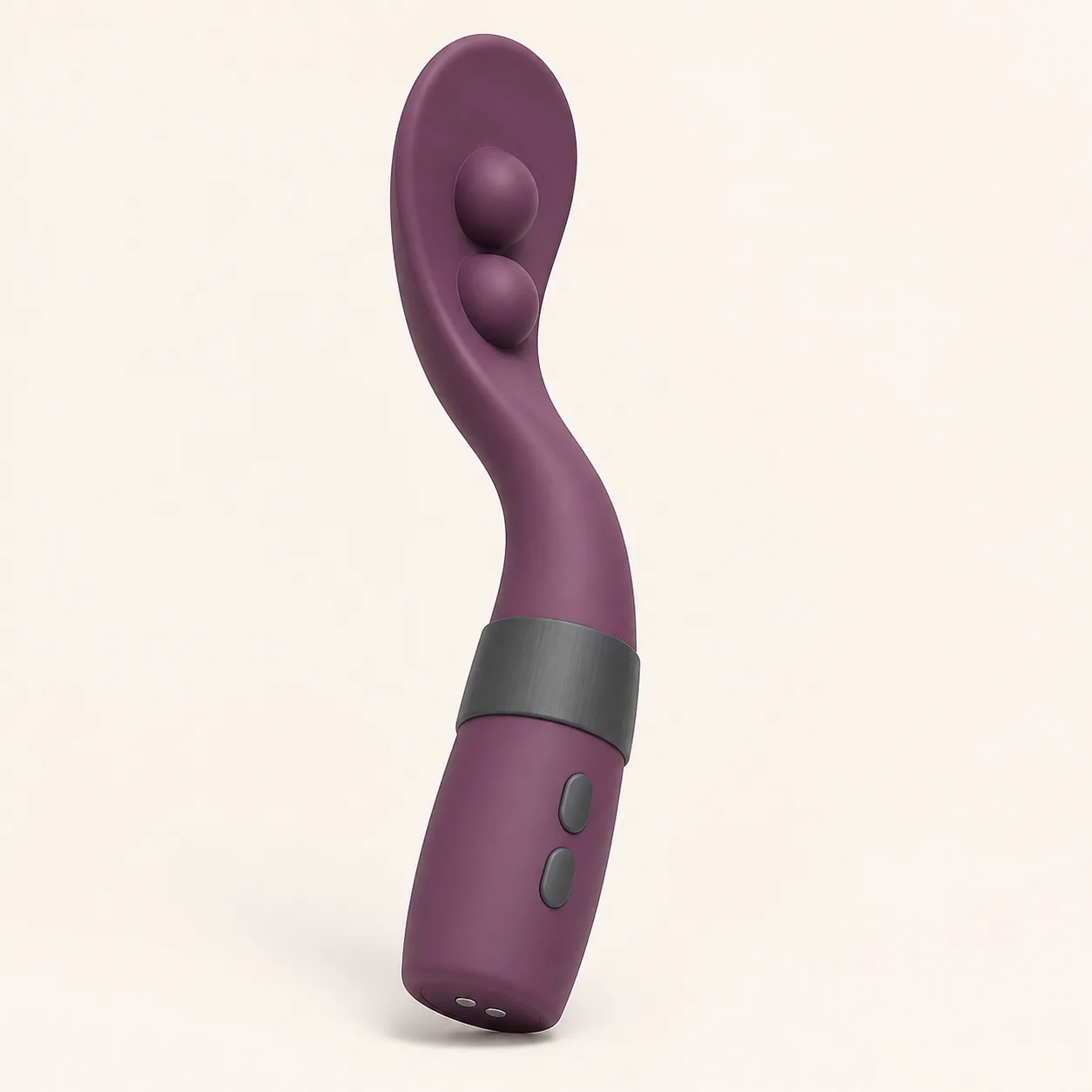
Twin-Node Flexible G-Spot Vibrator with Sliding Grip Collar
A curved smoky-plum vibrator concept with one broad spoon head, exactly two raised oval contact nodes, a flexible S-curve neck and a sliding charcoal grip collar.
49,99 $
200 in stock
Place two oval contact nodes along one broad spoon head
This twin-node flexible G-spot vibrator uses a single smoky-plum body with exactly two raised oval nodes aligned on the inner face of a broad spoon-shaped head. An S-curve neck leads to one charcoal sliding grip collar, two oval control buttons and two charging contacts at the flat base.

The image defines design intent only. Dimensions, materials, hardness, flex, collar travel, motor performance, battery, ingress resistance and production readiness remain pending.
Audit the single-device pack before adding accessories
The proposed sellable unit contains one curved vibrator. A purchase specification must separately list any charging lead, storage item, printed guide or protective cap if later approved, because none is shown or included in the present concept.
Final pack count, connector type, cable length, packaging, labels and spare-part policy require supplier confirmation.
Measure the spoon head on three perpendicular axes
Record maximum head length, width and thickness, then capture the distance from its rounded tip to the centre of each node. Add perimeter profile scans at the tip, upper node, lower node and neck transition so tooling changes can be detected.
Target tolerances and usable dimensions must come from approved engineering samples rather than the rendering.
Label the upper and lower nodes N1 and N2
For each oval node, measure major axis, minor axis, projection, edge radius, centre position and spacing to the other node. Compare the two shapes under a fixture so apparent perspective does not mask an incorrect mould.
Exactly two nodes are proposed. Their final firmness and contact feel require material and pressure testing.
Map pressure across the twin-node face
Use a compliant pressure mat over a defined range of forces and angles to record how N1, N2 and the surrounding spoon share load. Look for sudden peaks at node edges and loss of contact when the neck bends.
No universal stimulation result is claimed; anatomy, angle, force and preference differ between consenting adults.
Characterize the S-curve neck without overstating flexibility
Measure neutral curvature, minimum bend radius, force at fixed deflections, elastic recovery and permanent set after repeated cycles. Inspect the narrow transition for surface whitening, wrinkles, separation or internal contact with moving parts.
Do not force the device beyond the verified bend envelope. Stop use if the surface cracks, a rigid part becomes exposed or controls behave unexpectedly.
Define the sliding collar travel with fixed landmarks
Mark the collar’s upper and lower approved positions and record total travel, rotational play, sliding force and clearance to the neck and buttons. Check that each position improves hand indexing without pinching a finger or blocking a control.
The image proposes movement, but the final range and any detents remain pending a functional sample.
Test collar retention during wet and dry handling
Measure the force needed to shift or rotate the charcoal collar with dry hands, damp gloves and the approved lubricant simulant. Apply repeated pull, twist and drop cycles, then inspect for looseness, trapped liquid, abrasion and colour transfer.
Collar material, texture, internal guide method and serviceability require supplier disclosure.
Separate the two-button control logic clearly
Assign a documented function to each oval button and verify short press, long press, lock state, mode advance, power-off and low-charge behaviour. Buttons should remain distinguishable by position and tactile response without looking at the handle.
Mode count, memory, indicator behaviour and travel-lock sequence are not confirmed until firmware and sample testing agree.
Measure output at both nodes and along the handle
Record frequency, acceleration and displacement at N1, N2, the spoon edge, neck, collar and grip across every verified setting. Repeat measurements under free-air and compliant-load conditions to identify damping, imbalance or excessive handle transfer.
Marketing strength labels must be replaced by measured ranges and tolerances before sale.
Control surface temperature and acoustic output
Run the longest verified operating cycle at representative load and ambient conditions, then log temperature at both nodes, neck, collar, buttons, battery zone and charging contacts. Measure sound at a fixed distance in a controlled room.
Operating time, maximum temperature, noise and duty cycle remain pending. Stop testing after abnormal heat, odour, swelling or intermittent output.
Verify battery protection and two-contact charging
Identify cell chemistry, capacity, protection circuit and the exact charger matched to the two base contacts. Test polarity, alignment, charging current, full-charge cut-off, short-circuit response, standby drain and cycle retention.
No charging lead is promised by the image. Charge only with the supplier-approved system once electrical evidence is complete.
Validate ingress resistance before writing cleaning advice
Test seams, buttons, collar guide and base contacts to a documented ingress method in new and aged samples. Repeat after flex, collar cycling and drop conditioning because movement may change sealing performance.
Do not claim waterproof use or immersion cleaning without passing evidence. Until then, keep charging areas dry and follow only verified wipe-clean instructions.
Confirm every skin-contact material and lubricant pairing
Request traceable composition, hardness, restricted-substance and migration data for the outer surface, nodes, collar, buttons, adhesives, pigments, shell and seals. Screen approved lubricant types for swelling, tackiness, cracking, staining and loss of mechanical fit.
Silicone, body-safe, hypoallergenic and medical-grade claims are withheld unless documents and independent checks support the exact production materials.
Set a landed-price plan from curved-vibrator references
An Alibaba public listing displayed a curved rechargeable personal massager at USD 7.49 for 1 to 99 pieces, USD 6.79 for 100 to 499, USD 6.39 for 500 to 2,999 and USD 5.79 at 3,000 or more. A broader category page displayed a powerful curved-tip reference at USD 4.10 to 5.30 with MOQ 1. These are benchmarks, not quotations for this twin-node collar design or approved suppliers.
The public procurement reference supports an EUR 49.99 planning price after provisional allowance for China-origin freight, custom dual-node tooling, collar and neck cycling, pressure, vibration, thermal, acoustic, battery, charging, ingress, material and cleaning validation, discreet fulfilment and quality-loss provisions. Exact supplier, quote, MOQ, dimensions, materials, modes, battery, packed weight, freight, duty, tax, certification, payment terms, lead time and production availability remain pending.
Frequently asked questions
How many raised contact nodes are on the head?
Exactly two oval nodes are proposed in tandem on the inner face of the spoon head.
Does the charcoal collar move?
The concept specifies a sliding grip collar. Its travel, retention and wet-hand performance require functional samples.
Is the curved neck fully flexible?
No unrestricted-flex claim is made. Bend force, safe radius and recovery remain pending cycle tests.
How many vibration modes are included?
The final mode count and control sequence await firmware and physical verification.
Can the device be immersed?
Immersion is not claimed. Ingress level and cleaning method remain pending documented tests.
What material touches the body?
Exact surface composition and hardness require supplier documents and approved production samples.
Reviews
There are no reviews yet.