


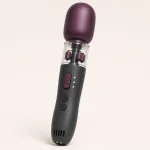
Tri-Cam Three-Orbit Wand Massager
August 14, 2026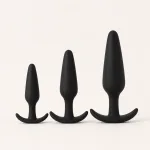
Three-Piece Silicone Set – Graduated Sizes, Flared Bases
August 14, 2026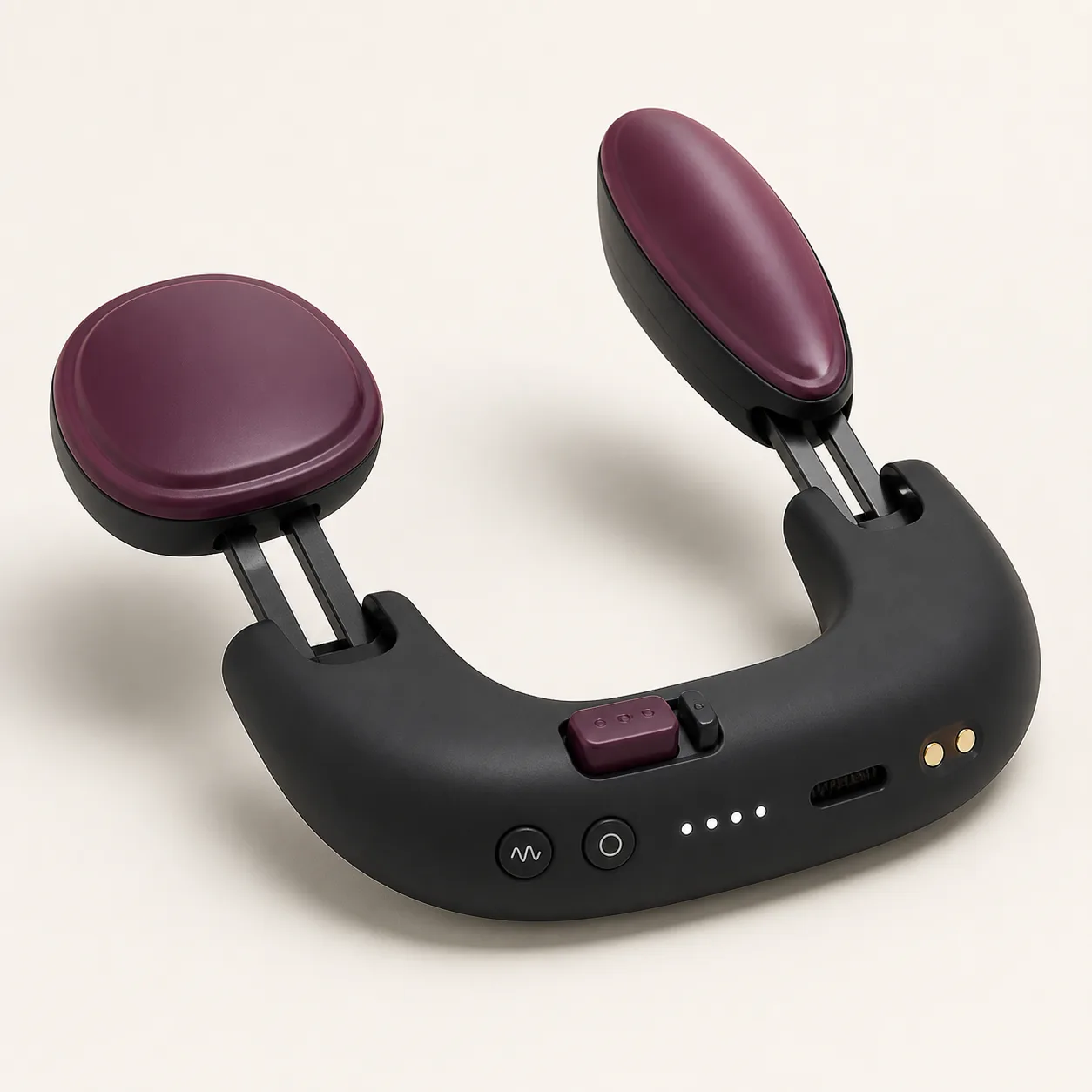
Three-Stop Preload Twin Leaf-Spring Couples Vibrator
An open U-shaped couples vibrator concept with two unequal contact pods, each supported by paired leaf springs and a proposed three-stop preload slider.
57,99 $
200 in stock
Float two unequal pods on parallel leaf springs
This leaf spring couples vibrator concept places a broad shallow pod and a longer oval pod at the ends of an open U bridge. Each pod is carried by two visible parallel spring strips, while a guarded three-stop slider is proposed to change system preload without a hinged four-bar mechanism.

The image does not prove spring material, preload range, pod travel, parallelism, fit, motor count, programs, ingress protection, runtime or supplier approval.
Inventory both compliant pod assemblies
Request an exploded drawing and bill of materials for both pod skins, cores, carriers, four leaf strips, clamps, anchors, guards, hard stops, preload slider, detents, lock tab, transmission bar, U bridge, motors, counterweights, sensors, controller, buttons, indicators, vent, cell, contacts, conductors, seals, pigments, coatings, lubricants and adhesives.
Identify which parts transmit preload and which only guide or guard movement.
Measure the neutral U geometry
Record bridge gap, arm curvature, pod dimensions, separation, face angle, carrier offset, leaf length, width and thickness, anchor spacing, guarded openings, slider travel, control positions, vent area, contact spacing, mass and center of gravity.
Repeat at every verified preload stop after a standardized rest period.
Characterize all four leaf strips
Measure flatness, initial curvature, thickness variation, surface defects, clamp length, free span, edge radius and neutral alignment for each strip. Compare paired strips on the same pod and opposing assemblies.
Reject a twisted, nicked, delaminated, corroded or unequally clamped spring element.
Map load versus pod deflection
Apply controlled inward, outward, lateral and torsional loads to each pod while recording displacement, stiffness, hysteresis, damping, cross-axis movement and permanent set. Repeat with both pods loaded together.
Determine whether the bridge or preload transmission adds nonlinear force near the hard stops.
Calibrate the three preload states
Measure slider travel, detent engagement, lock force, false-seating resistance and resulting pod preload at every position. Approach each stop from both directions under no load and standardized pod deflection.
The three visible dots are reference marks only until force and geometry repeatability are proven.
Verify loaded pod parallelism
Track pitch, roll, yaw, face plane and lateral shift for both pods across preload settings and compliant loads. Compare the two strips on each carrier for unequal bending.
Parallel springs suggest controlled motion but do not guarantee alignment after molding tolerance, clamp creep or fatigue.
Map contact pressure and retention
Use standardized paired compliant fixtures to record contact area, peak and edge pressure, bridge opening, pod migration, rotation resistance and stable orientation at each preload state. Add modest axial and torsional disturbances.
Set limits from local peaks, spring strain and retention changes rather than average surface force.
Measure U-bridge coupling
Record bridge opening force, twist, permanent set and transfer between pod carriers when one side is displaced. Track how preload changes the rigid-arm and spring-strip load share.
Stop if the bridge takes a set, a carrier contacts its arm or the lock moves under asymmetric load.
Probe every spring and carrier gap
Inspect strip-to-strip, strip-to-arm, strip-to-carrier, anchor, guard, hard-stop, slider and lock clearances throughout preload adjustment, full pod travel and combined loading. Use articulated probes from every direction.
Guards must prevent pinch access without trapping residue, hiding cracks or obstructing spring inspection.
Measure pod output and cross-coupling
Confirm actual motor count and assignment. Record three-axis acceleration, frequency, harmonics, rise, decay, sound and current at both pods and the handle for every verified program, preload and compliant load.
Quantify vibration transfer through leaf strips and the U bridge, including any resonance or fatigue-relevant amplification.
Document controls and charging
Verify startup hold, channel selection, level changes, program order, pause, immediate stop, memory, lockout and indicator meanings. Confirm mechanical preload changes cannot restart or alter a stopped program.
Verify cell chemistry, capacity, protection, input, polarity, charge time, runtime method, storage guidance, charging interlock and transport paperwork.
Test heat and spring-obstruction faults
Log temperature at both pod faces, carriers, all four springs, anchors, guards, bridge, slider, controls, vent, contacts, motor zones and cell. Obstruct one pod and one spring pair using protected fixtures.
Verify current limiting, shutdown, neutral release, cool-down and restart behavior without forcing a bent strip by hand.
Cycle preload, flex, vibration and cleaning
Run repeated slider changes, detent locking, independent and combined pod deflection, vibration programs, immediate stops, charging, cleaning, measured drying and storage. At checkpoints repeat spring geometry, stiffness, parallelism, preload, pressure, gaps, output, sound, current and heat tests.
Validate cleaning beneath pod edges, between every leaf pair, around clamps, anchors and guards, along the slider track, at controls, the vent and contacts.
Price after spring-fatigue validation
An Alibaba couples-vibrator listing currently shows a dual-head category example at USD 9.59-9.99 with MOQ one thousand. It is a category benchmark only and does not confirm this four-leaf suspension, three-stop preload slider or unequal floating pods.
The procurement reference supports an EUR 57.99 planning price after allowing for China-origin freight, exact-model sourcing, teardown, spring-strip metrology, load-deflection curves, preload calibration, loaded parallelism, pressure and retention maps, bridge coupling, gap inspection, dual-pod output, battery, thermal and obstruction review, combined fatigue, material evidence, cleaning validation, protective packing and discreet fulfillment. Exact quotation, MOQ, packed size, weight, freight, duty, tax, insurance, payment fees and delivery terms remain pending.
Frequently asked questions
Are the pods held by real leaf springs?
The concept shows four strips; exact material, clamps and load paths require teardown.
Do the three dots prove three preload levels?
No. Slider engagement, pod force and repeatability must be measured at each stop.
Will both pods stay parallel?
Loaded pitch, roll, yaw and strip-to-strip bending need fixture tests.
How many motors are installed?
Motor count, assignment and bridge cross-coupling remain pending.
Can the spring gaps be immersed?
No ingress claim is made; guarded strip and anchor spaces require validated cleaning and drying.
Which faults require retirement?
A bent or nicked strip, loose clamp, skewed pod, false preload lock, closing gap, cracked bridge, exposed conductor, swollen cell or abnormal heat.
Reviews
There are no reviews yet.