


Automatic Piston Massager – Adjustable Suction-Base Design
August 14, 2026
Plum-Cushion Open-Ring Gag
August 14, 2026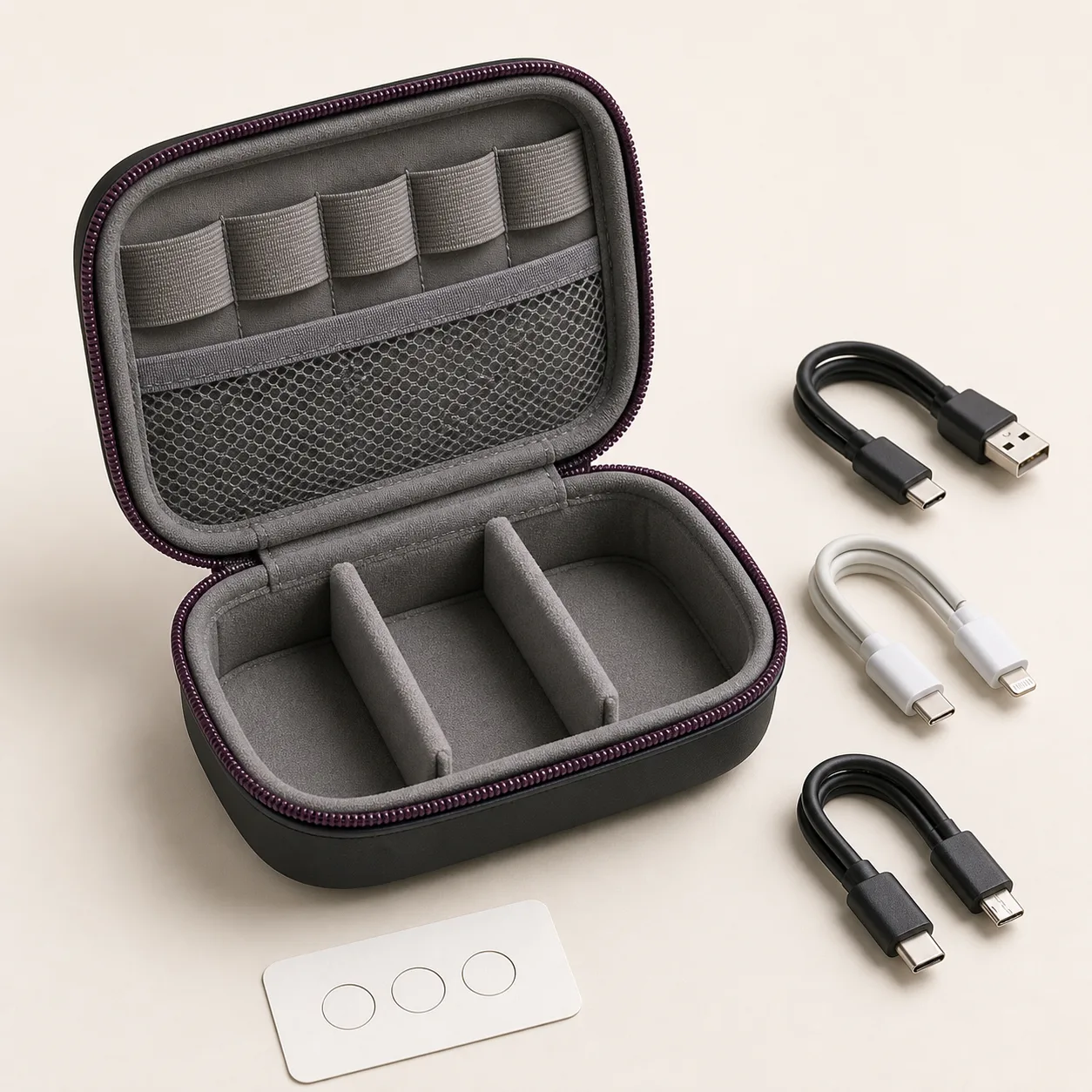
Compact Hard-Shell Charging Cable Organizer Case
A compact charcoal charging-cable organizer concept with plum zipper, mesh pocket, elastic loops, movable dividers and blank inventory marker card.
19,99 $
200 in stock
A cable case should organize identities before it organizes coils
The charging cable organizer case concept uses a charcoal clamshell, plum zipper track, gray lining, mesh pocket, five elastic loops and two movable dividers. Three different connector silhouettes and a blank three-marker card illustrate the real problem: similar-looking leads can carry different voltages, pin layouts and device instructions.

The case does not make an unknown cable compatible, safe or electrically equivalent.
Internal measurements decide what can close without pressure
Record external length, width and depth, then measure each compartment with the dividers installed. Compare those limits with coiled cable diameter, connector height and any charger body intended for storage.
The lid should close naturally without bending a plug, pressing a button or forcing the zipper around a hard corner.
Hard-shell is a construction description, not a crush rating
Identify the molded core, outer textile, adhesive, foam and lining. Test deformation under defined flat and point loads, then inspect whether the shell rebounds and whether stored connector housings remain undamaged.
No protective rating is approved until the exact production case completes a documented method.
The zipper is both closure and wear point
Cycle the slider around both corners with the case empty and at the approved load. Check tooth alignment, pull strength, fabric abrasion and whether loose lining can enter the track.
Stop if unusual resistance appears; forcing the slider can damage the case or press against the cable inside.
Padding must separate hardware without trapping heat
Measure lining thickness and compression set where plugs contact the wall. Padding can reduce rattling, but it cannot make storage safe while a charger or device is powered.
All electronics should be disconnected and cool before the case is closed.
Movable dividers need hook strength and clean edges
Confirm divider count, attachment type, edge softness and usable adjustment range. Reposition them repeatedly, then inspect for lint, exposed hook material, delamination and loss of holding force.
Leave enough clearance that a rigid connector cannot become a load-bearing divider.
Elastic loops should hold the coil, not kink the conductor
Measure loop width, stretch and seam strength with the intended cable diameters. Secure a broad coil without folding the lead sharply at the plug or pulling against the strain relief.
Replace the storage position if the elastic leaves a permanent bend or compresses a connector shell.
The mesh pocket is for light accessories only
Test pocket opening, seam strength and retained depth. Small adapters can move through oversized mesh or become pressed against the lid, while heavy power units can distort the panel.
Keep metal pieces capped or isolated so they cannot scratch connectors or bridge exposed contacts.
Disconnect every lead before it enters storage
Remove the cable from mains adapters, power banks and devices using the connector housing rather than pulling the wire. Inspect for cuts, crushed sections, loose housings, corrosion and bent contacts.
A damaged lead should be quarantined according to the device maker’s guidance, not hidden in the organizer.
Moisture and charging equipment do not share a closed case
Let cleaned device exteriors, cable jackets and connectors dry completely before packing. The case is not presented as sealed, and moisture trapped in mesh, foam or textile can remain out of sight.
Never charge a device inside the closed organizer.
A simple inventory marker prevents connector guessing
Use color dots, removable symbols or an external list to link each lead to its intended device and approved power source. Avoid adhesive labels on contacts, strain reliefs or areas that flex.
Update the record when a device or cable is retired so an old lead is not selected by appearance alone.
Travel exposes the case to heat, compression and loss
Keep it in a cool, dry section of luggage away from liquids, direct sun and heavy hard-sided items. Airline and battery rules apply to the actual electronics being carried; the empty case changes none of those requirements.
Do not advertise the shell as waterproof, theft-resistant or airport-approved without specific evidence.
Clean the organizer only after removing every electronic item
Confirm the outer cover, lining, foam, adhesive and divider care method with the supplier. Until then, avoid soaking, bleach, alcohol, fragrance, oils and high heat.
Use the approved minimal-moisture method and keep the case open until the lining, mesh and seams are fully dry.
Incoming inspection should use a loaded closure test
Sample dimensions, odor, color, shell symmetry, zipper travel, loop stretch, divider grip, mesh seams and lining adhesion. Load standardized cable forms, close without force and repeat the cycle before lot acceptance.
Quarantine cases with sharp edges, strong odor, dye transfer, crushed walls, loose lining, weak seams or unstable dividers.
The supplier price covers a generic electronics organizer
An Alibaba guide lists an EVA electronic travel cable organizer from Shenzhen Baoliyuan Bags Co., Ltd. at USD 0.65 with MOQ 2 pieces. Exact model, dimensions, shell, lining, features, resistance and included contents remain pending.
The procurement reference supports sample inquiry only. The EUR 19.99 plan includes a provisional China-origin freight allowance plus closure, fit, material, odor, load and care review; packed weight, freight, duty, tax, insurance, payment fees and destination terms remain pending.
Frequently asked questions
Are charging cables included?
No included leads are promised; the cables shown are display props and final pack contents require written confirmation.
Will every charger fit?
No. Internal dimensions, divider layout and closure clearance must be compared with each intended cable and adapter.
Can a device charge while inside the case?
No. Store electronics disconnected, cool and dry, and never operate charging equipment in the closed organizer.
Is the shell waterproof or crushproof?
No such rating is approved. Those claims require production-specific ingress and load test methods.
How tightly should cables be coiled?
Use a broad relaxed coil that does not kink the conductor or pull against either strain relief.
When should the case be removed from use?
Stop using it if the zipper fails, walls collapse, lining separates, sharp edges appear, dye transfers or persistent odor develops.
Reviews
There are no reviews yet.