



Lavender Satin Handkerchief-Hem Slip and Sheer Mesh Robe Set
August 14, 2026
Three-Stop Cam-Compression Wand Massager with Adjustable Head Collar
August 14, 2026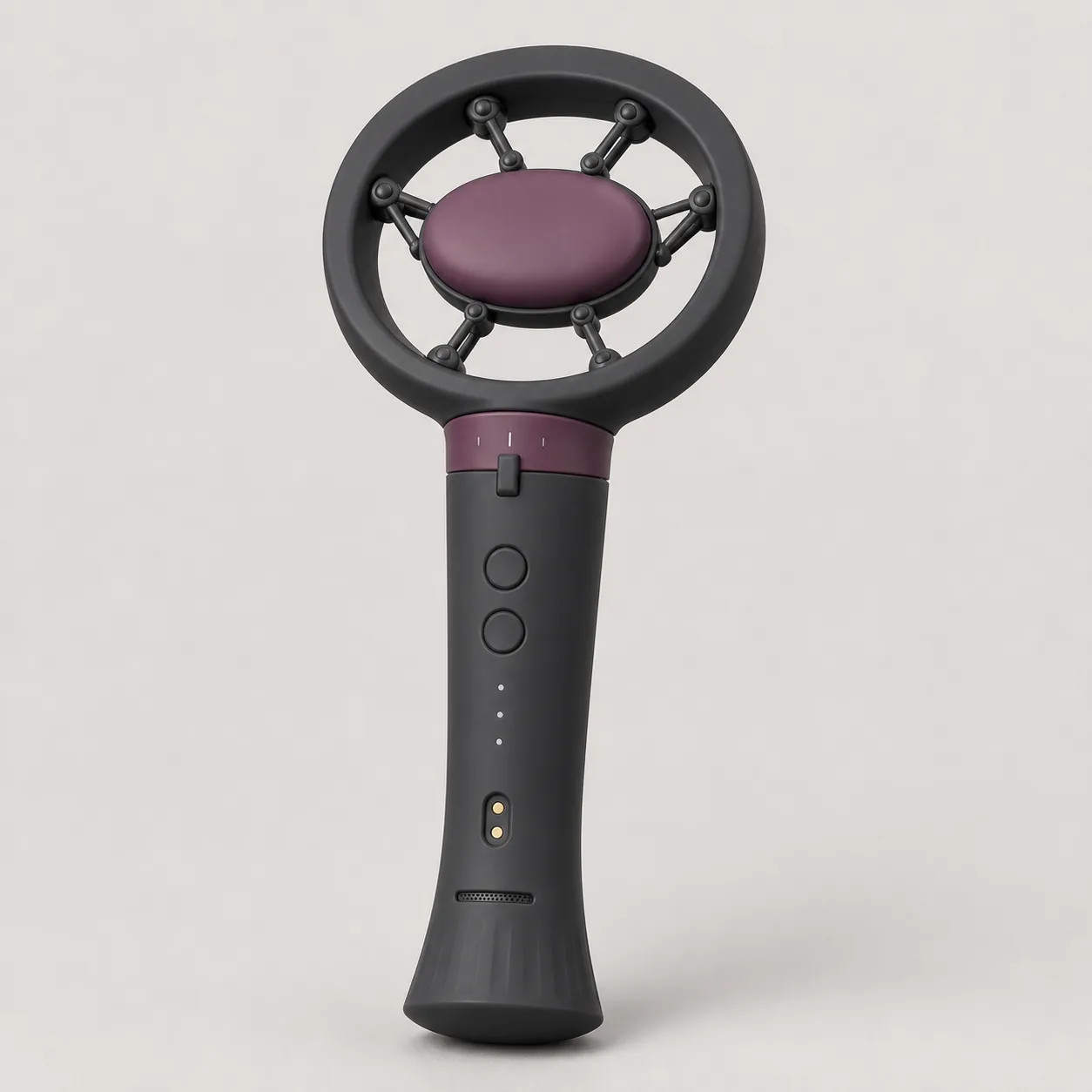
Six-Strut Parallel-Platform Wand Massager with Tilt-Limit Collar
A broad-ring wand concept with one floating oval contact platform, six articulated support stations and a lockable three-stop tilt-limit collar.
72,99 $
200 in stock
Float one contact platform inside a six-strut head
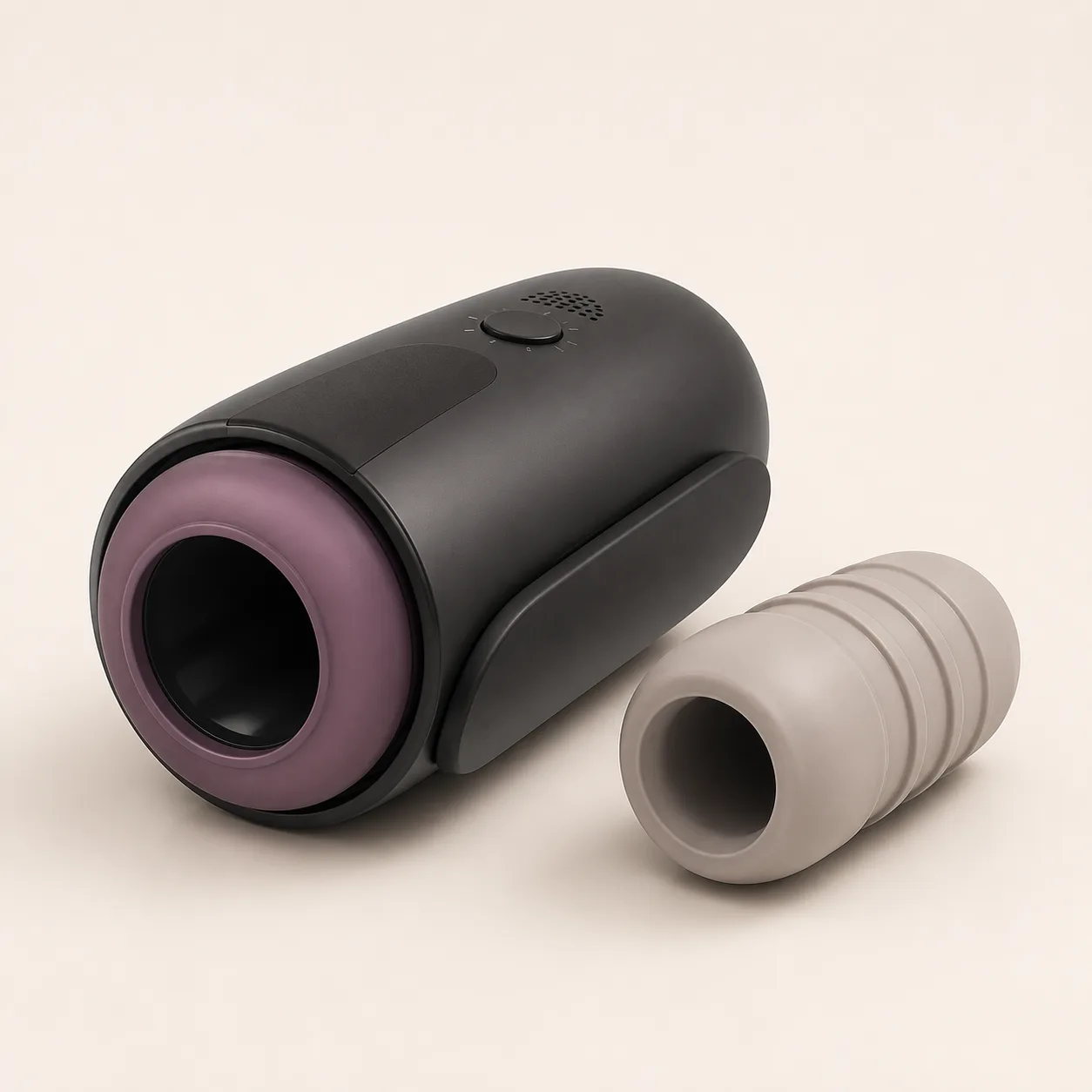
This six-strut parallel-platform wand massager concept suspends one raised plum oval contact platform inside a broad charcoal ring at exactly six guarded perimeter stations. A three-stop tilt-limit collar and separate lock tab are intended to change the allowed platform envelope without replacing the head.

The image does not prove linkage architecture, platform travel, tilt range, output, dimensions, materials, sealing, charging safety, sound level or production availability.
Inventory the complete parallel-platform assembly
Request an exploded bill of materials for contact skin, platform carrier, outer head ring, six articulated strut assemblies, upper and lower joints, guards, pins, bushings, retainers, actuator, moving mass, neck frame, tilt-limit collar, three stops, linkage, lock tab, two buttons, indicators, handle shells, controller, cell, charging contacts, vent membrane, conductors, seals, pigments, lubricants and adhesives.
Link every part to drawing revision, tolerance, approved supplier batch and reference sample.
Measure head ring neck and handle geometry
Record overall length, ring outer and inner diameters, ring thickness, platform axes, neutral projection, neck width, collar diameter, handle axes, control reach, contact recess, vent area, grip flare, mass and center of gravity.
Measure ring circularity, platform centering, handle alignment and neutral face plane before and after defined thermal and humidity conditioning.
Characterize the oval contact dome
Measure major and minor axes, crown, edge blend, skin hardness, compression curve, recovery, surface friction, seam position and local thickness. Inspect for flash, voids, thin regions, hard inclusions, tack change and pigment transfer.
Map the carrier beneath the skin and define the compliant area separately from its harder perimeter support.
Map all six support stations independently
For stations J1 through J6, record anchor coordinates, strut length, paired-link spacing if present, pin diameter, joint angle, axial play, lateral play, friction, backlash and free articulation. Compare the six stations under identical small test loads.
Visual symmetry does not establish equal stiffness, range or fatigue life; keep each station traceable throughout testing.
Inspect joints guards and moving clearances
Measure every joint-to-guard, strut-to-ring, strut-to-platform and platform-to-ring gap at neutral pose, allowed tilt extremes, centered preload, edge preload and powered operation. Use articulated probes and soft-film screening.
Reject an exposed pin end, retainer migration, joint rub, hard rim contact, hair or film trap, or recess that cannot be cleaned and dried by the validated process.
Calibrate the three-stop tilt-limit collar
Measure collar angle, stop geometry, detent torque, hysteresis and its effect on allowable pitch, roll and axial travel at all three marks. Approach each stop from both directions while the platform is unloaded and under bounded force.
A partly seated collar must not create an unstable limit, asymmetrical hard stop or sudden shift of the contact face.
Resolve platform pose and reachable envelope
Use optical tracking to map platform center coordinates, pitch, roll, yaw and axial displacement under a matrix of centered, offset and swept forces. Record neutral recovery, hysteresis, coupling and repeatability for each collar stop.
Confirm whether yaw is deliberately constrained and identify any pose where struts approach singular alignment, stack, bind or overload one station.
Map vibration across platform struts and ring
Measure three-axis acceleration, displacement, frequency, harmonics, rise and decay at the platform center, perimeter, all six joints, outer ring, collar, neck and handle. Test each program under no load and representative compliant loads.
Compare collar stops for cancellation, amplification, phase change, platform rattle, ring contact and excessive transfer into the grip.
Map pressure under centered and edge loading
Use an instrumented compliant pad to record contact area, peak pressure, platform tilt and ring approach under centered, offset and moving load. Repeat for every verified collar position and output program.
Reject ring-first contact, exposed-carrier pressure, unstable snap-through, one-joint overload or collar creep under the accepted load envelope.
Evaluate handle balance grip and controls
Measure center of gravity, wrist torque, grip pressure, dry and damp friction, button reach and accidental collar or lock contact in several hand fixtures. Confirm that either button can stop operation without covering the vent or contacts.
Track handle acceleration and local heat at the controls, neck, collar, grip flare and charging recess.
Verify charging power loss and shutdown
Document charging polarity, specified lead, input limit, cell chemistry and capacity, protection circuits, charge time, runtime, low-voltage behavior and operation-during-charge interlock. Interrupt power in every program and collar position and confirm a predictable off state.
Ingress and washability claims remain pending until the exposed joints, ring, platform edge, collar, lock, controls, contacts and vent pass appropriate tests.
Log current sound and temperature
Measure operating current, accessible temperature, actuator, cell, joint and collar hot spots and A-weighted sound at a stated distance for every program and representative tilt limit. Repeat with maximum approved preload, one protected joint restrained and low battery.
Investigate current spikes, joint chatter, platform rattle, ring resonance, collar drift, asymmetric heat or intermittent indicators.
Challenge joint faults then cycle and clean
In protected specimens, add play or friction at one station at a time while monitoring platform pose, adjacent loads, pressure, current, heat, sound and shutdown. Stop before damage and quarantine units with pin migration, binding, ring contact or uncontrolled tilt.
Cycle collar selection, locking, platform articulation, output programs, controlled loading, charging, defined cleaning, measured drying and storage. Recheck geometry, six station traces, gaps, stops, platform envelope, output, pressure, controls, contacts, heat, surfaces and seams.
Build landed price after platform proof
An Alibaba wand-massager page currently shows a 2-in-1 rechargeable category example at USD 7.50-8.61 with MOQ five. It is a benchmark only and does not confirm this six-strut platform, articulated head, tilt-limit collar or an approved supplier.
The procurement reference supports an EUR 72.99 planning price after allowing for China-origin freight, exact-model sourcing, ring, platform and six-station metrology, tilt-limit calibration, pose, vibration and pressure mapping, gap and handle review, electrical, current, sound and heat tests, protected fault and cycle work, protective packing and discreet fulfillment. Exact quotation, MOQ, materials, battery, packed size, weight, freight, duty, tax, insurance, payment fees, certifications and delivery terms remain pending.
Frequently asked questions
Does the head move in six degrees of freedom?
That cannot be assumed; optical tracking must identify which translations and rotations are permitted or constrained.
What does the tilt collar change?
It is intended to select three movement limits, subject to measured pitch, roll, axial travel, stability and repeatability.
Can the exposed joints pinch hair or film?
All pins, guards and moving gaps need articulated-probe and soft-film checks throughout the complete pose envelope.
Will the outer ring touch under pressure?
Ring approach and contact pressure require centered, offset and moving-load maps for each collar stop.
Is the wand waterproof?
No ingress claim is confirmed; joints, platform edge, collar, buttons, contacts and vent require evidence.
Which faults require retirement?
Growing joint play, pin migration, cracked struts, platform binding, ring contact, collar drift, failed locking, exposed contacts, abnormal heat, cell swelling or persistent residue.
Reviews
There are no reviews yet.