


Six-Loop Ladder Positioning Strap with Twin Padded Quick-Release Cuffs
August 14, 2026
Zhongrongxin ZRX-889 Lollipop Suction Vibrator
August 14, 2026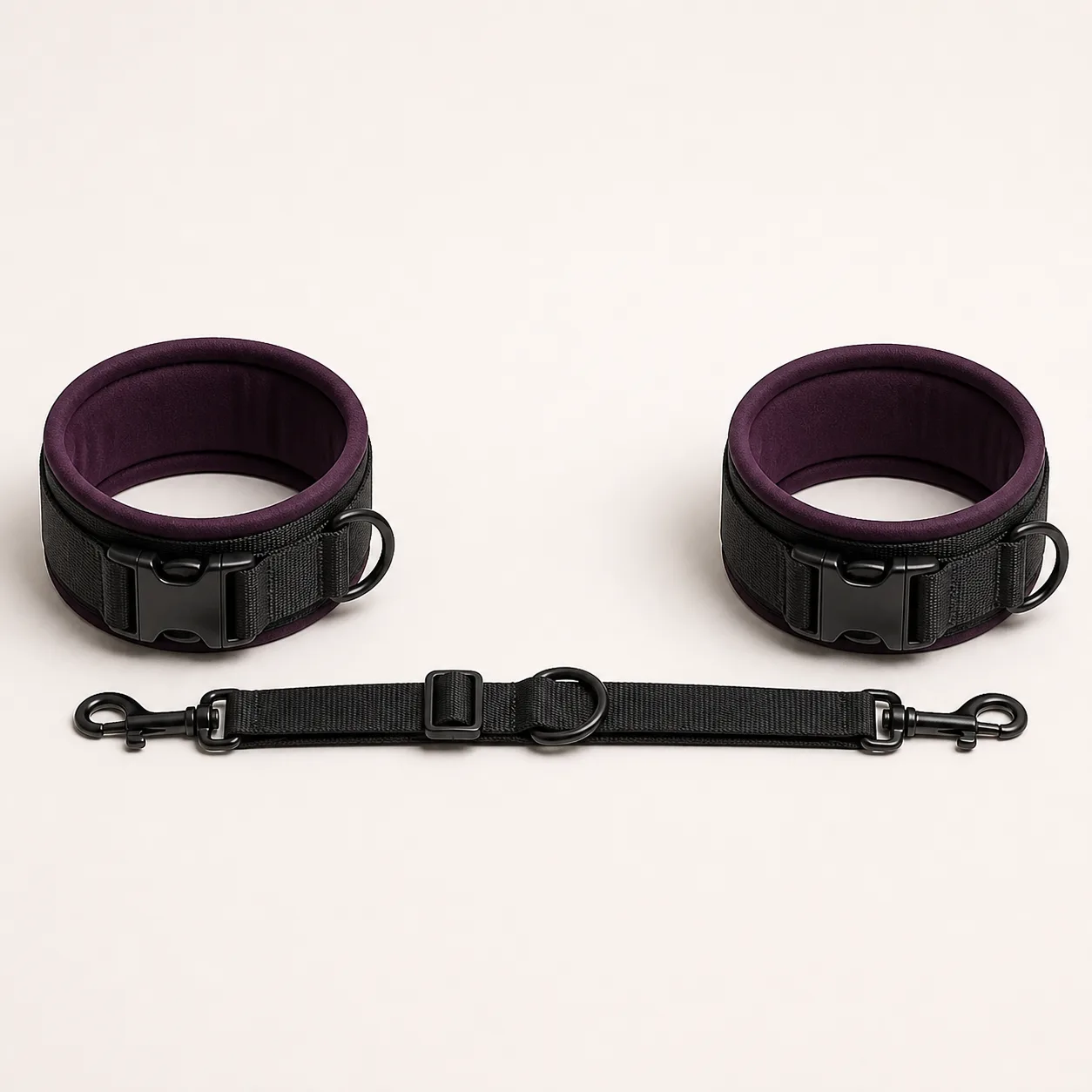
Twin-Thigh Padded Cuff and Center Positioning Strap Set
A three-assembly restraint concept with exactly two matching wide padded thigh cuffs and one adjustable center positioning strap with quick-release end hooks and a sliding center D-ring.
44,99 $
200 in stock
Coordinate three adjustable restraint assemblies
This twin-thigh padded cuff and center positioning strap set concept contains exactly two matching wide padded thigh cuffs and one adjustable center strap. Each cuff presents one side-release buckle and one external D-ring; the center strap presents two permanently attached snap hooks, one length slider and one sliding center D-ring.

The image establishes visible layout only. It does not confirm dimensions, fit range, textiles, foam, hardware, strength, care or production readiness.
Audit the exact three-piece pack
The planned inventory is two padded cuffs plus one center positioning strap. Wrist cuffs, ankle cuffs, collar, rigid bar, chain, leash, padlock, keys, storage bag and other accessories are excluded.
Pack inspection should count the three assemblies, compare the cuffs as a pair and confirm that both end hooks, the center D-ring and the strap slider are attached before sealing.
Measure both thigh cuffs independently
Record the inside circumference at minimum, midpoint and maximum adjustment for left and right cuffs. Also record band width, padded depth, buckle overlap, webbing tail length, total mass and any difference between the pair.
A thigh-fit range must remain pending until approved samples are measured under a stated method. Do not infer body sizing from the flat-lay opening.
Inspect every padded contact edge
Check the full inner circumference for even cushioning, smooth binding, compressed spots, exposed webbing, hard inclusions and abrupt thickness changes. Measure foam thickness and compression set at several marked points.
Softness, comfort, skin-contact and long-session language remains pending textile declarations, foam specifications, seam inspection and controlled wear evaluation.
Cycle the two side-release buckles
Operate each buckle through a defined closure-and-release cycle count. Record positive engagement, pull-tab access, accidental partial closure, grit sensitivity, webbing slip and any edge that can press into the lining.
The quick-release description refers only to the visible buckle format; actual one-hand release force and reliability remain pending validated samples.
Audit the cuff D-rings and anchors
Measure each external ring, webbing loop and stitch box. Compare ring orientation and anchor position so the two cuffs route the center strap without twisting the padded bands.
Ring metal, coating, corrosion resistance, nickel status, weld quality and rated working load all remain pending documentary evidence and lot testing.
Size the center positioning strap
Measure end-to-end length with both hooks, the adjustable webbing section, minimum and maximum hook-to-hook span, strap width, thickness and slider travel. Mark the usable zone that preserves enough tail through the slider.
The strap is intended to set a bounded relationship between the two cuffs, not to act as a rigid spreader. Exact spacing options remain pending the final measurement map.
Verify both snap hooks before use
Inspect each hook gate for full closure, smooth swivel movement if present, burrs, side play and interference with the adjacent webbing loop. Cycle both gates and compare the force needed to open them.
Hooks must attach only to the intended cuff D-rings. Their metal, finish, gate strength, corrosion resistance and safe load remain unverified.
Inspect the sliding center D-ring
Move the center ring along the strap and observe whether it stays flat, drags a folded edge or traps the adjustment tail. Record its position relative to the slider at minimum, midpoint and maximum strap lengths.
The center ring is a routing and positioning feature only. Do not treat it as a suspension point, overhead anchor or body-weight attachment.
Test webbing, seams and buckle retention
Map the webbing layers, stitch pattern, thread, fold length and reinforcement around both cuff buckles, both cuff rings, both hook ends and the center ring keeper. Apply only a documented bench test appropriate to the approved construction.
Reject skipped stitches, loose thread, edge fray, heat damage, webbing cuts, slider creep, buckle cracking, hook deformation and separated padding.
Trace the load path and pinch zones
Follow force from one cuff ring through its hook, center webbing and opposite hook to the second cuff ring. Check every change of direction for sharp edges, trapped fabric, hardware-on-hardware binding and pressure concentrated beside the buckle.
No load rating or strength claim is made. Never suspend, support body weight, connect to moving equipment or use the set with overhead anchors.
Set fit around circulation boundaries
Start with generous clearance and verify that two fingers can pass between each padded band and the body without forcing. Recheck after any strap adjustment because the center connection can rotate a cuff or change local pressure.
Stop immediately for numbness, tingling, coldness, colour change, swelling, unusual pain or loss of movement. Never place a cuff or strap around the neck.
Plan consent, release access and monitoring
Use only between informed sober adults with explicit consent, an agreed stop signal and continuous communication. Keep both cuff buckles and both snap hooks visible and reachable throughout the session.
Assign one person to perform frequent skin, circulation, hardware and webbing checks. Remove the set promptly if a buckle, hook or slider cannot be operated as rehearsed.
Clean, dry and store each assembly separately
Before setting care instructions, identify every textile, foam, buckle polymer, hook metal, ring metal, coating and thread. Test a hidden area with the approved mild cleaner and avoid soaking foam or trapping moisture beneath webbing folds unless the validated method permits it.
Air-dry fully away from direct heat, then store the three assemblies loose and separated from sharp objects, dyes, oils, solvents and heavy compression. Cleaning chemistry and storage temperature remain pending supplier validation.
Build landed price from public thigh-cuff benchmarks
An Alibaba adult-thigh-cuff category page displayed wrist-to-thigh restraint sets at USD 5.99 to 6.99 with MOQ 10, cross-waist thigh restraints at USD 12 to 16 with MOQ 3, and a waist-and-thigh cuff kit at USD 9.90 to 11.90 with MOQ 1. These are broad procurement references, not this exact three-assembly design or an approved supplier.
The public procurement benchmark supports an EUR 44.99 planning price after provisional allowance for China-origin freight, discreet fulfilment, padded construction, buckles, rings, hooks, sampling, inspection and handling loss. Exact supplier, quote, MOQ, materials, packed weight, freight, duty, tax, certifications, payment terms and lead time remain pending.
Frequently asked questions
How many assemblies are included?
Exactly two matching padded thigh cuffs and one adjustable center positioning strap are planned.
Does the set include wrist cuffs?
No. Wrist cuffs and other body restraints are excluded from the planned pack.
Can the center strap hold body weight?
No. The strap and center ring must never be used for suspension, overhead anchoring or body-weight support.
What thigh sizes will the cuffs fit?
The usable circumference range remains pending measurements from approved production samples.
What are the padding and hardware made from?
Textiles, foam, buckle polymer, hardware metals and coatings remain pending supplier declarations and testing.
How should the set be cleaned?
Follow only the validated care method for the approved textile, foam, polymer and metal construction, then dry every assembly completely.
Reviews
There are no reviews yet.