


Contoured Blackout Blindfold – Adjustable Sensory Eye Mask
August 14, 2026
KRSJJ SM81 Black & Red Positioning Harness and Inflatable Ramp Restraint Set
August 14, 2026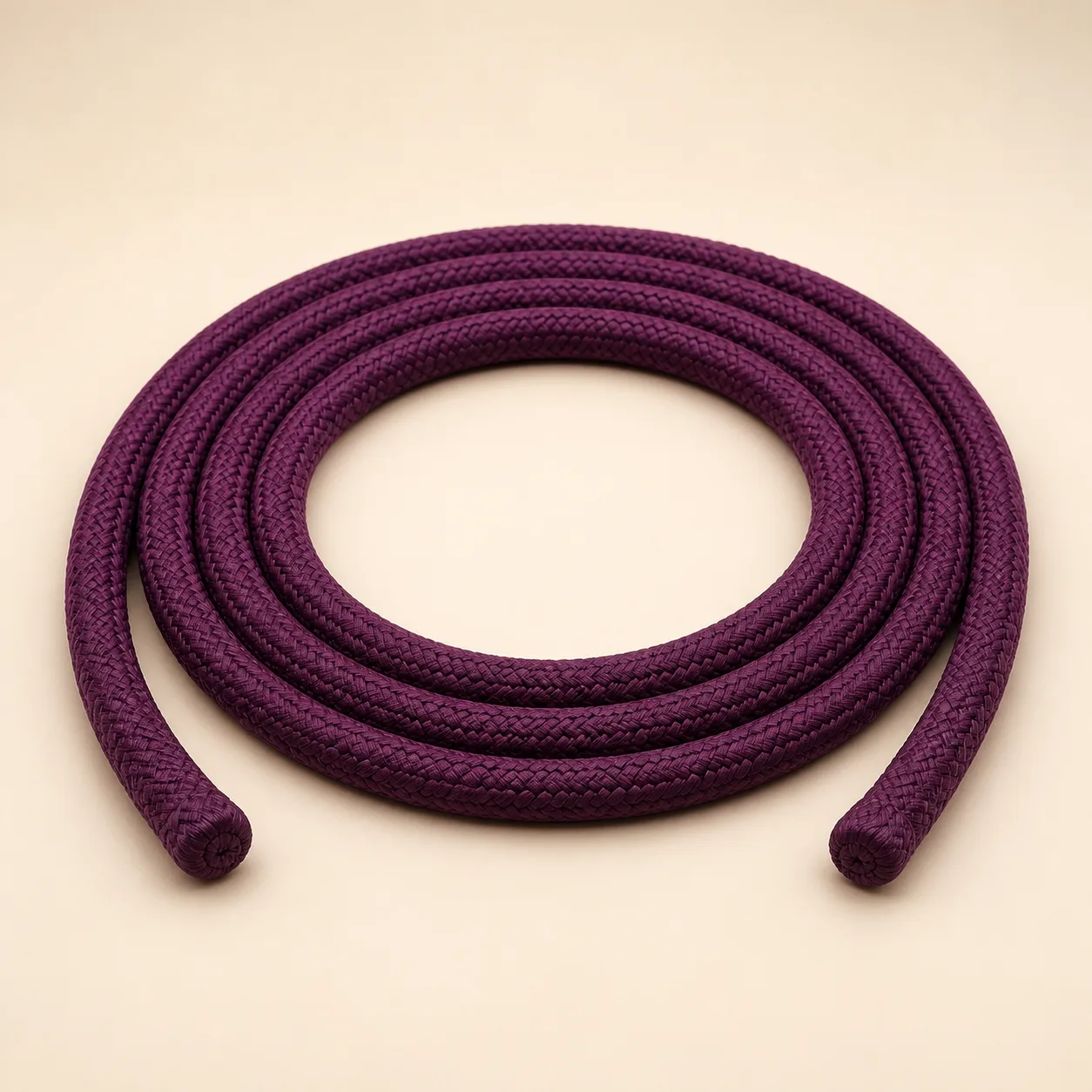
Deep-Plum Soft-Braid Bondage Rope
A long soft-braid restraint rope assessed through simple ground-level practice, circulation checks, controlled slack and immediate cutting access.
19,99 $
200 in stock
A soft braid does not remove restraint risk
This deep-plum rope is intended for consensual, ground-level practice using broad wraps and simple release plans. A textile surface can still tighten, trap skin, create friction burns or compress nerves and circulation. Softness is a sample property to test, not a safety guarantee.
The indexed listing refers to a 10 m rope, but the production length, diameter, fiber and stretch remain pending. Measure the complete relaxed rope and both finished ends before building any use guide around it.

Learn release before learning decorative patterns
Practice handling the rope on cushions or training forms before it touches a person. The first human exercise should use one accessible limb, a small number of broad wraps and a tie that the responsible partner already knows how to release. Decorative complexity is not a beginner goal.
Keep purpose-made safety shears openable and within the responsible partner’s reach throughout the session. Test the shears on an offcut of the exact rope batch; some dense braids flatten or slide instead of cutting cleanly.
Neck, airway and chest loading are excluded
Never place this rope around the neck or across the front and sides of the throat. Do not create chest or torso wraps that restrict breathing, and do not route rope where body position can tighten it unintentionally.
The rope is not for suspension, partial suspension, lifting, climbing, impact, towing or supporting body weight. Do not attach it to doors, ceilings, furniture, vehicles, stairs, balconies or another anchor point.
Choose broad muscle areas and avoid nerve corridors
Place wraps over broad, well-padded parts of the limbs while staying away from joints, the inner upper arm, elbow crease, wrist crease, back of the knee, outer knee, ankle bones and areas where nerves or blood vessels lie close to the surface. Do not cross recent injuries, swelling, varicose veins, rashes or reduced-sensation skin.
Wraps should lie flat without twists, ridges or hidden overlaps. Maintain enough room for immediate finger checks and normal small movements. Never solve a loose structure by pulling the tail harder around the body.
Circulation checks require a starting reference
Before tying, note the skin’s normal colour, warmth, sensation and movement. During the session, compare both sides and ask specific questions about tingling, numbness, pressure and ability to move fingers or toes. General reassurance is not a substitute for a physical check.
Release immediately for increasing pain, coldness, swelling, colour change, weakness, pins-and-needles, numbness, reduced movement or confusion. Do not wait for the pattern to be photographed or completed.
Rope tension can migrate after the tie is finished
Changing posture, leaning, muscle relaxation and pulling on a free tail can shift pressure into one narrow line. Recheck every wrap after any movement. Keep the person on a stable floor-level surface with a clear path for rapid release.
Do not tuck long tails under the body or leave loose loops where hands, feet, hair, jewelry or furniture can catch. Coil unused length beside the responsible partner rather than around another limb.
Self-bondage removes the primary safety layer
This product is not for self-restraint. A jammed knot, dropped tool, sudden cramp, faintness or loss of sensation can make independent release impossible. The responsible partner remains present, alert and able to access every tie and the shears.
Intoxication, drowsiness, impaired communication, panic, illness or any condition that affects circulation, sensation or mobility excludes use. Seek qualified medical advice when personal health makes compression or restricted movement uncertain.
Friction depends on fiber, finish and speed
Feed rope slowly through the hands and across skin. Fast pulls can heat the surface and cause burns even when the material feels smooth at rest. Never drag a loaded line across one point or use skin as the brake for a moving rope.
Procurement should compare friction dry and after the approved cleaning cycle. Fuzzing, glazing, stiff spots, melted-looking fibers or increased drag can change handling and require retirement.
“Cotton” remains unverified until composition is documented
The supplier listing uses cotton language, yet many ropes blend natural and synthetic fibers. Obtain a written fiber percentage, braid specification, dye information, restricted-substance evidence and batch traceability. Do not infer composition from softness or a burn test.
Screen the plum colour with dry and damp white cloths and after wash testing. Dye transfer, persistent chemical odour, oily residue, skin irritation or unexpected shrinkage requires investigation.
Cleaning affects both size and handling
Follow the method approved for the verified fiber and end finish. If washing is permitted, contain the rope in a mesh bag, avoid tight knots and measure length and diameter after complete drying. A damp coil can retain odour and support microbial growth.
Bleach, strong solvents, high heat, tumble drying and aggressive machine cycles are not assumed safe. Do not share the rope between people when cleaning and drying cannot be validated for the exact material.
Inspect the whole length, not only the ends
Uncoil the rope under good light and run it loosely through the hands. Look for cuts, thin areas, pulled strands, hardened spots, uneven diameter, exposed core, loose end finishing and stains. Markers or tape added by the user can create stiff pressure points and are not part of the approved sample.
Retire the rope after contamination that cannot be cleaned, any structural damage, major shrinkage, loss of flexibility or a session in which it was cut for emergency release. Rejoining sections with knots is not an acceptable repair.
Questions specific to a long restraint rope
Can it support body weight?
No. Suspension, lifting and anchor-point use are outside this product concept.
Can it be placed around the neck?
No. Neck and airway contact are completely excluded.
Is the rope confirmed cotton?
No. Fiber percentage, dyes, braid and restricted-substance evidence remain pending.
Why are safety shears needed?
They provide a fast cutting option if a tie jams or sensation and circulation change. They must be tested on the exact rope and kept reachable.
Can one person use it alone?
No. A present, alert responsible partner is required for monitoring and immediate release.
How should unused length be managed?
Coil it beside the responsible partner, away from the body, feet, furniture and moving lines.
Supplier reference and provisional EU display price
Alibaba listing 1600265453556 showed USD 1.22 for 1–49 pieces, USD 1.13 for 50–4,999 and USD 1.06 from 5,000 pieces. The planned EUR 19.99 display price provisionally allows for China-origin freight planning, sample purchase, full-length and diameter measurement, braid and end inspection, friction and elongation checks, colour-transfer and wash-shrinkage testing, cleaning evaluation, material-document review, safety labeling, breathable neutral packaging, payment processing and destination delivery. Supplier identity, fiber, certification, freight, duty, tax, insurance, lead time and all purchasing conditions remain pending written confirmation.
Approval converts one coil into a controlled product
Freeze one exact model and record relaxed length, diameter, mass, braid architecture, fiber percentages, elongation, friction behaviour, breaking characteristics, end finish, colourfastness, wash shrinkage and drying time. Approve dyes, restricted-substance evidence, skin-contact review, cleaning limits, traceability, non-suspension warnings, shears guidance and breathable packaging before final claims are published.
Reviews
There are no reviews yet.