


Open-Lattice Vibrating Sleeve with Removable Side Bullet
August 14, 2026
16m Electrostatic-Cling Bondage Tape Roll
August 14, 2026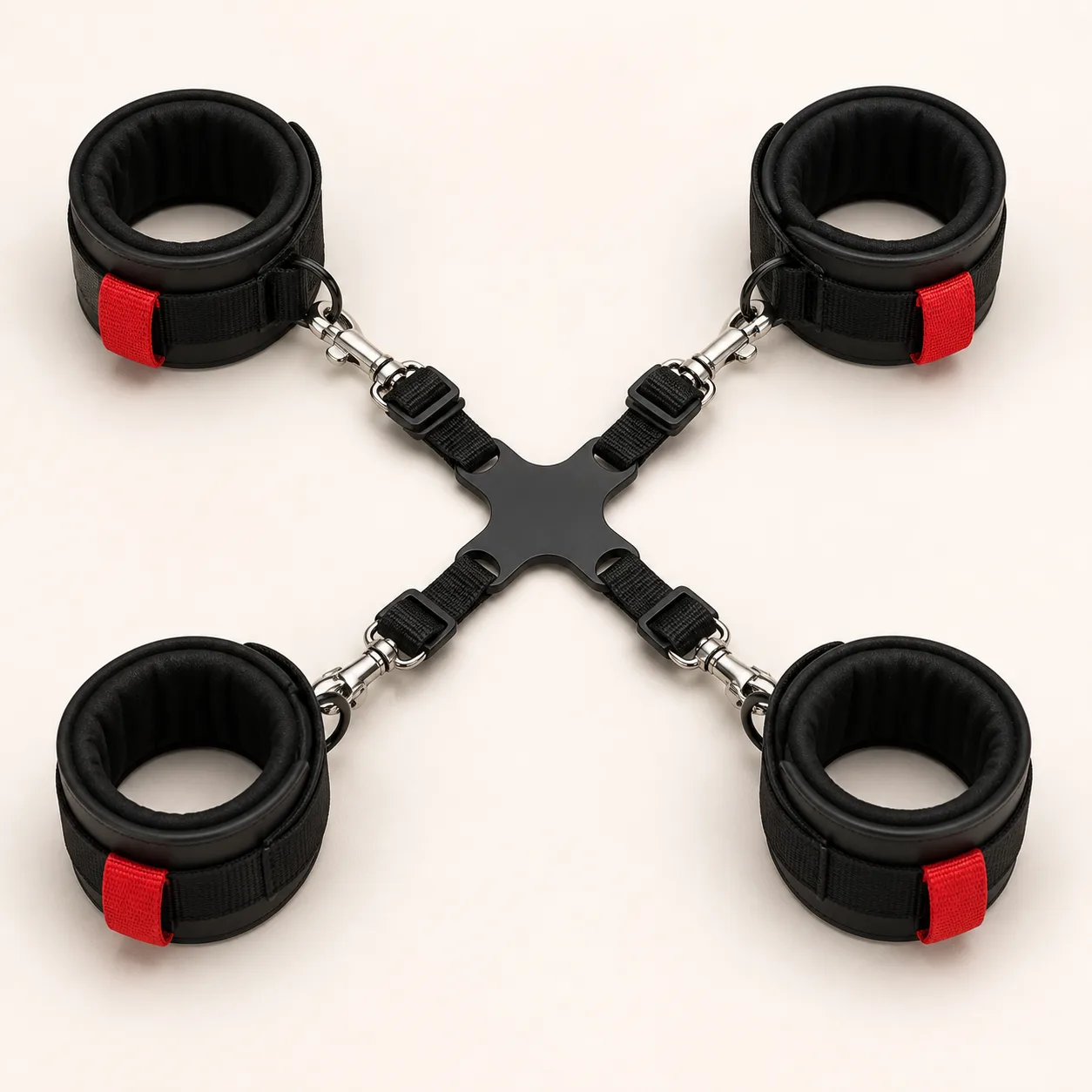
Four-Way Cross Connector Cuff Set
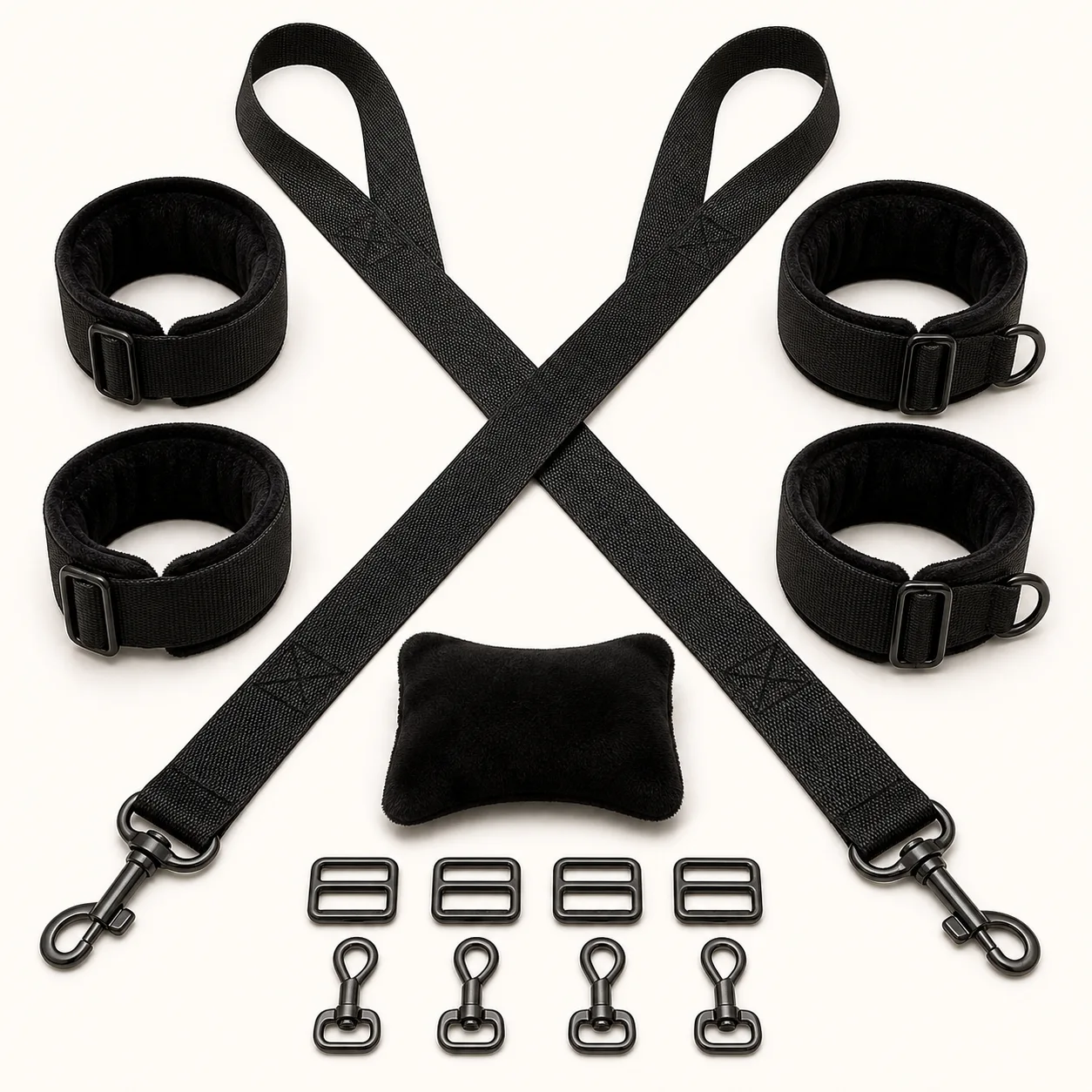
A compact four-way restraint concept with a central X connector, four padded cuffs, adjustable links, swivel clips and visible release tabs for supervised low-force positioning.
54,99 $
200 in stock
A compact layout that keeps all four connection points visible
This concept places a low-profile X connector between four padded cuffs. Short adjustable arms make it easier to see which cuff is linked to each corner, while swivel clips are intended to reduce strap twisting during supported, low-force positioning.
The central plate does not make the set structural equipment. Its practical value is organization: the whole connection map stays close enough for a supervising partner to inspect and release without reaching under furniture.

Consent must cover the exact body position
Four-point positioning can limit a person’s ability to straighten a limb or shift weight. Agree on the intended pose, maximum duration, areas that remain off-limits and a clear stop signal before any cuff is closed.
Add a nonverbal signal that works with the planned position, such as releasing a soft object held in one hand. The supervising partner must stay present, alert and ready to open every point immediately.
Map the cuffs before anyone wears them
Lay the set flat and decide which two cuffs are for wrists and which two are for ankles. Trace each strap through its adjuster and rotate every clip through a full turn to identify twists, sharp edges or gates that do not close cleanly.
Practice separating all four cuffs from the connector while the set is empty. A release route that is confusing on a table will be harder when a body is limiting access.
The connector belongs on a supported surface
Keep the central piece on a mattress or other broad, stable padded surface where it cannot press into the spine, abdomen, neck or a bony joint. Place a folded protective layer beneath hard hardware if the exact instructions permit it.
Never use the connector as an overhead anchor, lifting point, balance aid or suspension fitting. It is planned only for gentle positioning while the body is fully supported.
Joint angles matter more than strap tension
Set shoulders, elbows, hips, knees and ankles in a neutral range before shortening any arm. The goal is to organize movement, not force a deeper stretch. A joint should never be pulled toward its limit by the strap.
Begin with enough slack for small changes of position. Stop at once for sharp pain, muscle cramping, shaking, weakness or a sensation of joint instability.
Fit every cuff one at a time
Place padding against clean, dry skin and close the first cuff loosely. Check that the closure has full contact, the lining is not folded and no clip or buckle touches a wrist or ankle bone.
Ask the wearer to flex fingers or toes and slide a fingertip under the edge. Repeat the check after connecting the strap because angle and movement can change the pressure pattern.
Circulation checks stay frequent and symmetrical
Compare the paired hands or feet for warmth, color, sensation and swelling. Numbness, tingling, cold skin, unusual pallor, discoloration, throbbing or reduced movement means immediate release.
Early trials should be brief, with a complete cuff opening between intervals. If altered sensation or color persists after release, seek medical guidance.
Red tabs are useful only after a timed drill
The original image uses red pull tabs to make the intended release area easy to locate. That visual feature is not proof of the final closure type or opening force.
With the set empty, close each cuff and time how long one hand needs to open all four in an unpredictable order. Do not use a sample that jams, hides its release under tension or needs a tool for normal opening.
Swivel clips need clean gates and smooth edges
Inspect the clip nose, spring gate, rotating barrel and attachment ring under bright light. Burrs, gaps, flaking finish, looseness or a gate that remains partly open can pinch skin or release unexpectedly.
Orient gates away from the body. Decorative shine and supplier photography cannot establish the metal grade or working strength, so both remain pending until the exact sample is tested.
Never connect the set to the neck or head
These cuffs are planned only for wrists and ankles. No cuff, strap, clip or central connector should touch the neck, throat, face, chest or any area where tightening could affect breathing.
Keep hair, jewelry and loose clothing away from clip gates. Remove rings and bracelets that could become trapped beneath padding as the hands change position.
Sober supervision is part of the equipment
Alcohol, sedatives and intoxicants can delay recognition of pressure injury, panic or breathing changes. The supervising partner should remain sober, awake and within arm’s reach for the full duration.
Keep a phone and material-appropriate safety cutter accessible to that partner. A restrained person must never be left alone, including during a brief interruption.
Cleaning starts with separating the components
If the production clips are detachable, separate cuffs from the connector so fabric and metal can be handled appropriately. Wipe the hard parts with a lightly damp cloth and dry them immediately.
The exact lining, webbing, coating and closure materials are unconfirmed. Until model-specific care guidance is supplied, avoid soaking, bleach, solvents, heat and fragranced sprays, and let padded layers air-dry fully while open.
Inspect the short straps where force concentrates
Look closely at the webbing folds nearest the X plate, the seams around each cuff ring and the adjusters where fibers bend. Glazed webbing, pulled stitches, elongating holes or a warped plate removes the set from use.
Do not repair load-bearing seams with household thread or reshape bent hardware. The exact sample must be evaluated as a complete system.
Store the set open enough for moisture to escape
After cleaning, close hook-and-loop surfaces lightly so they do not catch the lining, then coil each arm without sharp folds. Wrap metal pieces in a soft dry cloth to prevent abrasion.
Keep the set away from sunlight, heaters, damp rooms, children and pets. Inspect it again before every session even if it looked sound when stored.
Marketplace details are procurement leads, not verified specifications
The observed Alibaba page displayed Jiangxi Huakou Adult Products Co., Ltd., a EUR 9.48-25.36 range, one-piece minimum and model DV-9006-WH-2002. Exact contents, dimensions, closure construction, materials, load data and batch documentation are pending.
The EUR 54.99 plan includes a provisional allowance for China-origin freight, sample checks and neutral packaging. Duty, tax, insurance, lead time and destination delivery require a written quote.
Questions buyers often ask
Is this set suitable for suspension?
No. The concept is limited to low-force positioning with the body fully supported.
Are all four cuffs the same size?
The artwork shows matching cuffs, but wrist and ankle fit ranges must be measured on the exact sample.
How long should a first session last?
Start with a brief fit and release drill, opening every cuff between intervals while checking skin, sensation and joint comfort.
Can one person use it alone?
No. Four-point positioning requires an attentive supervising partner who can reach every release immediately.
Does the listed material apply to this exact configuration?
The marketplace page mentioned leather, but the full production composition and backing require supplier documents and sample verification.
Why is the retail price provisional?
The displayed sourcing range does not confirm freight, duty, tax, inspection, insurance, packaging or destination delivery.
Reviews
There are no reviews yet.