


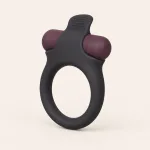
Detachable-Bullet Couples Vibrating Ring with Quick-Grip Tab
August 14, 2026
Adjustable Flexible Loop Ring – Quick-Release Manual Fit
August 14, 2026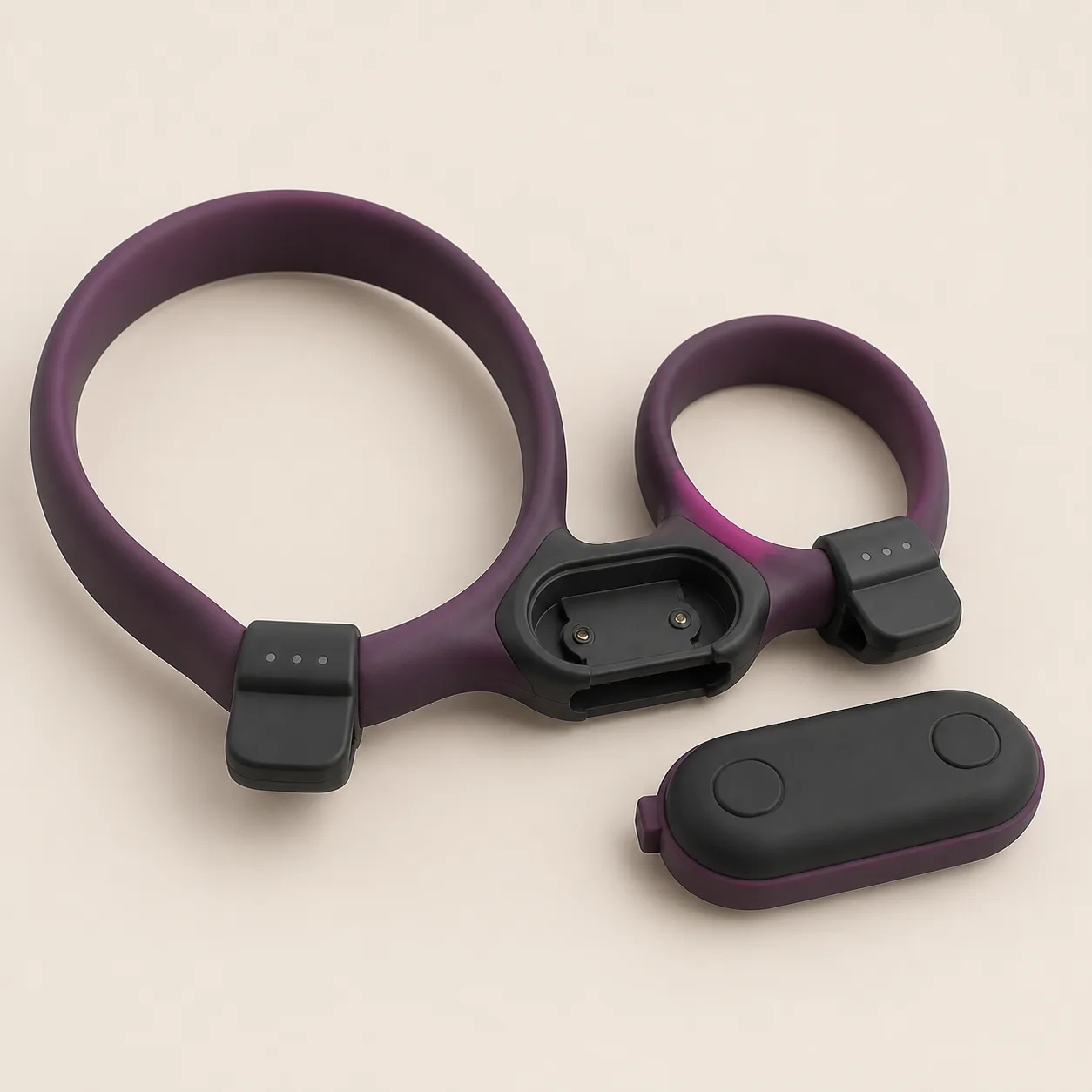
Twin-Clutch Dual-Loop Couples Ring with Removable Flat Vibrator
An adjustable dual-loop couples ring concept with separate sliding clutches, broad release tabs and a removable low-profile two-button vibration module.
32,99 $
200 in stock
Two independently adjusted loops frame one removable module
This adjustable dual-loop couples ring concept places a larger and a smaller deep-plum loop on opposite sides of a compact charcoal bridge. Each loop passes through its own broad sliding clutch, while a flattened two-button vibration module docks between them.

The layout is intended to make fit adjustments and powered-part cleaning easier to evaluate, but the two loops must never be treated as a universal-fit or circulation-safe design without measurement.
Inventory the bridge, both loop paths and the powered insert
Confirm the assembled loop body, left clutch, right clutch, dock frame, removable vibration module and exact charging accessory before qualification. Ask whether any pins, springs, magnets, seals, stiffeners, adhesives or molded inserts are hidden inside the bridge.
Mixed revisions, missing retainers or an unmarked charger specification should place the unit on hold.
Measure relaxed geometry before stretching either loop
Record each loop’s inner circumference, cross-section width and thickness, center spacing, bridge width, overall mass and relaxed profile on a calibrated surface. Document the minimum bend radius at every junction.
The larger and smaller openings require separate measurements; one label cannot describe both fit paths.
Map the usable travel of each sliding clutch
Move one clutch at a time through every stable position and log opening circumference, required pull force, tooth or detent engagement and remaining tail length. Repeat with the other loop held neutral.
Verify that adjustment is continuous or stepped exactly as supplied and that neither clutch transfers load into the neighboring loop.
Prove a quick local release under light tension
On a padded fixture, place each loop under a documented low qualification load and test the broad release tab with dry and damp gloved fingers. Record release direction, peak force and whether the body pinches or folds around the clutch.
A release that jams, needs a tool or depends on the powered module must fail evaluation.
Cycle both clutches and check for tension creep
Run a defined open, tighten, hold and release sequence on each side independently. At planned intervals, remeasure opening size, holding force, tab shape, housing cracks and surface abrasion.
Any unintended tightening, slip, permanent set or sharp wear edge requires retirement.
Qualify the keyed bridge dock as a mechanical joint
Measure rail length, insertion depth, contact position, latch overlap, exposed gaps and module-to-bridge flushness. With the product off the body, apply controlled push, pull and twist checks below documented supplier limits.
The module must not lift, rattle or expose a hard ledge during ordinary handling.
Remove and install the module only while the product is off
Switch power off, release both loops completely and separate the entire product before touching the dock. Align the keyed rails, press to the confirmed stop and perform a gentle local retention check.
Never use the module as a pull handle, adjust the dock during wear or improvise a strap through its cavity.
Compare vibration transfer on a repeatable fixture
Use an instrumented soft fixture to map output at the module surface, bridge center and both loop junctions at every available setting. Compare installed and removed readings, operating noise and housing movement.
Pattern count, amplitude, frequency, sound level and contact pressure remain pending until a production sample is tested.
Make local shutdown obvious and repeatable
Identify power and mode controls by position rather than assumed icons. Time startup, mode changes and full shutdown, then repeat after charging and after a controlled splash-cleaning simulation.
Both users should know how to stop power and release each loop locally without a phone, remote or account.
Use fit and circulation signs as hard stop criteria
Adjust both loops gradually while keeping each release tab accessible and the bridge stable. Stop immediately for pain, numbness, tingling, coldness, swelling, marked color change or difficulty operating either clutch.
No fixed wear time, safe diameter or universal anatomy claim is made. Exact fit limits and supplier instructions require confirmation for the production unit.
Verify battery, charging and ingress construction
Request cell chemistry, rated capacity, charge voltage, current, cable specification, charge time, runtime method, low-voltage behavior, thermal protection and transport paperwork. Inspect contacts and dock seals for corrosion or trapped moisture.
Do not charge while worn, wet, hot, damaged or unattended, and do not claim an ingress rating without exact certification evidence.
Confirm every material and compatibility claim
Obtain composition for both loops, clutch housings, tabs, bridge, module shell, pigments, seals, contacts, internal frame and adhesives. Review hardness, porosity, restricted-substance and skin-contact evidence for the exact revision.
Lubricant, cleaner and barrier compatibility must be tested rather than inferred from appearance or a generic material name.
Clean separated surfaces without flooding the dock
Power off, release the loops, remove the module and follow confirmed mild-cleaning instructions for each component. Use a soft swab around clutch slots, bridge rails and contact recesses, then dry all gaps before reassembly.
No boiling, dishwasher, bleach, alcohol, abrasive brush, submersion or shared use is approved without exact construction evidence.
Plan price from a detachable-ring benchmark, not a promise
An Alibaba wholesale page lists a detachable nine-mode couples vibrating ring at USD 5.27-6.50 with a one-piece minimum. It is a category benchmark only and does not establish this twin-clutch geometry, a legal supplier or a production quotation.
The procurement reference supports an EUR 32.99 planning price after allowing for China-origin freight, exact-model quotation, dual-loop and clutch measurement, release and creep testing, dock retention, output mapping, battery and materials review, cleaning validation, protective packing and discreet fulfillment. Packed size, weight, freight, duty, tax, insurance, payment fees and destination terms require confirmation.
Frequently asked questions
Do the two loops adjust independently?
That is the proposed mechanism, but each clutch’s stable positions, holding force and interaction with the other loop require sample testing.
Can the vibration module stay installed during cleaning?
Separate it while the product is fully off the body, then clean and dry each confirmed washable area according to verified instructions.
Does the product need an app or remote?
No app or remote is planned; two local buttons are shown, while exact control behavior remains pending.
How should a loop be released?
Stop power, support the bridge and use the accessible broad clutch tab without tools or added pulling force.
Is one size suitable for everyone?
No. Both opening ranges, stretch behavior and safe fit limits must be measured, and any circulation warning sign means stop.
Which faults mean the unit should be retired?
A jammed or slipping clutch, cracked bridge, sharp wear, loose module, corroded contact, swelling surface, unusual heat or damaged charging lead.
Reviews
There are no reviews yet.