


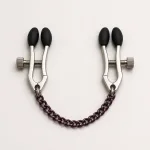
Wide-Pad Screw-Adjustable Sensory Clamps
August 14, 2026
Black Threaded Prostate Massager with RGB-Window Safety Base and Oval Remote
August 14, 2026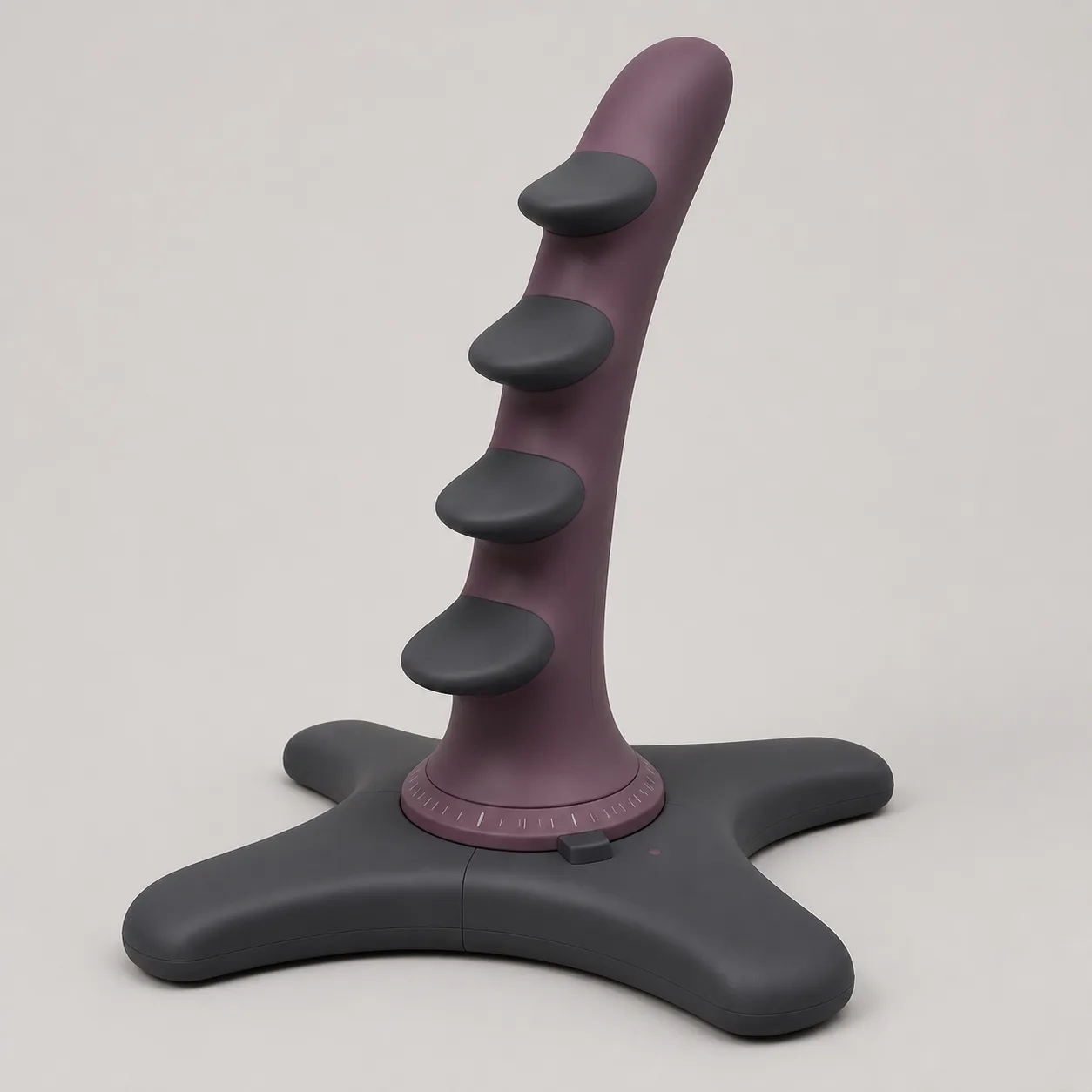
Four-Lobe Helical-Offset Anal Trainer with Indexed Safety Base
A non-powered curved trainer concept with four shallow staggered compliance lobes, three indexed orientations and a wide four-arm retrieval base.
43,99 $
200 in stock
Stage four shallow lobes along one helical offset
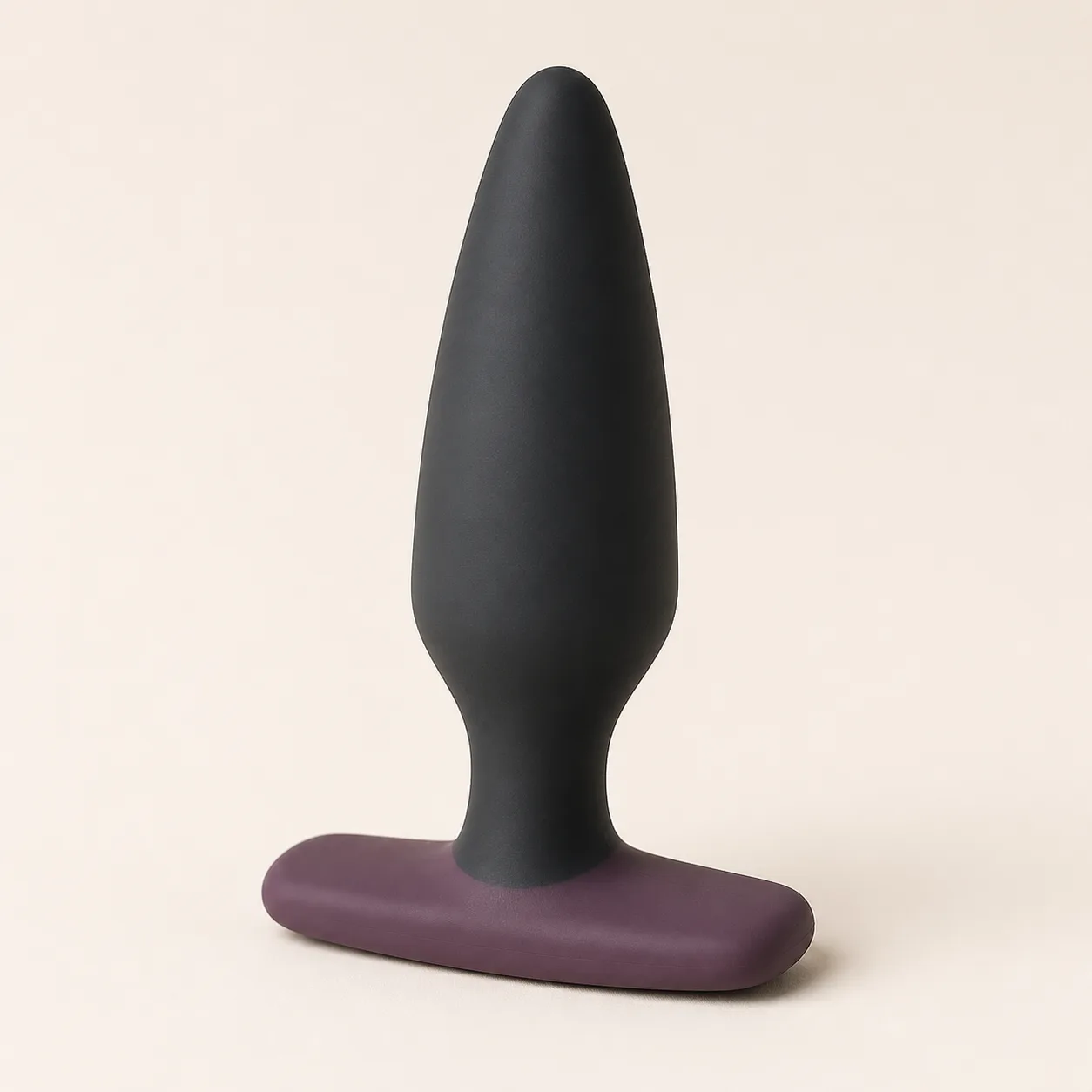
This four-lobe helical-offset anal trainer concept integrates exactly four shallow charcoal compliance lobes along a gently curved plum body. The lobes are staggered progressively rather than stacked on one straight line, while an external three-stop orientation ring and lock tab are intended to index the body above an exceptionally wide four-arm retrieval base.

The image does not prove insertable dimensions, lobe compliance, indexing accuracy, material composition, retention, cleaning access or production availability.
Inventory every body base and indexing part
Request a complete bill of materials for rounded tip, curved body, lobes L1 through L4, bond or overmould interfaces, flexible neck, internal reinforcement if any, orientation ring, three detents, lock tab, central hub, four base arms, service seam, batch marker, pigments, process aids and adhesives.
Link each part and interface to drawing revision, tolerance, supplier batch, mould cavity and approved physical sample.
Measure all insertable and external dimensions
Record total height, maximum intended insertable length, shaft diameters by station, tip axes, neck minimum diameter, lobe projection, lobe spacing, ring diameter, base span in both axes, base thickness, edge radii, mass and center of gravity.
Publish a dimensioned drawing only after several samples are measured at defined temperature and conditioning time.
Characterize the curved body profile
Capture the centerline, curvature by station, cross-section ovality, taper, tip radius, shaft smoothness and neck transition using non-contact metrology. Compare mould sides and samples for twist, waviness, sink and asymmetry.
Check whether bending or ring indexing changes the intended profile or exposes a harder internal structure.
Measure each compliance lobe separately
For L1 through L4, measure major and minor axes, projection, crown, edge blend, hardness, compression curve, lateral deflection, recovery and surface friction. Inspect seams, flash, voids, thin regions, hard inclusions and pigment transfer.
Matching color does not establish equal compliance; keep individual lobe data throughout pressure and cycle work.
Inspect lobe bonds and surrounding transitions
Examine every lobe perimeter under magnification before and after conditioning, flexing, compression and cleaning. Measure any lip, recess, undercut or local hardness change at the interface with the plum body.
Reject lifting edges, exposed substrate, cracks, tack change, residue traps or a transition sharper than the approved reference sample.
Map the helical offset and indexed orientation
Measure angular position and axial station for the center of every lobe relative to the base datum. Quantify progression, cumulative angular error and left-right bias rather than describing the pattern from appearance.
At each ring stop, record body orientation, lobe coordinates and repeatability after full unlock, rotation, relock and bounded side load.
Calibrate ring detents and the lock tab
Measure ring travel, three stop angles, detent torque, hysteresis, axial play, lock-tab travel, engagement depth and actuation force. Approach each stop from both directions and apply bounded bending and torsion while locked.
The ring must not climb a stop, drift between marks, expose a pinch gap or create an ambiguous partially locked state.
Verify the four-arm retrieval base
Measure tip-to-tip span, hub diameter, arm width, thickness, stiffness, edge blend and deflection under centered and asymmetric load. Inspect the service seam and ring-to-base joint while the body is bent in several directions.
The base must remain substantially wider than the insertable body in every orientation and retain its intended geometry after conditioning and cycling.
Map pressure across lobes body and neck
Use an instrumented compliant fixture to measure contact area, peak pressure and progression for the smooth body and each lobe under several insertion depths, indexed orientations and bounded lateral angles.
Reject a sharp pressure spike, exposed hard stop, lobe edge fold, unstable base contact or neck load outside the approved envelope.
Measure bending torsion and recovery
Record force versus deflection at multiple body stations and directions, plus torsional stiffness from the body to the locked base. Measure recovery time, permanent set, whitening, internal movement and ring creep after sustained bounded loads.
Repeat after temperature conditioning and cleaning exposure to identify stiffness drift or delayed damage.
Require material and contact evidence
Obtain exact formulations or traceable declarations for body, lobes, base, reinforcement, pigments, process aids and adhesives. Review restricted-substance, sensitization, extractables, odour, ageing and batch-consistency evidence appropriate to the intended contact.
Material appearance and generic supplier wording are not proof of composition, contact suitability or regulatory compliance.
Validate cleaning access and measured drying
Challenge every lobe edge, service seam, ring gap, lock tab, neck transition and base joint with a visible test soil, the proposed cleaning method and a defined rinse. Inspect with magnification after a measured drying period.
Do not claim full immersion or sterilization unless the exact construction, material compatibility and validated procedure support it.
Challenge faults and complete cycle testing
Test false locking, ring stop climb, one compressed lobe, asymmetric base load, repeated neck bending and controlled torsion in protected samples. Stop before damage and quarantine units with interface lift, internal exposure, growing play or base deformation.
Cycle insertion-fixture loading, orientation selection, lock engagement, bending, torsion, cleaning, drying and storage. Recheck dimensions, profile, lobe compliance, bond edges, orientation, detents, lock strength, base geometry, material surface and seams.
Build landed price after retention proof
An Alibaba silicone-prostate-massager page currently shows a rechargeable category example at USD 5.50-5.90 with MOQ four. It is a benchmark only and does not confirm this non-powered four-lobe design, indexed base or an approved supplier.
The procurement reference supports an EUR 43.99 planning price after allowing for China-origin freight, exact-model sourcing, profile and lobe metrology, orientation calibration, pressure mapping, base-retention and gap review, material evidence, fault and cycle testing, protective packing and discreet fulfillment. Exact quotation, MOQ, materials, packed size, weight, freight, duty, tax, insurance, payment fees, certifications and delivery terms remain pending.
Frequently asked questions
Are all four lobes the same size?
The concept shows four shallow faces, but each needs separate axes, projection, hardness, compression and friction measurements.
What does the orientation ring change?
It is intended to index the staggered lobe path at three external angles; stop accuracy and lock strength require testing.
Is this a beginner size?
No size level can be assigned until maximum insertable dimensions, taper, lobe projection and user instructions are confirmed.
Why is the base so wide?
The four-arm base is intended for retrieval retention, subject to span, stiffness, deflection and repeated-load evidence.
What lubricant is compatible?
Compatibility depends on the confirmed formulation, so supplier evidence and sample exposure tests are required.
Which faults require retirement?
Lobe lifting, cracks, exposed reinforcement, growing ring play, stop climb, failed locking, neck damage, base deformation, tack change or persistent residue.
Reviews
There are no reviews yet.