



Remote Vibrating Prostate Massager – Safety Guide
August 14, 2026
Wireless Vibrating Adjustable Nipple Clamps
August 14, 2026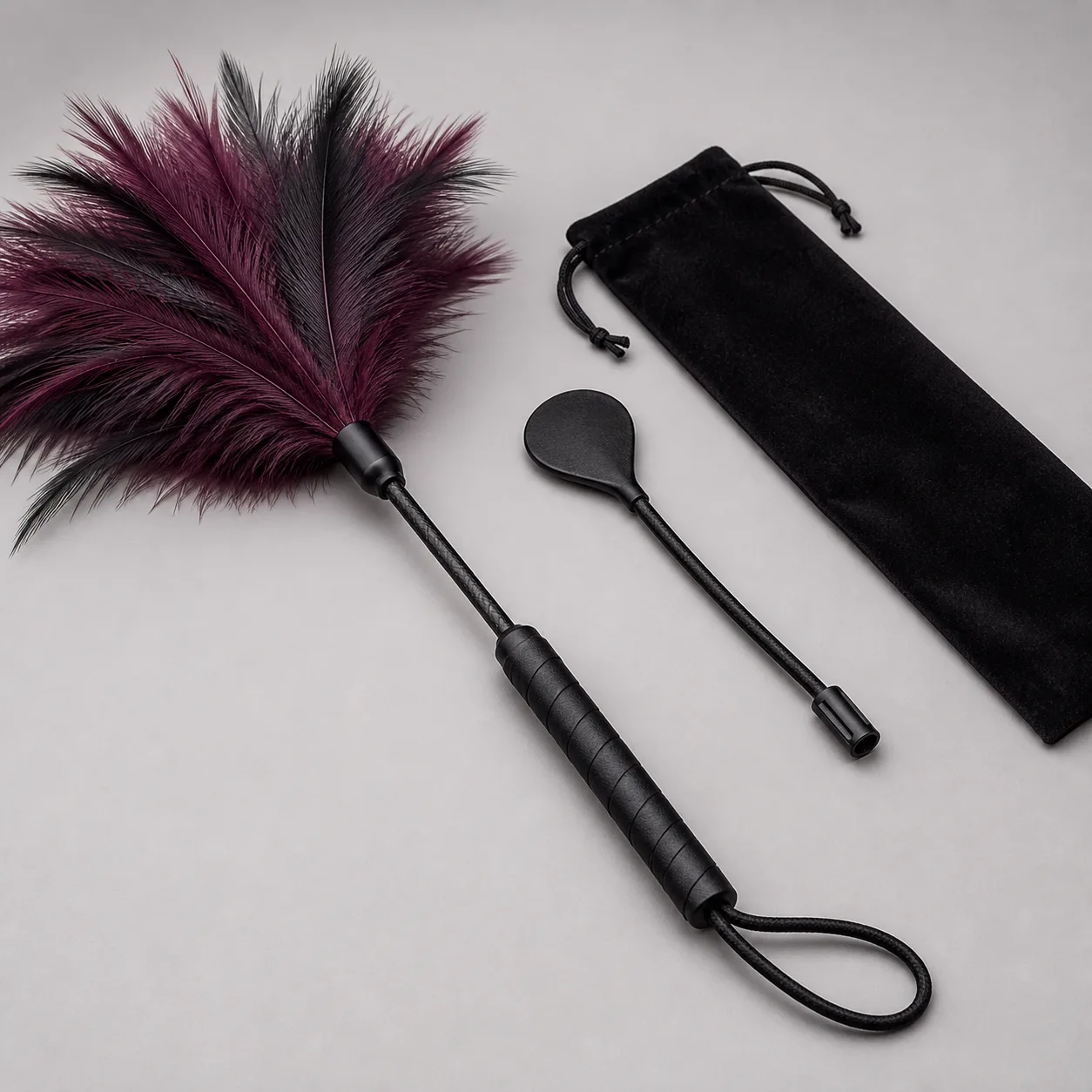
Plum Feather Sensory Tickler
A light-touch feather tickler assessed through fibre origin, quill enclosure, shedding, colourfastness, shaft flex and plume care.
14,99 $
200 in stock
The plume should move air before it applies pressure
A feather tickler works best as a light external sensory tool. Hold the wrapped handle near its center and move the plume slowly through the air above the skin before making contact. This reveals the balance and shaft response without turning the first touch into an unexpected scratch.
Begin on an easy-to-see area such as the forearm. Use the broad side of the plume rather than aiming a quill end toward the body. The face, eyes, mouth, neck, broken skin and irritated areas stay outside the intended contact zone.

Feather origin and treatment need a written answer
The marketplace description does not establish whether the plume is natural feather, synthetic fibre or a mixture. Procurement should obtain an origin declaration, dye information, cleaning treatment and allergen-control statement for the exact production batch.
People with feather, dust, dye or textile sensitivities should avoid uncertain material. A clean white damp cloth can reveal colour transfer on a sample, but it does not replace chemical documentation. Persistent odour, oily residue or powder at the base requires rejection.
Quill ends belong inside the collar, never among loose fibres
Separate the plume gently and inspect where individual fibres enter the ferrule. Cut shafts and wire should remain fully enclosed. Run a soft cloth through the plume; any hard point that snags the cloth can also catch skin.
Turn the tool under bright light and check the collar for gaps, adhesive squeeze-out and sharp edges. A feather cluster that rotates, pulls out or exposes its core should be removed from use rather than pushed back into place.
Shedding is a measurable quality issue
Comb the dry plume lightly with gloved fingers over a contrasting clean sheet and count loose fibres. Repeat after the permitted cleaning method and after a defined number of gentle strokes. Procurement should set a shedding limit and compare batches against the approved sample.
Loose fragments must not be left on bedding, near eyes or where a child or pet can reach them. Do not trim the plume to disguise poor attachment; shortened shafts can create sharper ends.
Shaft flex should damp motion instead of whipping unpredictably
Bend the unloaded shaft through a shallow arc and release it away from people. It should recover smoothly without cracks, splinters, clicking or a sudden sideways kink. The ferrule and handle junctions deserve close inspection because stiffness changes concentrate stress there.
This catalog concept is limited to light brushing and controlled tracing. Do not strike, snap, throw or use the tickler as a crop. A separate rounded accessory shown in concept imagery is not included unless the final supplier configuration and safety review explicitly approve it.
The handle should support precision without trapping the wrist
Check the wrap for raised seams, loose adhesive and dye transfer. The grip should remain secure with dry hands without requiring excessive squeeze. Keep rings and bracelets away from the plume and shaft junction.
A wrist loop is for preventing an accidental drop, not for restraint or pulling. It should fit loosely and release easily. Do not tighten it around another person or attach it to furniture, cuffs or load-bearing equipment.
Consent for light touch is specific to location and sensation
Agree on permitted areas and an immediate stop signal before contact. Slow strokes, hovering air movement and brief taps can feel very different even with the same plume. Check in again when changing location, rhythm or visibility.
Stop for itching, coughing, eye irritation, breathing difficulty, rash, dizziness, panic, pain or broken skin. The tickler is not used to test nerve function, diagnose sensation or provide therapy.
Cleaning a plume is different from cleaning a solid toy
Until an approved care guide identifies the fibres and dyes, do not soak, boil, steam, bleach, machine-wash or apply alcohol or fragrance. Remove surface dust with a gentle dry method reserved for the sample and wipe the handle separately with a compatible damp cloth.
If wet cleaning is approved, keep the ferrule from flooding and support the fibres during drying. Reshape them without pulling and dry completely with airflow away from heat. A musty odour, clumped base or dye run after cleaning ends use.
Storage protects both hygiene and shape
Place the fully dry plume into a breathable protective sleeve without crushing it. Store flat or hang by a verified handle loop where the feather cluster is free, away from direct sun, heaters, oils, cosmetics, sharp accessories and high humidity.
Do not share a porous plume without a validated cleaning and cross-contamination protocol. Label separate items when several people or display samples are present. Recheck the base and fibres after long storage before any skin contact.
Questions that should be answered before the final specification
Are the feathers natural or synthetic?
The source does not confirm this. Origin and treatment remain pending supplier documents and sample inspection.
Is the product exactly 16 inches long?
That length appears in the indexed title but must be measured on the chosen production configuration.
Can it be used for impact?
No. This catalog concept is restricted to light external sensory contact.
Is the wrist loop a restraint point?
No. It is only a loose anti-drop aid and must never carry load or restrict another person.
How should it be disinfected?
No disinfection process is assumed for an unverified porous plume. Cleaning limits remain pending, and sharing should be avoided.
What if a quill end becomes visible?
Stop using the tool. Do not tape, glue or push the exposed part back into the collar.
Supplier reference and provisional EU display price
The selected Alibaba listing, ID 1601022365139, displayed USD 2.08 for 1–49 pieces, USD 1.93 for 50–199 and USD 1.70 for 200 or more. The planned EUR 14.99 display price provisionally allows for China-origin freight, sample purchase, length and balance measurement, feather attachment and shedding tests, shaft-flex and handle-grip inspection, colourfastness review, edge and tip assessment, cleaning evaluation, material-document review, protective packaging, neutral labeling, payment processing and destination delivery. Supplier identity, feather origin, material, treatment, certification, freight, duty, tax, insurance, lead time and all purchasing conditions remain pending confirmation.
Procurement approval follows the plume from fibre to handle
Lock one configuration and record total length, plume length and density, natural or synthetic origin, treatment and dye, quill enclosure, ferrule construction, shaft material and flex, handle wrap, wrist-loop attachment, unit weight, shedding limit, colourfastness, care method and packaging. Restricted-substance evidence, traceability, warnings, freight, duty, tax and contract terms must be reviewed before pending details become final claims.
Reviews
There are no reviews yet.