



Perimeter-Bead Remote Prostate Plug
August 14, 2026
Lockable Travel Privacy Pouch – Practical Storage Guide
August 14, 2026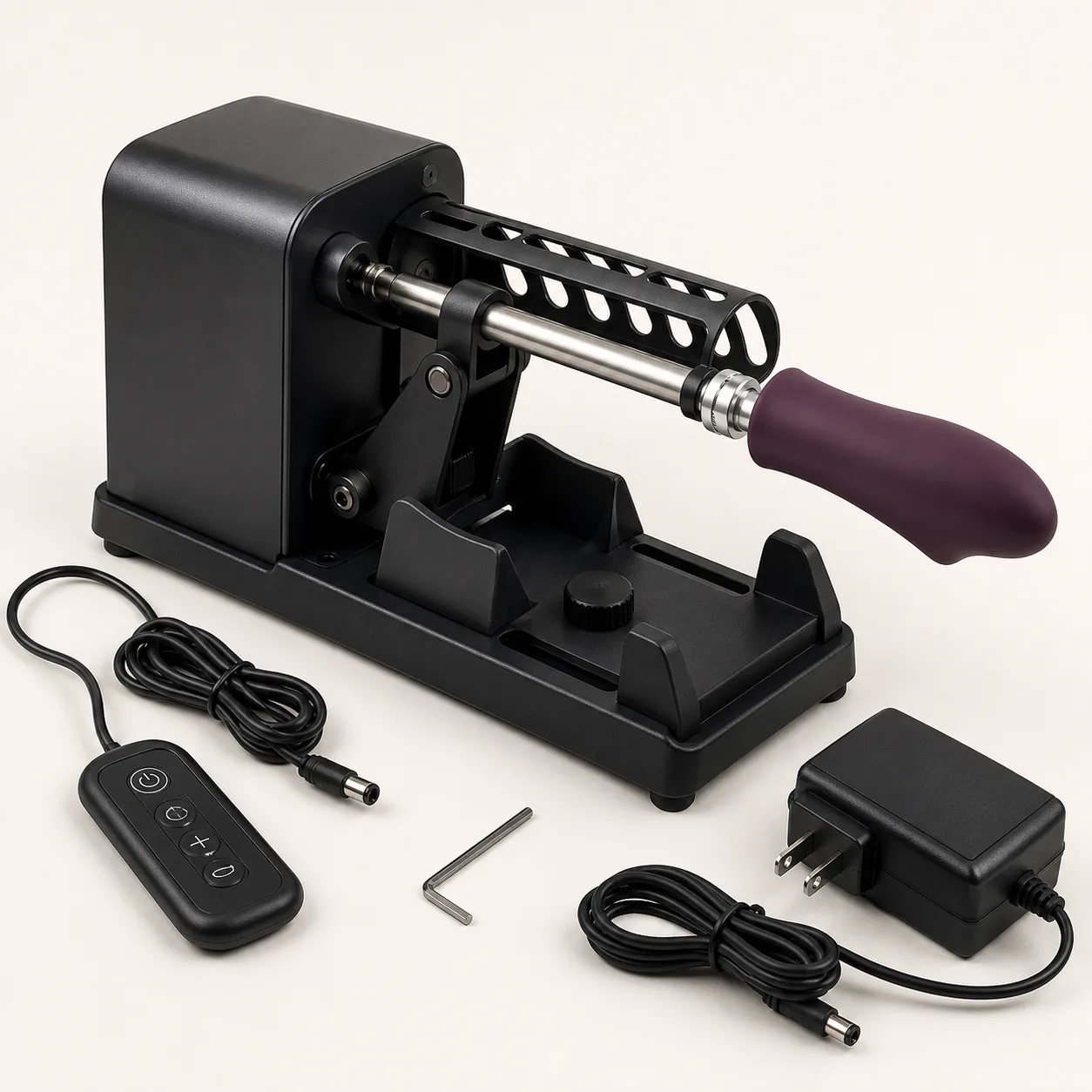
Remote Multi-Angle Thrust Machine
A compact powered thrust system planned around stable mounting, guarded motion, locked angle adjustment and immediate wired stopping control.
149,99 $
200 in stock
A remote thrust machine is powered equipment, not a hands-free shortcut
This compact concept combines a motor housing, angle-adjustable drive assembly, detachable external attachment, hand control and mains adapter. It can repeat motion without tiring, which also means it can continue after posture, alignment or comfort has changed. Setup and immediate stopping ability are therefore central to the product decision.
Alibaba listing 1601391991553 identifies model D55 and presents numerous motion and power figures. They remain procurement leads until the exact sample, adapter, firmware and attachment are measured together.

Start with an empty working envelope
Before power is connected, move the carriage through its full travel by the approved setup method and mark the space occupied by the rod, connector and attachment. Keep hands, hair, jewelry, loose clothing, bedding, cables and furniture outside that envelope.
Allow additional clearance for flex and user movement. A path that looks clear at rest may close around a hinge, bed frame or body-support cushion when the machine reaches its forward limit.
The base needs a surface that resists sliding and tipping
Place the machine on a level rigid surface capable of supporting its measured dynamic load. Confirm every foot contacts the surface and that controls, ventilation and cables remain accessible. Soft mattresses and unstable tables can change the drive angle during motion.
Procurement must establish whether the production unit requires clamps, straps, bolts or a dedicated stand. Weight alone is not a mounting specification.
Lock the angle only while disconnected
Unplug the adapter before adjusting the hinge or cradle. Set the working angle, tighten the intended lock to its documented torque and try to move the assembly by hand. There should be no creeping, free play or partial engagement.
Never reach across the drive rod to adjust a live machine. If the angle changes under load, stop use and inspect the fastener, teeth, pin and surrounding frame.
A guard must cover the hazard, not merely decorate it
The moving shaft and linkage create crush, shear and pinch zones. A useful guard prevents fingers and soft items entering those areas throughout the complete stroke while allowing inspection and cleaning. Openings, edges and fastener access must be measured.
The concept image shows a vented rod cover for clarity. The actual D55 guard arrangement is unknown and must be checked on a sample before approval.
Fit the attachment with the power lead removed
Confirm connector diameter, thread or locking geometry, insertion depth and pull-off force. Seat the clean dry attachment fully and perform a controlled hand pull before restoring power. A soft sleeve that hides the connector must not conceal incomplete engagement.
Only attachments named for the verified connector and load rating belong on the machine. Adapters, tape, improvised spacers and untested third-party parts can detach or create eccentric loads.
Run the first motion test with no body contact
Place the machine in its final position and use the lowest speed with the shortest confirmed stroke. Watch several complete cycles from the side. Check for base movement, rod wobble, guard contact, cable tension, loose fasteners and an attachment that rotates on the connector.
Stop immediately for knocking, scraping, irregular motion, a hot smell or any visible migration. Increasing speed cannot correct poor alignment.
Stroke length and cycle rate are separate controls
The marketplace shows a 55 mm stroke and 90–240 cycles per minute, but it does not establish tolerance, load condition or whether the stroke is adjustable. Measure travel at minimum and maximum settings with and without the approved attachment.
Begin at the lowest verified combination. A short fast motion and a long slow motion create different peak forces; neither can be judged from cycle count alone.
The stop action must work in one deliberate step
Identify the primary stop on the hand control and a second means of cutting power that can be reached without entering the moving path. Practice stopping before any use. The machine must not restart unexpectedly after power interruption.
A controller that requires scrolling through modes, holding an unreliable button or pairing a phone before stopping is unsuitable. Emergency behavior belongs in acceptance testing, not marketing copy.
Remote control does not replace close supervision
The controller should remain in the hand of a fully attentive adult who can see the machine, the user and the full moving assembly. Agree on a spoken stop word and a nonverbal signal before starting. Either signal ends motion immediately.
Do not operate from another room, over an unknown radio range or where signal loss could leave the last command active. Pairing, interference and fail-safe state need documented tests.
Body alignment can change during repeated motion
Use stable supports that keep the body aligned without straps across the chest, neck or circulation-sensitive areas. Recheck angle and distance after every posture change. Powered repetition should never be used to push through resistance.
Pain, pinching, numbness, cramping, bleeding, swelling or unexpected contact with the connector are immediate stop signs. Significant symptoms require appropriate medical evaluation.
Lubricant must stay away from the drive system
Apply a compatible lubricant to the verified attachment rather than the rod, connector, hinge or motor housing. Use enough for controlled glide and pause to reapply instead of compensating with force or speed.
Place an absorbent barrier where it cannot enter the carriage. Liquids on the guard, cables or adapter require shutdown, disconnection and inspection under the approved cleaning procedure.
Duty cycle and motor temperature set the session ceiling
The production manual must state maximum continuous run time, required cool-down and the load used for that rating. Measure housing, motor, adapter and connector temperatures during worst-case approved operation.
Stop for unusual heat, slowing, oscillating speed or a thermal odor. Do not cover ventilation openings or place the motor in bedding to reduce sound.
Noise needs measurement under a realistic load
Record sound at a defined distance with room background, surface type, attachment, speed and load documented. Rattling from a table or bed frame can dominate the motor itself. Add isolation only if it does not reduce stability.
No sound value or privacy claim is currently established for model D55. Quiet operation cannot be inferred from a promotional video.
Power compatibility begins with the supplied adapter
The listing presents 100–240 V input, 12 V output and 36 W. Confirm adapter model, polarity, current, plug type, insulation markings and destination-country documentation. The machine and adapter must be approved as one system.
Keep the adapter dry, ventilated and visible. Do not use an unverified extension lead, travel converter or higher-output adapter. Disconnect by gripping the plug rather than pulling the cable.
Heating, vibration, swing and spray are not assumed features
The supplier page lists several functions without mapping them to the offered configuration. Each must be confirmed in writing and on the sample. A model that lacks a function must not inherit instructions or claims from another option.
Any liquid reservoir, heater or lateral motion would add new leakage, thermal, cleaning and pinch hazards. Those functions remain outside this planned configuration unless separately validated.
Cleaning divides into detachable and powered parts
Disconnect mains power, remove the attachment and wait for all moving parts to stop. Clean the attachment according to its confirmed material. Wipe the housing, guard and control only within their verified moisture boundary.
Inspect the connector, guard openings and base slots for lubricant, fibers and residue. Do not rinse or immerse the machine unless a model-specific procedure explicitly allows it.
Fasteners and cables need a pre-use walk-around
Before each session, check feet, hinge hardware, guard screws, rod, connector, attachment lock, remote cable, adapter lead and strain relief. Marked fasteners can make movement easier to detect during validation.
Remove the machine from service for frayed insulation, bent metal, cracked guards, loose feet, oil leakage, growing backlash or any part that contacts the moving rod.
Storage should prevent unauthorized energizing
Detach the attachment, disconnect the adapter and store the controller and power supply separately from the machine. Use a rigid ventilated case that protects the drive rod and prevents heavy items pressing on the guard.
Keep the entire system inaccessible to children, pets and anyone unable to understand the mechanical hazards. A remote or adapter left attached can make accidental startup easier.
Practical questions about a multi-angle thrust machine
Is the 55 mm stroke confirmed?
No. Travel, tolerance and adjustability remain pending measurement on the exact D55 sample.
Can any attachment fit the rod?
No. Connector geometry, pull-off force, mass and load rating must match the verified machine specification.
Does remote control make unattended use acceptable?
No. An attentive adult must maintain a clear view and immediate stopping access.
Are heating and spray included?
Not confirmed. Marketplace feature lists may combine configurations, so neither function is part of the planned offer without separate validation.
Can the motor housing be washed under running water?
No approved immersion or rinsing boundary is established. Disconnect it and follow the validated wipe-clean method.
Will it work worldwide?
Not yet established. Adapter input, output, plug, polarity and destination compliance must all be confirmed.
Observed sourcing terms and provisional display price
Alibaba listing 1601391991553 displayed Shenzhen Everycom Technology Company Limited, model D55, USD 50.00 for 10–499 pieces, USD 48.00 for 500–999, USD 42.88 for 1,000–2,999, USD 39.71 from 3,000 pieces and a USD 52.00 sample. It also presented 2.9 kg net weight, 3.5 kg gross weight and a 30 × 12 × 12 cm package; every figure remains pending verification.
The planned EUR 149.99 price provisionally accounts for heavy-item China-origin freight planning, sample purchase, mounting and tip-over assessment, guard and pinch-point review, stroke and speed measurement, overload and electrical testing, adapter documentation, thermal and duty-cycle validation, remote and stop testing, attachment checks, cleaning review, safety labeling, protective discreet packaging, payment processing and destination delivery. Freight, duty, tax, insurance, lead time, certification and purchasing terms remain pending written quotation.
Final acceptance freezes a complete mechanical system
Approval applies to the exact base, motor, gearbox, rod, guard, angle lock, connector, attachment, remote, firmware, adapter, cables and packaging tested together. A change in any one of those parts starts a new assessment. Until then, speed, stroke, force, sound, power, material, features and included contents are provisional.

Reviews
There are no reviews yet.