



Discreet Silicone-Nub Brush Vibrator
August 14, 2026
Automatic Rotating Suction Stroker with Removable Sleeve
August 14, 2026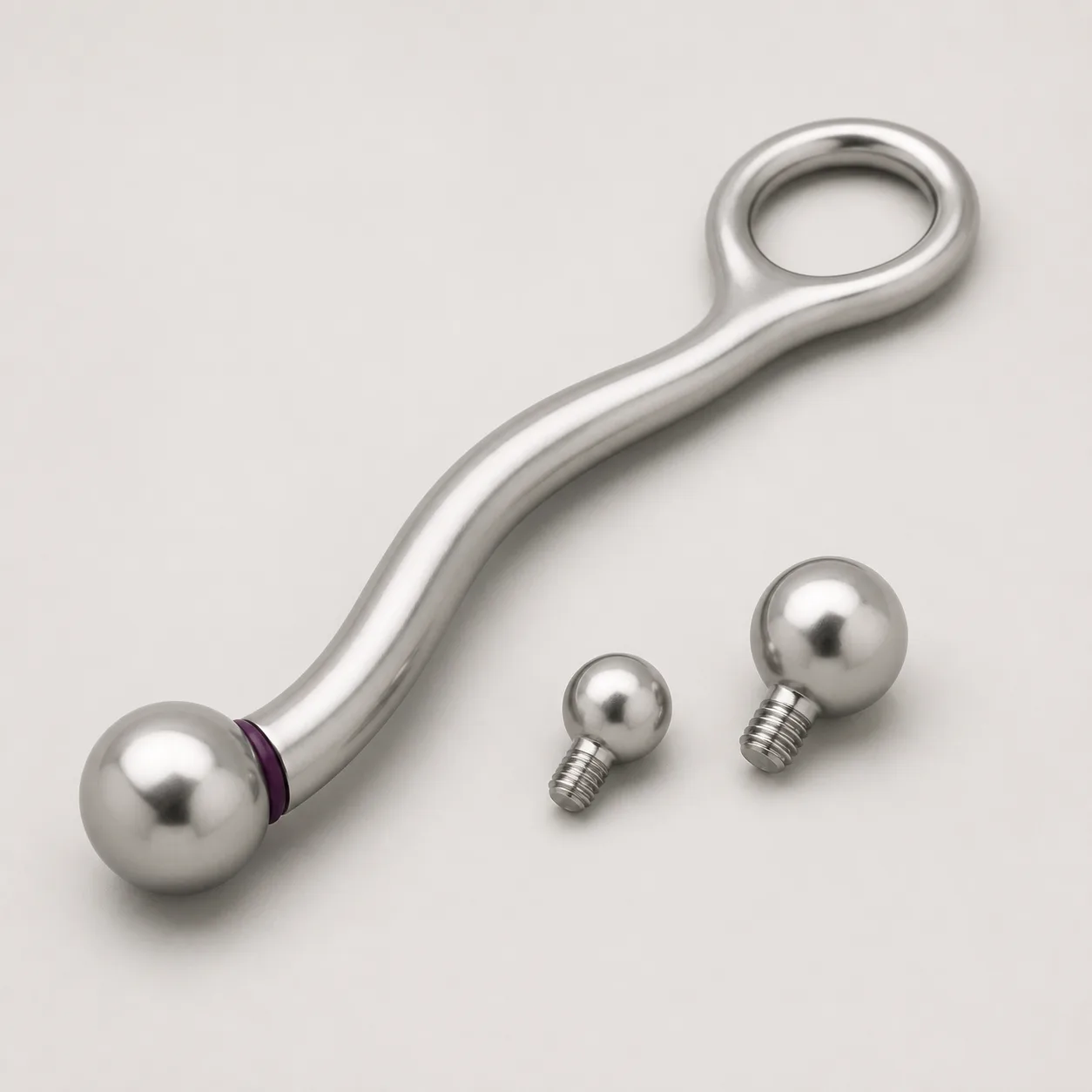
Three-Head Curved Metal Sensory Hook
An advanced rigid hook set planned only for controlled static positioning, verified head retention and zero tethering or traction.
34,99 $
200 in stock
A curved metal hook is an advanced static-position product
This three-head curved metal sensory hook combines a rigid S-profile, threaded round attachments and an external loop. Its shape can magnify leverage, so the planned use is controlled static positioning by experienced consenting adults—never pulling, suspension, tethering or forced movement.
The supplier page states 25 cm and 250 g, while its title and variation field conflict on stainless steel versus aluminum alloy. Exact metal, curvature, head sizes, mass and thread design remain pending.

Choose the head before any body contact
Measure every attachment, inspect its full circumference and compare progression between sizes. A larger head is not automatically appropriate because curvature and stem length also change handling.
Never change the installed head while the product is positioned. Remove, clean and inspect the assembly first.
Threads must seat fully without tools
Screw the selected head on by hand until its shoulder sits flush. There should be no wobble, exposed sharp thread or gap that can catch skin.
Do not use pliers, thread-locking compounds or improvised washers. A head that loosens during a bench twist test is rejected.
Curvature determines the safe movement envelope
Map the hook’s path externally and note how a small movement at the loop changes the angle at the head. Keep the loop supported and movement minimal.
Never rotate, lever or straighten the rigid shaft against the body. Stop for pressure, sharp sensation or any loss of orientation.
The loop is not an attachment point
The closed loop may help steady the product by hand, but it is not approved for rope, chains, weights, cuffs, furniture, pulling or suspension.
Adding tension can transmit force internally before the wearer can react. Final labels should state this prohibition plainly.
Insertion requires patience and compatible lubricant
Use only a validated compatible lubricant and proceed slowly without force. The user must be relaxed, in control and able to stop immediately.
Pain, bleeding, numbness, cramping or resistance are stop signals. This is not a beginner or stretching product.
Never leave a rigid hook unsupported
Maintain control of the external loop so the shaft cannot drop, swing or catch. Do not stand, walk, change furniture or hand control to a fixed object.
A stable body position and clear communication reduce unexpected leverage.
Surface finish needs magnified inspection
Examine the head, joint, full shaft and loop for pits, burrs, dents, polishing residue, rough welds and sharp transitions. Wipe with lint-free fabric to reveal snag points.
Do not sand or polish a defect; alteration changes dimensions and material validation.
Metal identity must be resolved before approval
The listing conflicts between stainless steel and aluminum alloy. Procurement must obtain alloy composition, coating, nickel-release, corrosion and restricted-substance evidence for the exact sample.
Discoloration, pitting, residue, flaking or persistent metallic odor are rejection signs.
Temperature play is outside the specification
Let the product reach comfortable room temperature naturally. Metal can hold heat or cold and cause injury before the user recognizes it.
Do not place it in a freezer, boiling water, microwave, oven or direct heating appliance.
Head retention needs repeated-cycle testing
Install and remove each head through defined cycles, then measure thread wear, shoulder gap and release torque. Apply only controlled fixture loads within a conservative static range.
Cross-threading, metal dust, wobble or changed torque ends testing.
Cleaning separates every threaded part
Disassemble after use and follow the validated method for the confirmed alloy. Clean the female and male threads, head shoulders, shaft curve and loop.
Rinse and dry completely before inspecting and storing heads in separate compartments.
Medical warning signs require prompt action
Stop immediately for bleeding, severe or persistent pain, abdominal pain, dizziness, fever, weakness or concern that a part is retained. Seek urgent medical care when symptoms or removal concerns warrant it.
Never use on injured tissue or when sensation, judgment or immediate communication is impaired.
Common questions about a metal sensory hook
Can the loop be tied to restraints?
No. Tethering, pulling and suspension are outside the planned use.
Is the material stainless steel?
Not confirmed; the supplier page conflicts with its aluminum-alloy variation field.
Can heads be swapped during use?
No. The entire product must be removed, cleaned and inspected first.
Is it suitable for beginners?
No. Rigid curvature and leverage require experienced static handling.
Can it be heated or chilled?
No. Temperature play is not part of the specification.
When should it be retired?
Stop for burrs, corrosion, loose heads, thread wear, bending, dents or a changed finish.
Observed supplier terms and provisional price
Alibaba listing 1601031081594 displayed Hefei Jiaang E-Commerce Co., Ltd., model SJ-GS123, GBP 6.80 for 1–99 pieces, GBP 6.54 for 100–499 and GBP 6.27 from 500 pieces, with a GBP 6.73 sample. It stated three heads, 25 cm and 250 g; all claims remain pending.
The planned EUR 34.99 display price provisionally allows for a China-origin sample, freight planning, dimensional and mass checks, alloy analysis, surface and edge inspection, head retention and thread cycles, curvature review, corrosion and cleaning validation, safety labels, discreet packing, processing and destination delivery. Exchange rate, freight, duty, tax, certification and terms remain pending.
Approval binds every head to one verified shaft
The accepted specification must identify alloy, coating, curve, shaft diameter, loop, head geometry, threads, shoulders, mass and package. Mixing heads or shafts from another batch starts a new review.
Until validation is complete, material, dimensions, load behavior, waterproofing, cleaning and suitable use remain provisional.
Reviews
There are no reviews yet.