



Quick-Release Padded Collar & Detachable Chain Set
August 14, 2026
Remote Heated Rocking Prostate Massager
August 14, 2026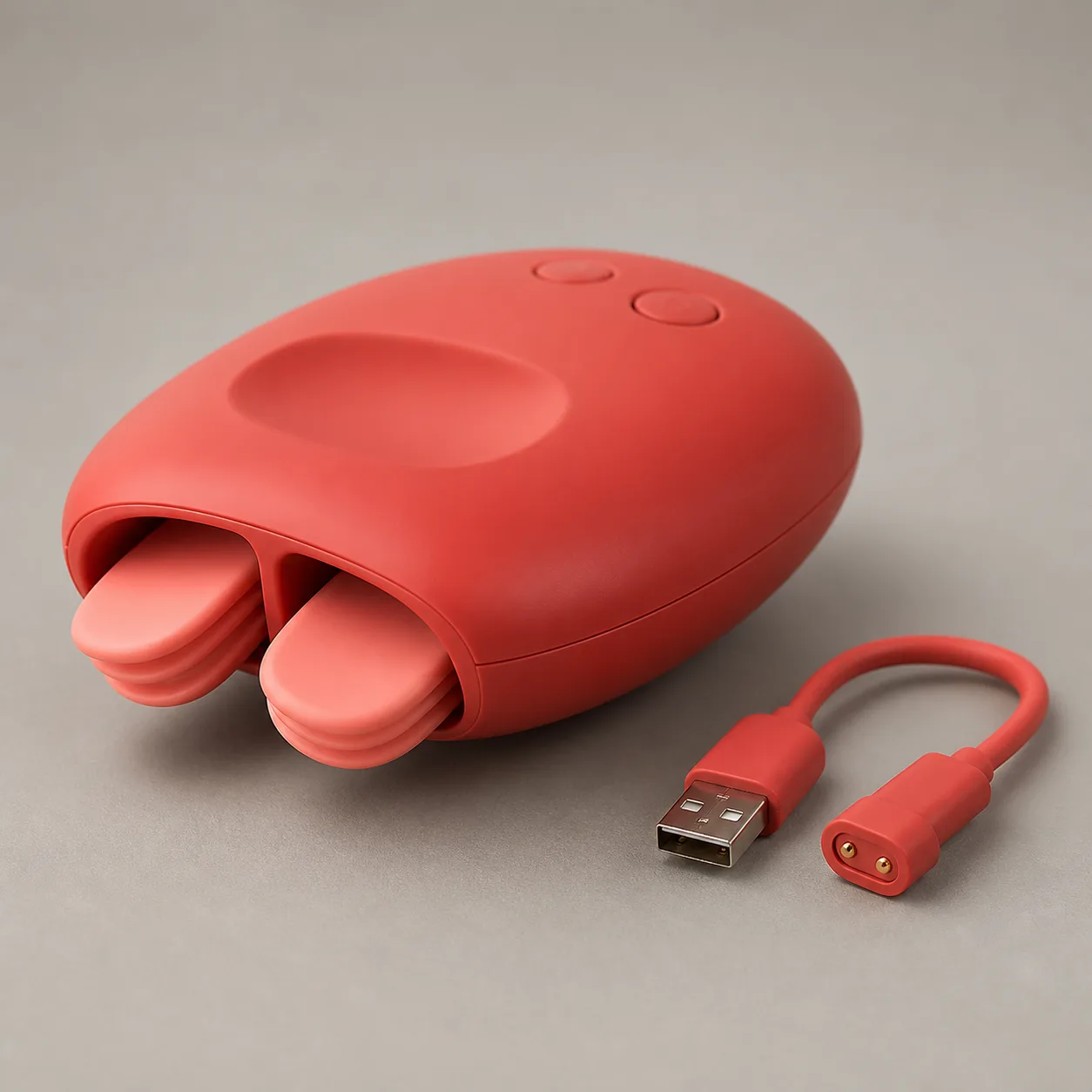
Dual-Flap Palm-Shell Vibrator
A coral palm vibrator concept with paired rounded flaps, thumb-rest grip and evidence-led checks for travel, gaps and stall behavior.
34,99 $
200 in stock
A palm shell changes how motion is aimed
The dual flap palm vibrator concept places two short rounded fins under a low coral shell with a shallow thumb rest. The format is intended for external contact, with the hand stabilizing the housing while the paired flaps provide movement distinct from a conventional fixed vibration tip.

No therapeutic, circulation, pain-relief or health outcome is claimed.
The shell must fit a hand without hiding the controls
Record length, width, height, mass, thumb-rest depth and button reach. Test control access with different hand sizes and confirm that grip pressure does not unintentionally activate a mode or stall the front mechanism.
A stable hold should not require squeezing the moving flap roots.
Two flaps need a synchronized-motion table
Measure travel, frequency, phase and resting position for the left and right flap at every selectable state. They may move together, alternate or follow unequal paths, and each behavior creates a different contact pattern.
Do not describe the motion as synchronized until phase data confirms it.
Rounded tips still need dynamic edge checks
Inspect tip radii, thickness, surface seams and stiffness at rest, then repeat against a compliant pad at the highest approved travel. A soft-looking fin can feel sharper when its edge accelerates or folds.
Begin at the lowest measured state with light external contact.
The flap roots are the primary fatigue zone
Cycle both flaps under repeatable light loads, then inspect for whitening, cracking, permanent bend, looseness and gaps at the shell openings. Root thickness and internal reinforcement should match the approved drawing.
Retire a unit with a changed resting angle or exposed internal part.
The front openings need pinch and hair guards
Map clearances around each moving root and the divider between the two channels. Test whether skin, hair or loose fabric can enter the openings during a full cycle and whether an obstruction stops motion safely.
Keep hair and fabric away, and power off before repositioning or clearing debris.
Stall behavior is part of the control design
Apply a controlled increasing load to each flap separately and together while measuring current, temperature and recovery. The mechanism should not overheat, chatter, restart unexpectedly or continue driving against a blocked fin.
One accessible button action must stop both flaps immediately.
Vibration and flapping should be identified separately
The supplier page mixes vibration and flapping language without a verified channel map. Measure shell vibration, flap travel and dominant frequency to show whether there is a separate rumble motor or whether the mechanism alone creates the felt vibration.
Publish only functions demonstrated by the approved sample.
Two buttons require a complete press sequence
Document long press, short press, mode order, intensity order, startup state, memory behavior and lockout. If one button controls flapping and the other controls vibration, confirm that each channel can be stopped without changing the other first.
Controls should be identifiable by touch without decorative claims.
Material records must cover moving and static surfaces
Request lot-linked evidence for both flaps, their roots, the coral outer shell, internal frame, thumb-rest surface, buttons, pigments, seals, adhesives and charging-contact surround. Generic silicone wording does not establish the compound used in every zone.
Check odor, tack, oil bleed, dye transfer, abrasion and swelling after conditioning.
Cleaning has to reach inside the flap mouths
Validate access beneath each fin and around both root openings using only the supplier-approved method. Confirm that cleanser and rinse water can be removed and that hidden channels dry without leaving residue or odor.
Do not force tools into the mechanism or twist the flaps by hand.
Ingress evidence must include moving seals
No rinse or immersion claim is approved without a model-specific report covering the two flap roots, shell seam, buttons and magnetic contacts under motion. A static splash test does not demonstrate sealing while the fins cycle.
Charge only after the shell, openings and contacts are completely dry.
Runtime tests should use paired loaded motion
Confirm cell chemistry, capacity, input, charge time, runtime and low-battery behavior. Monitor the front channels, palm shell and magnetic contacts while both flaps operate against repeatable compliant loads.
Stop for abnormal heat, swelling, odor, rattling or erratic speed.
The planned price includes mechanism-specific checks
The Alibaba lead displays USD 9.46 for 16 to 99 pieces, USD 9.12 for 100 to 499, USD 8.70 for 500 to 999 and USD 8.54 from 1,000. Its material, certification and performance language is not model-linked evidence.
The procurement reference is a sourcing lead only. The EUR 34.99 plan allows for China-origin freight, a sample, grip, flap geometry, travel, phase, fatigue, pinch-gap, stall, thermal, ingress and material checks; freight, duty, tax, insurance, packaging, payment fees and destination terms remain pending.
Compare flapping motion with fixed-tip vibration
This format is for adults curious about paired moving fins controlled from a palm shell. A bullet or compact wand offers fewer moving gaps and simpler cleaning, while a tongue-style device may provide a narrower single moving contact.
Final positioning guidance will follow measured travel, spacing and grip data.
Frequently asked questions
Do both flaps move together?
Their phase and travel remain pending measurement across every mode.
Is there a separate vibration motor?
The source mentions vibration and flapping, but the exact motor and channel layout requires teardown and output testing.
Can the flap openings pinch?
Clearance, guarding and stall response must be verified; keep skin, hair and fabric outside the root openings.
Can the device be rinsed or submerged?
No water-use guidance is approved without ingress evidence for the moving roots, shell seam, buttons and contacts.
What are the flap materials?
Compounds, pigments, internal supports, seals and adhesives remain pending lot-linked documentation.
What should be inspected before operation?
Check both fins, their roots, front openings, shell seam, buttons and charging contacts, then confirm low movement and immediate stop away from the body.
Reviews
There are no reviews yet.