


Fine-Mesh Care-Washing Sink Catcher Basket
August 14, 2026
Red-Light Warming Mini Prostate Vibrator
August 14, 2026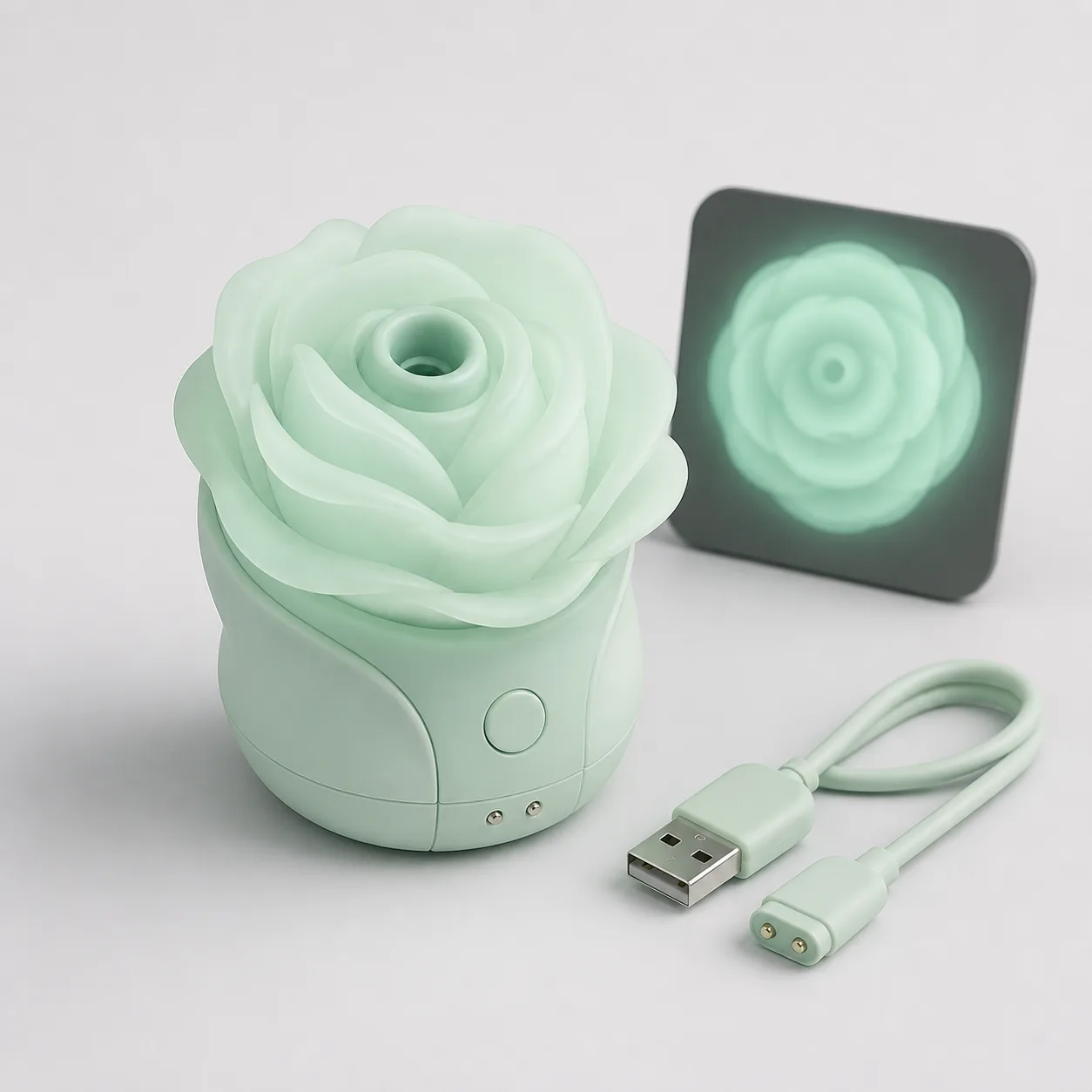
Glow-in-the-Dark Rose Air-Pulse Stimulator
A pale-mint rose-shaped air-pulse stimulator concept with layered luminous petals, central opening, single button and magnetic charger.
39,99 $
200 in stock
The glow is a material property, not an electrical light
The glow-in-the-dark rose air-pulse stimulator concept uses pale-mint sculpted petals around a central air-pulse opening, with one physical button and a magnetic USB lead. A small dark display tile in the original image illustrates the proposed afterglow. The final product must clearly distinguish stored-light luminescence from LEDs, indicator lamps or illuminated accessories.

No brightness, duration or safety claim is approved from appearance alone.
Photoluminescent additives need full disclosure
Request the additive name, particle specification, carrier, concentration, colorant system and location within the molded parts. Confirm whether luminous material is dispersed throughout the body-contact layer, placed under a clear cover or confined to non-contact petals.
Supplier use of eco-friendly or silicone wording does not identify the complete formulation.
Light charging must have a defined source and exposure
Test ordinary indoor light, indirect daylight and any specifically recommended lamp at measured intensity and distance. Record exposure time, surface temperature and afterglow without using ultraviolet sources unless a complete photobiological and material review approves them.
Instructions should never encourage placing the device on a hot lamp, windowsill or other heat source.
Afterglow performance should be measured as a decay curve
Use a calibrated luminance method to record brightness immediately after charging and at fixed intervals in darkness. Compare petals, base, color variants and samples from different lots. Note the point at which the glow is no longer practically visible rather than describing it as all-night or permanent.
A darker room can make a weak glow appear stronger, so test conditions belong with every claim.
Darkness must not hide damage or cleanliness issues
The glow is decorative and cannot replace a bright-light inspection before and after use. Examine the central rim, petal valleys, housing seam, button and charging contacts for residue, tears, discoloration, trapped moisture and surface change.
Do not use the device in darkness if controls, cable location or surface condition cannot be checked safely.
Air-pulse modes require a pressure-and-flow map
Measure pulse frequency, peak pressure, average pressure, airflow, noise and variation across each mode with a defined fixture. Repeat at full, mid and low battery charge and after cleaning cycles. Confirm whether any vibration motor operates independently or only accompanies the pneumatic system.
Mode count is not a substitute for tested performance limits and consistent stepping.
The central opening needs a soft, uniform rim
Record opening diameter, rim thickness, roundness, compliance and distance to any rigid air channel. Inspect the complete circumference for molding flash, thin spots, internal ridges and a hard core that can be felt through the cover.
The rim should recover after compression without cracking, whitening or staying distorted.
Petal valleys are the defining cleanup challenge
Map every groove between the layered petals and check whether a fingertip or approved soft brush can reach it without overstretching the material. Soil-and-cleaning validation should cover the deepest valley, the opening, button edge and base seam.
A dramatic flower shape is unsuitable if routine cleaning leaves moisture or residue behind.
The decorative shell must not interfere with the air path
Section samples to identify motor, diaphragm, valve, air channel, battery and rigid housing. Petals must not collapse over vents or transfer cleaning liquid toward the electronics. Check for rattling components, blocked ports and variation in pulse output when the rose is held at different angles.
Never insert tools into the central air channel or cover an operating vent.
One button needs a predictable start and stop sequence
Verify long-press power behavior, short-press mode stepping, lowest-level startup, transport lock and memory behavior. The button must remain distinguishable by touch without being easy to trigger in storage.
A stop command should cease pressure generation promptly, including after a low-battery or fault event.
Magnetic charging contacts need alignment and corrosion tests
Confirm polarity protection, connector retention, input limits, charge time and whether the lead can attach in an incorrect orientation. Expose the contacts to approved cleaning and drying cycles, then inspect for pitting, discoloration and increased resistance.
Charge only when the device and connector are clean, dry and away from sinks, baths and bedding.
Battery heat can change both color and glow behavior
Map temperature at the base, button, petal core and charging contacts during operation, charging and a simulated stall. Repeat after accelerated aging to detect color shift, surface softening or a changed afterglow curve near the cell.
Quarantine a unit that becomes unusually warm, develops odor, swells or shows localized loss of luminescence.
Water resistance must include the flower geometry
Request complete-unit ingress testing that covers the central opening, petal roots, button, housing seam, vents and charging contacts. Decorative crevices can retain water even if liquid does not enter the electronics, so drying time and orientation must be validated separately.
Until evidence is accepted, do not immerse the device or use it in a bath or shower.
Storage conditions can age pigment and elastomer differently
Define allowable temperature, humidity and light exposure for storage. Keep the clean dry device separated from direct sunlight, heaters, sharp objects and dissimilar soft materials. Long exposure intended to charge the glow should not become the default storage method.
Protect the petal edges from crushing and store the magnetic lead so its contacts cannot scratch the body.
The supplier option list needs careful SKU separation
An Alibaba listing offers a glow-in-the-dark rose product at USD 0.80-3.50 with MOQ 3 boxes, but its options include several colors and may include a charger-only selection. Supplier identity, full-device variant, luminous formulation, glow duration, air-pulse system, dimensions, ingress protection, battery, packaging and compliance evidence remain pending.
The procurement reference supports sample inquiry only. The EUR 39.99 plan includes a China-origin freight allowance plus additive, afterglow, pneumatic, cleanability, charging, thermal and ingress review; actual freight, duty and tax remain pending.
Frequently asked questions
Does the rose contain an LED?
The concept is based on stored-light luminescence; any electrical lighting in the final sample must be identified separately.
How long will it glow?
No duration is approved until brightness decay is measured after a defined light exposure.
Can ultraviolet light be used to charge it?
No ultraviolet method is approved without a specific exposure, material and photobiological safety review.
Are all petals made from the same material?
That remains pending; the body-contact layer, pigment carrier, rigid shell and colorants need separate specifications.
Is it safe to immerse?
Not until complete-unit ingress and trapped-water testing covers the opening, petals, seams, button and charging contacts.
Does the lowest listed price include the full device?
That is unconfirmed because the option list may include charger-only and multiple color selections.
Reviews
There are no reviews yet.