


Palm-Size Matte Rechargeable Bullet Vibrator
August 14, 2026
Lift-Out Slotted Care-Drying Tray with Drip Basin
August 14, 2026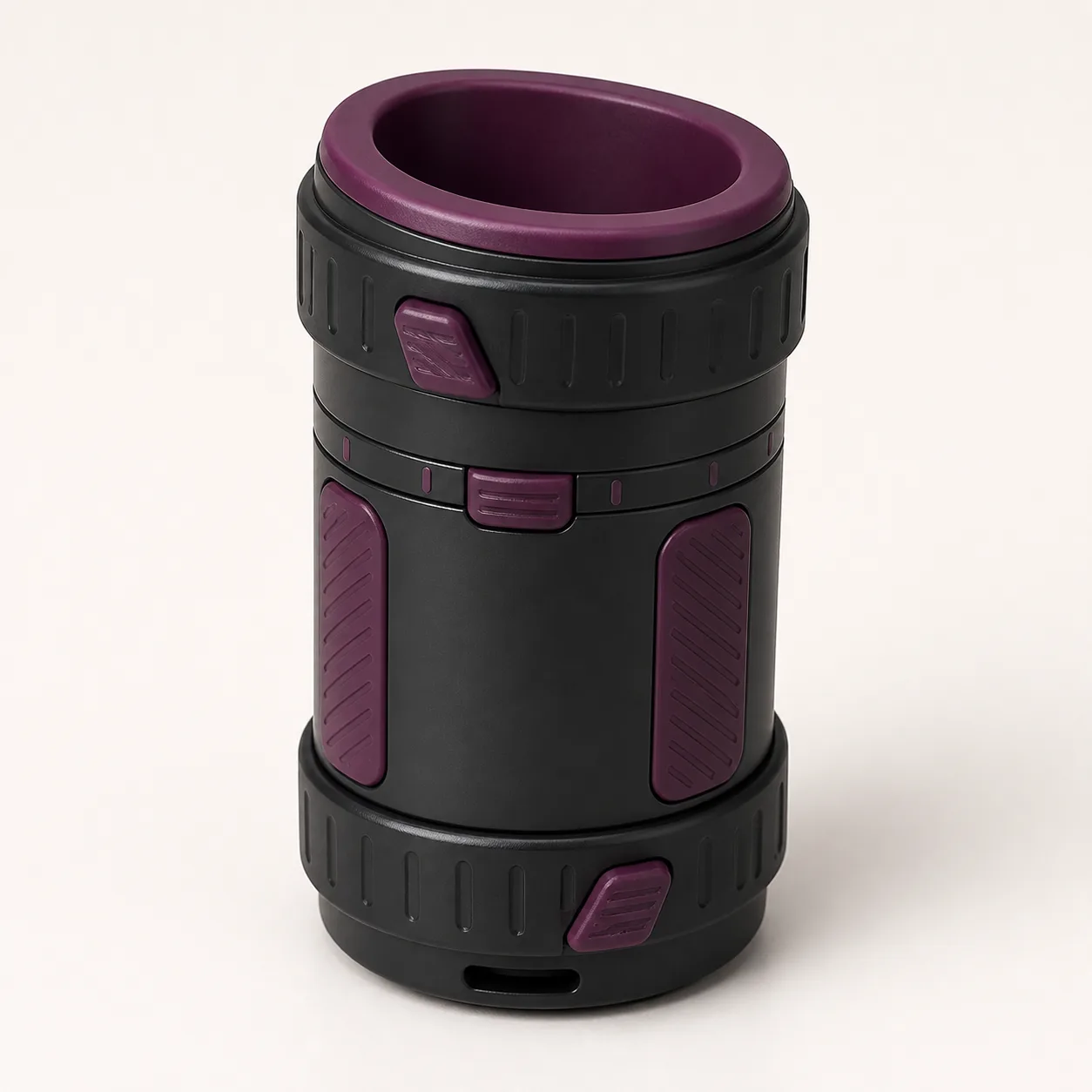
Counter-Twist Twin-Collar Manual Stroker with Torsion-Limit Clutch
An open-ended manual stroker concept with two opposing rotating collars, separately anchored liner zones and a central torsion-limit clutch.
36,99 $
200 in stock
Drive opposite liner twist through two collars
This counter twist manual stroker concept uses separate upper and lower rotating collars with grip tabs offset in opposing directions. The proposed linkage anchors two liner zones so relative collar rotation creates controlled torsion, while a central clutch ring is intended to limit transmitted torque.

The image does not prove collar coupling, liner anchoring, twist angle, clutch threshold, pressure, suction, dimensions, materials or production availability.
Identify every torsion-path component
Request an exploded drawing and bill of materials for the rim, through-liner, upper anchor, lower anchor, upper collar, lower collar, grip tabs, gears or linkages, central clutch, springs, release tab, bearings, bushings, stops, frame, shell, grip panels, vent, seals, pigments, lubricants and adhesives.
Trace force from each external collar to its liner zone and identify components shared by the two paths.
Measure the complete geometry
Record shell height and diameter, rim opening, liner bore, internal length, wall thickness, upper and lower collar width, grip-tab projection, central-ring width, vent area, grip-panel spacing and mass.
Profile the bore at neutral, maximum verified clockwise differential and maximum verified counter-clockwise differential using a compliant gauge.
Verify both liner anchors
Measure anchor engagement, axial retention, torsional slip, edge radius, assembly orientation and resistance to accidental partial seating. Use witness marks to detect creep during repeated movement.
Stop if either liner zone wrinkles into a hard fold, separates from its anchor, exposes an edge or shifts axially into the shell.
Map independent and linked collar motion
Measure free rotation, working arc, backlash, detents, hard stops and required torque for each collar while the other is fixed and while both are moved together. Confirm the actual direction at each liner anchor.
Do not infer counter-rotation from tab orientation; instrument both collars and the liner simultaneously.
Characterize the torsion-limit clutch
Measure breakaway torque, steady slip, reset behavior, hysteresis, temperature sensitivity and cycle drift in both directions. Document how the central release tab changes engagement.
A click or visible witness mark is not a verified torque limit until correlated with the force transmitted through an exact liner assembly.
Measure twist along the liner
Place circumferential reference markers on an instrumented liner sample and record angular displacement at multiple depths for each collar differential. Compare unloaded and compliant-loaded states.
Identify local twist concentration, delayed movement, anchor slip, helical buckling or a region that does not relax fully after the collars are neutralized.
Map pressure and shear separately
Use a compliant sensor sleeve to record normal pressure and tangential force at the rim, anchor zones, middle liner and seams while applying small verified collar increments. Test both directions.
Define conservative limits from the highest local pressure and shear, not from the average torque at the external grip tabs.
Measure movement resistance at fixed twist
Move the complete device along a standardized compliant fixture at controlled speed while holding each verified collar differential. Record entry, sustained and extraction force, stick-slip, liner migration and collar creep.
Confirm the liner can be restored to its measured neutral profile before removal; stop for abrupt resistance or a collar that will not disengage.
Validate vent and pressure behavior
Measure airflow, pressure change and occlusion response with the lower vent open, partially blocked and closed only if an approved control exists. Verify the vent does not create a hidden suction claim.
Inspect the flow path for liner intrusion, sharp edges, residue traps and a configuration that can lock under negative pressure.
Test two-handed grip and pinch clearance
Measure dry and damp grip force on the two vertical panels, reach to both collar tabs and unintended contact with the clutch release. Map gaps between moving collars, tabs, shell and grip panels throughout rotation.
Reject sharp rails, accessible gear teeth, narrow pinch zones or a tab that catches clothing or skin.
Challenge jams and recovery steps
Use compliant fixtures to create anchor slip, liner bunching, blocked collar motion, clutch slip and vent occlusion. Document neutralization, release-tab use and safe disassembly without adding torsion.
Never force a jammed collar. Retire a sample with a broken stop, failed clutch, exposed linkage, torn liner or repeatable inability to reach neutral.
Cycle twist, movement and cleaning together
Run repeated liner seating, anchor engagement, opposite collar motion, clutch slip, neutralization, translation, extraction, disassembly, cleaning, drying and storage cycles. At checkpoints repeat torque, twist, pressure, shear, movement resistance, anchor retention and vent tests.
Track changes separately in both directions so one-way wear is not hidden by an average result.
Clean anchors and clutch-adjacent seams
Obtain exact material and cleaner compatibility data first. Remove the liner only by the approved sequence and clean its faces, rim, anchor interfaces, collar seams, clutch-ring edges, release recess, grip panels and vent path.
Measure drying by mass and inspect hidden anchor and vent cavities before reassembly. Immersion remains unapproved without verified ingress and drainage evidence.
Price after torsion limits are verified
An Alibaba manual-stroker listing currently shows a category example at USD 15.97-17.47 with MOQ one. It is a category benchmark only and does not confirm this twin-collar counter-twist architecture, dual liner anchors or torsion-limit clutch.
The procurement reference supports an EUR 36.99 planning price after allowing for China-origin freight, exact-model sourcing, teardown, shell and liner metrology, anchor-retention tests, collar-motion maps, clutch characterization, depth-resolved twist, pressure and shear measurement, movement resistance, vent review, jam recovery, cycle life, material evidence, cleaning validation, protective packing and discreet fulfillment. Exact quotation, packed size, weight, freight, duty, tax, insurance, payment fees and delivery terms remain pending.
Frequently asked questions
Do the collars automatically rotate in opposite directions?
No automatic drive is proposed; the actual linkage and liner response require instrumented manual testing.
How much liner twist is available?
No angle is claimed until displacement is mapped by depth under unloaded and compliant-loaded conditions.
Does the clutch guarantee a safe torque?
No. Breakaway torque must be correlated with local pressure, shear and liner behavior.
Can one collar be used alone?
Independent motion, linked motion and anchor response need separate verification before instructions are written.
Can the device be immersed?
No ingress claim is made; anchors, clutch seams and the vent require the documented cleaning method.
Which faults require retirement?
Anchor slip, torn liner, broken stop, failed clutch, exposed linkage, sharp seam, blocked vent or inability to reach neutral.

Reviews
There are no reviews yet.