


Slim Tail-Dial Bullet Vibrator with Flexible Pull Ring
August 14, 2026
Hexa-Facet Tapered Suction-Base Dildo
August 14, 2026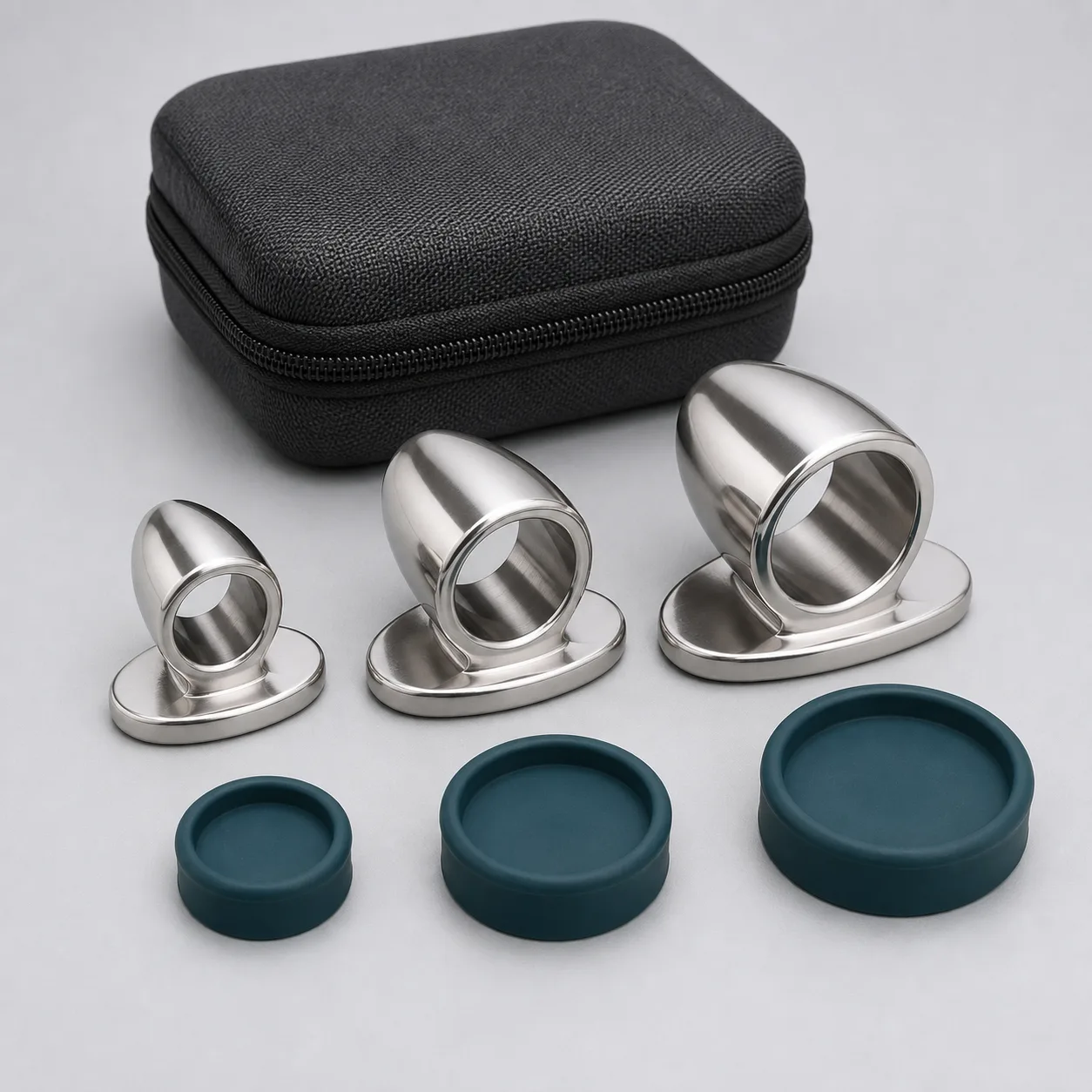
Three-Size Hollow Tunnel Metal Plug Set
A three-size polished hollow tunnel plug concept with tapered shells, smooth through-bores, wide oval external bases, dark-teal storage caps and protective case.
34,99 $
200 in stock
A tunnel profile adds two internal edges to inspect
The three-size hollow tunnel metal plug set concept presents small, medium and large polished tapered shells with smooth central bores, broad oval external bases and separate dark-teal storage caps. A charcoal case keeps the six pieces organized.

The image communicates the set architecture only; it does not establish scale, alloy, finish, cap seal or suitability for any user.
Every size needs a complete dimensional drawing
Record usable length, maximum diameter, neck diameter, taper angle, tip radius, bore diameter, wall thickness and base width and length. A nominal small, medium or large label cannot replace measurements and tolerance bands.
Choose only from verified dimensions; progression through the set is optional and never a schedule.
The oval base must remain broad in both directions
Compare base width and length with the largest insertable diameter and the neck. Test the flange on a compliant fixture to confirm that it remains external and resists rotation through the opening.
Do not use any sample with a narrow, flexible, detachable or damaged base.
Bore entrances must be rounded at both ends
Inspect the outer opening, inner channel and base-side exit under magnification. Edges should be continuously radiused, free from burrs and polished without deep tool marks that can abrade skin or retain residue.
Pass a lint-free swab through the dry bore; snagging fibers indicate a finish defect.
The hollow channel is not an irrigation device
No hose, nozzle, syringe, tube or pressurized source should be connected to the bore. The tunnel geometry is evaluated as a passive opening only and does not establish safe fluid delivery, drainage or prolonged ventilation.
Keep caps external and never insert a cap or any accessory into the body.
Caps need fit checks without becoming tight plugs
Measure cap diameter, insertion depth, retention and removal force on each size. A storage cap should protect the clean bore without scratching the rim, trapping moisture or becoming difficult to remove with dry hands.
Color, compound, cleanser compatibility and intended use of the teal pieces remain pending.
Metal temperature should be checked with a thermometer
Dense polished components can feel colder or warmer than the room. Bring the selected piece toward body-neutral temperature using only the approved method, verify it with a suitable thermometer and avoid freezers, flames, boiling liquid and microwave heating.
Stop for burning, numbness, sharp cold, pain or a rapid change in skin sensation.
Alloy identity matters more than a silver appearance
Obtain alloy grade, elemental composition, manufacturing route, passivation or electropolishing record and lot traceability. Marketplace wording such as stainless steel or waterproof does not prove corrosion resistance or nickel release.
Screen finished samples for rust, pits, plating flakes, discoloration and reaction after the intended cleanser and lubricant exposure.
Mass and center of gravity affect wearable comfort
Weigh each shell and locate its balance relative to the neck and base. A larger hollow piece may be lighter than a solid plug of similar dimensions, but mass distribution can still pull on one edge of the flange.
Limit movement until the actual weight, fit and base stability have been evaluated.
Cleaning begins inside the bore
Remove the external cap, wash the shell by the approved method and use a soft non-scratching brush sized to reach the entire channel. Inspect both bore edges, the neck-to-base junction and the underside of the flange.
Rinse fully and dry the channel from both directions before capping or placing the piece in its case.
Cross-size storage should prevent metal contact
Confirm that the case has separate recesses or sleeves so polished surfaces and bore rims do not strike each other. Store caps dry, loose and matched to their measured size.
Quarantine a component if the case lining leaves grit, dye, fibers or an unknown oily film on the metal.
Surface finish needs inspection after drop simulation
Perform controlled handling drops onto the planned packaging surface, then check base flatness, rim dents, tip damage and hidden cracks with the appropriate method. Metal can remain shiny while a bore lip becomes sharp.
Discard any dropped unit that cannot be fully inspected or that shows deformation.
The set is for individual selection, not simultaneous use
Evaluate and use one size at a time. Do not stack shells, nest one inside another during use, or place the next size before the body is comfortable and the first item has been completely removed and cleaned.
Stop for pain, bleeding, loss of sensation, unexpected resistance or difficulty reaching the base.
Incoming inspection needs bore gauges and edge controls
Use calibrated gauges for maximum diameter, neck, usable length, base dimensions, wall thickness and bore. Sample mass, cap fit, base stability, burr detection, surface roughness, corrosion exposure and post-drop edge condition.
Dimensional tolerances, base minimum, finish target, passivation criteria, cap force and carton tests remain pending supplier agreement.
The low wholesale quote excludes precision verification
An Alibaba hollow-plug page lists a three-size stainless tunnel product from Guangzhou Quaige Wellness Technology Co., Ltd. at USD 2.60-3.90 with MOQ 5 pieces. Exact model, dimensions, alloy, passivation, bore finish, cap material and compliance evidence remain pending.
The procurement reference supports sample inquiry only. The EUR 34.99 plan includes a China-origin freight allowance plus geometry, base, edge, cap, temperature, alloy, finish, cleaning and drop review; actual freight, duty, tax, insurance, payment fees and destination terms remain pending.
Frequently asked questions
Are all three sizes included?
That is the planned set, but final contents and measured dimensions require supplier and sample confirmation.
Can liquid be passed through the tunnel?
No. The bore is not approved for irrigation, pressurized fluid or connected tubing.
Are the teal pieces used during wear?
No. They are treated as external storage caps pending confirmation and must stay outside the body.
Can the metal be chilled or heated?
Only within a verified temperature range and method; extreme heating or cooling is not approved.
Is the alloy confirmed as stainless steel?
No. Alloy grade, finish, passivation and corrosion evidence remain pending lot-linked documentation.
What should be inspected before use?
Check the tip, outer bore rim, inner channel, neck, entire oval base and underside for burrs, dents, pits, cracks, corrosion or residue.

Reviews
There are no reviews yet.