


Pointed Foam Detail Swabs with Vented Case, 12-Pack
August 14, 2026
Adjustable Care-Shelf Privacy Curtain with Tension Rod
August 14, 2026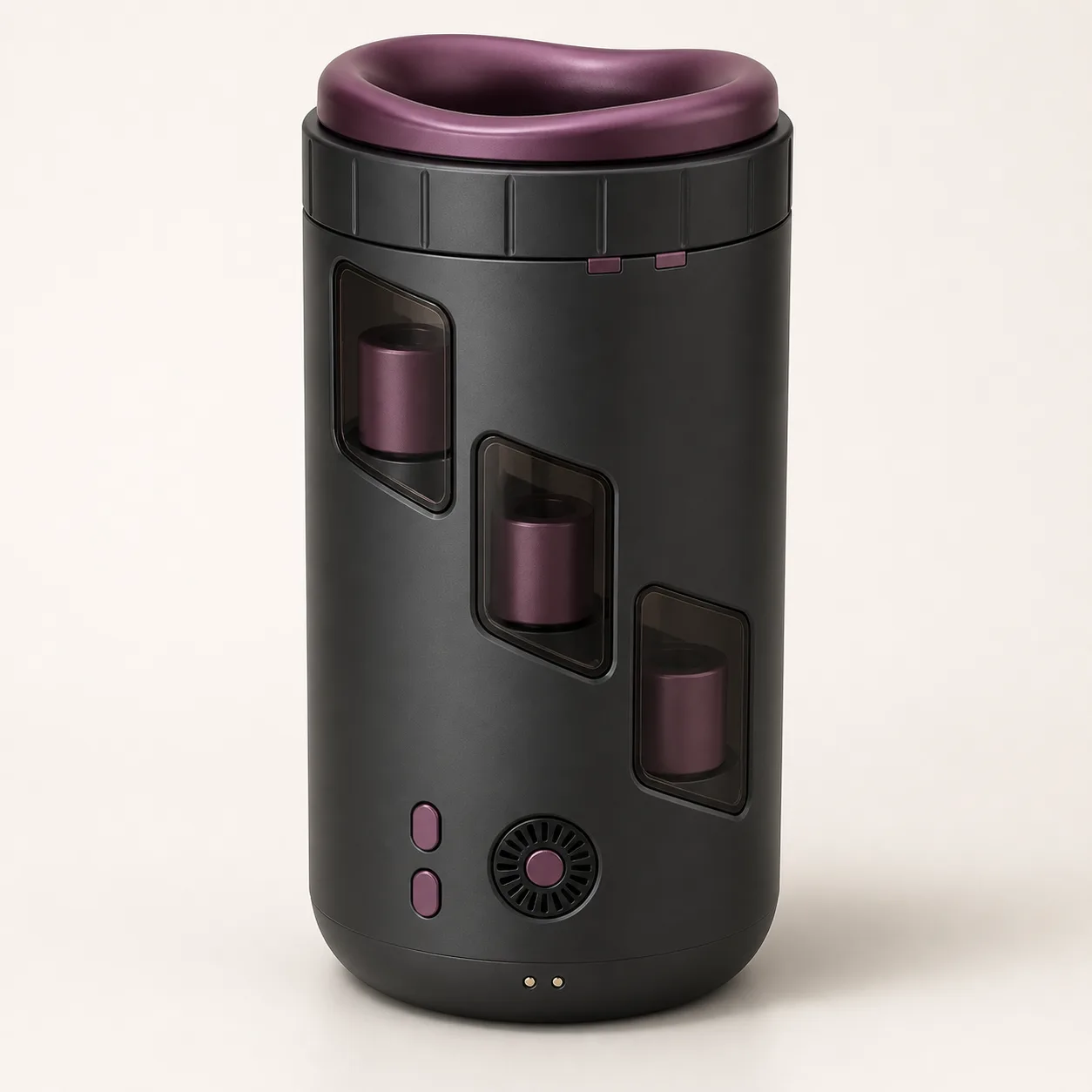
Three-Roller Helical-Track Automatic Stroker with Guarded Windows, Twist-Lock Collar and Vent Dial
An automatic cup concept with three guarded smoke windows showing three plum rollers at descending positions, an oval entry rim, twist-lock collar, two controls and a vent dial.
94,99 $
200 in stock
Stage three guarded rollers along a descending helical track
This three-roller helical-track automatic stroker concept places exactly three plum cylindrical rollers behind three smoke-tinted windows at upper, middle and lower positions. One abstract oval entry rim, a broad twist-lock collar, two front buttons, one vent dial and two charging contacts complete the upright charcoal housing.

The image establishes external architecture only. Sleeve construction, roller path, output, materials, battery and cleaning limits remain pending physical verification.
Keep the planned inventory to one powered device
The proposed pack contains exactly one assembled automatic cup. A separate liner, cap, charging cable, adapter, stand, remote, phone application, cleaner, lubricant and storage case are excluded unless an approved packing list adds them.
Whether the internal liner is removable from the housing remains unconfirmed.
Define the smooth oval entry as a non-anatomical boundary
Measure opening axes, rim width, depth, edge radius, local hardness and the transition into the internal sleeve. Inspect mould lines, pits and seams around the full oval before and after conditioning.
The image does not prove internal length, fit range or insertable limits.
Validate the broad twist-lock collar above the windows
Record collar rotation, axial play, lock torque, stops, retention and visible position cues. Cycle the collar while dry and after approved cleaning, checking false seating, cross-threading and accidental release.
The two visible plum blocks are unlabelled cues; no exact detent count is claimed.
Guard exactly three inspection windows
Label the upper-left, centre and lower-right windows W1, W2 and W3. Measure dimensions, transparency, wall thickness, impact resistance and attachment seams, then inspect for cracking, fogging and leakage.
Windows are observation guards and should not expose a finger-accessible moving gap.
Place one cylindrical roller behind each window
Record roller diameter, length, end radius, surface profile and axle construction for R1, R2 and R3. Measure breakaway torque, running torque, wobble and runout before and after loaded cycles.
Exactly three rollers are visible; hidden rollers or passive followers remain pending teardown.
Prove the helical path instead of inferring it from height
The descending window layout suggests a spiral sequence but does not demonstrate motion. Use transparent engineering samples, position tracking and load tests to map rotation, orbit, axial travel and timing for every roller.
Helical massage, continuous travel and synchronized-wave claims remain withheld until measured.
Screen roller guards gaps and liner clearance
Probe all spaces between roller, axle, window guard, sleeve carrier and housing across operating states. Test for liner snagging, pinch points, foreign-object entry and contact between moving parts and rigid edges.
Stop the device immediately if a liner shifts, catches or exposes a hard internal part.
Map the two-button control logic through firmware tests
Document power timing, short and long presses, sequence, speed, direction, pause, memory, travel lock, status feedback and emergency stop after firmware is fixed. Check accidental activation in the planned packaging.
Mode count, independent roller control and reversal remain unconfirmed.
Separate vent-dial airflow from roller settings
Measure dial rotation, stops, opening area, leakage, sound and airflow at each verified position. Confirm that adjusting the vent cannot loosen the housing, obstruct a moving part or create a cleaning trap.
Vacuum, suction strength and quick-release claims remain pending instrumented tests.
Measure motion pressure current heat and sound together
Run R1, R2 and R3 under multiple compliant sleeve loads while logging displacement, speed, force, pressure, current, housing temperature and sound. Test start, steady operation, obstruction, shutdown and restart across the full battery range.
Quietness, high torque, stall protection and continuous-duty claims remain withheld.
Set conservative use and withdrawal conditions
Use only after confirming the sleeve is intact, clean and compatible with the chosen lubricant. Begin at the lowest verified setting, keep the vent accessible and stop immediately for pain, numbness, swelling, bleeding, loss of control, unusual noise, heat or difficulty withdrawing.
Do not use while sleeping, intoxicated or unable to monitor sensation. No delay, erection, enlargement, therapy or medical claim is made.
Validate battery charging and moving-part protection
Request cell chemistry, rated capacity, charging input, cable type, charge time, runtime method, low-voltage cut-off, over-current and obstruction protection, storage limits and transport documents. Cycle several samples while logging capacity loss and temperature.
Cable inclusion, charging time, runtime and fast-charge claims remain pending.
Verify materials ingress liner compatibility and cleaning access
Obtain traceable composition, hardness, pigments, lubricants and adhesives for the rim, collar, housing, windows, rollers, axles, sleeve, buttons, vent and contact surround. Test cleaner and lubricant compatibility plus liquid ingress at every collar, window and vent boundary.
Silicone, TPE, ABS, latex-free, phthalate-free, hypoallergenic, body-safe and waterproof claims remain withheld. Clean and dry only by a validated method; stop using the unit for cracks, tackiness, corroded contacts, seized rollers, cloudy guards, trapped residue or erratic output.
Price from automatic-stroker references and helical-track validation
An Alibaba automatic-stroker page displayed a hands-free heated category example at USD 10.98 to 11.90 with MOQ 1. This is a broad benchmark, not a quotation for the three-window helical-track design or an approved supplier.
The public procurement benchmark supports an EUR 94.99 planning price after provisional allowance for China-origin freight, three guarded rollers, transparent window inspection, collar and vent tests, motion tracking, sleeve compatibility, motor, battery, obstruction, heat, sound and ingress validation, discreet fulfilment and expected mechanism quality loss. Exact supplier, quote, MOQ, dimensions, materials, motors, packed weight, freight, duty, tax, certification, payment terms, lead time and production availability remain pending.
Frequently asked questions about the three-roller stroker
How many rollers are visible?
Exactly three cylindrical rollers appear behind three separate guarded windows.
Do the rollers follow a helical path?
The staggered heights propose that architecture, but actual motion requires position tracking and teardown evidence.
Is the liner removable?
Removal method, lock interface and replacement availability remain pending.
What does the vent dial control?
Airflow adjustment is proposed, but opening area, leakage and pressure effects remain unverified.
Is a charging cable included?
Cable type and inclusion are not confirmed by the planned one-device inventory.
Is it waterproof?
No ingress claim is made until the complete collar, windows, vent and charging assembly pass documented tests.

Reviews
There are no reviews yet.