


Six-Leaf Iris-Dial Manual Stroker with Removable Open-End Liner
August 14, 2026
Pink Foldable Dual-Motor Rabbit Vibrator with Burst Button
August 14, 2026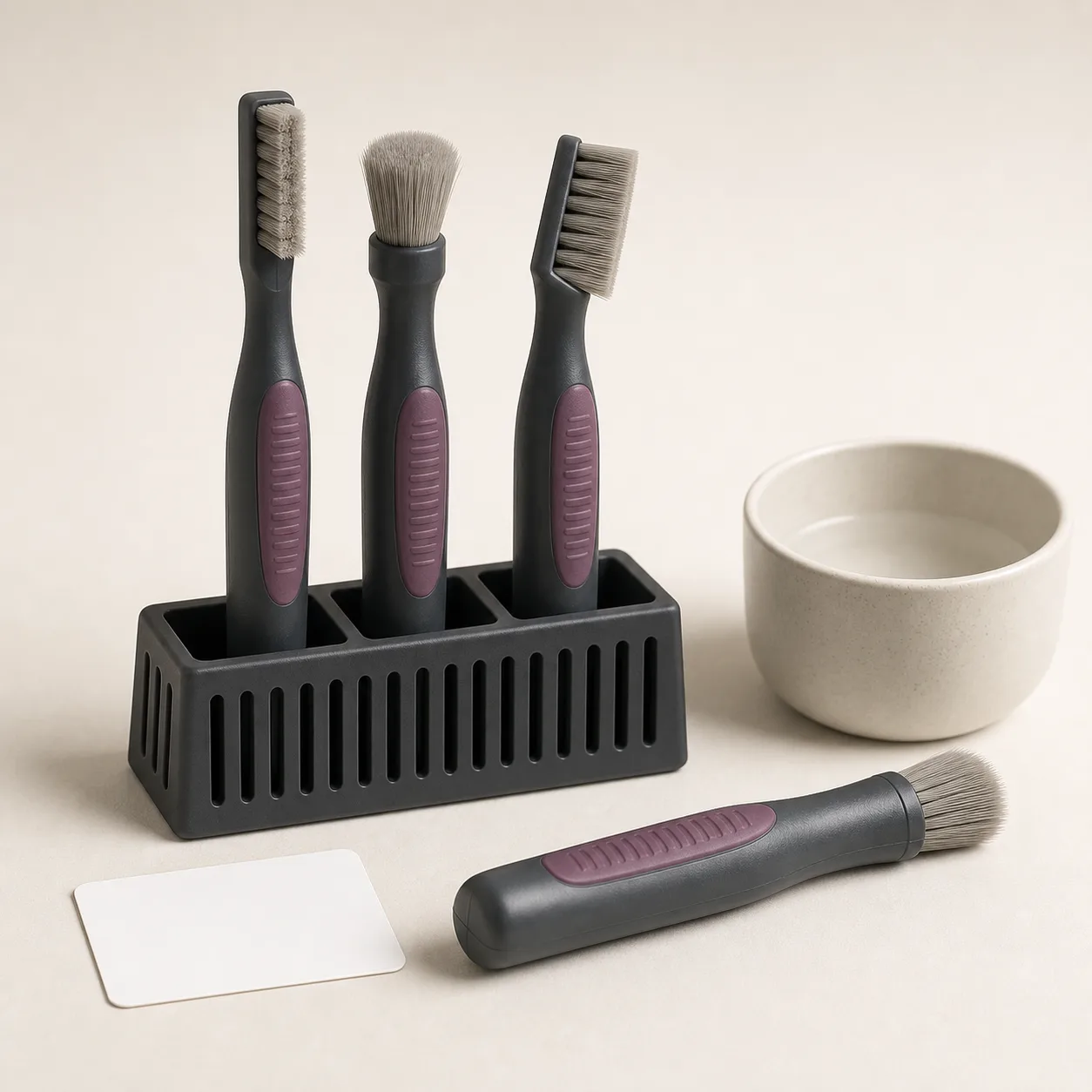
Multi-Profile Soft Detail Cleaning Brush Set with Vented Stand
A multi-profile manual detail brush concept with narrow, rounded and angled heads, muted grips and a vented stand for approved cleaning routines.
16,99 $
200 in stock
Different profiles solve different access problems
The soft detail cleaning brush set concept combines narrow, rounded and angled heads with charcoal handles, muted-plum grips and a vented stand. The profiles are intended to help reach seams, shallow recesses and broad edge transitions on products whose makers permit manual brushing.

Soft-looking bristles are not proof of compatibility; every surface and cleaning method needs its own documented approval.
Read the product instructions before choosing a brush
Some coatings, printed marks, soft finishes, membranes and plated surfaces can scratch or lift even under gentle contact. Confirm whether brushing is allowed and which cleaner, temperature and contact time the manufacturer specifies.
When instructions call for wiping only, a brush is the wrong tool.
A narrow row can follow an open seam without becoming a probe
Guide a slim head along accessible exterior joints using light strokes. Do not force bristles beneath bonded edges, seals, buttons or decorative overlays, because hidden damage can be worse than the residue being removed.
Stop if the seam opens, color transfers or the brush catches.
A rounded tuft spreads pressure over a small area
The domed profile can loosen surface dust and dried residue on approved durable zones while reducing hard edge contact. Keep the handle nearly upright and let the bristle tips work without grinding the ferrule or handle into the surface.
Stiffness and tip finish must be measured on production samples.
An angled head reaches corners but can concentrate force
Use the long edge first and approach tight corners gradually. The pointed end should not enter charging sockets, air vents, deep channels or any opening that the manufacturer says to keep dry.
Never use a brush as a lever, pick or connector-cleaning tool.
Assign brushes to tasks to limit cross-contact
Keep separate heads for dry dusting, water-based washing and other approved routines. A simple private code on the handle or storage slot can prevent a brush used with one formula from moving residue to another item.
Do not share a visibly soiled brush between products.
Cleaner compatibility includes the brush itself
Detergent can soften handles, swell grips, loosen tuft adhesive or change bristle stiffness. Soak and cycle-test the final materials with every approved formula at the intended concentration and temperature.
No solvent, disinfectant or high-heat compatibility claim is approved.
Pressure control matters more than scrubbing speed
Begin on a small inconspicuous area with minimal force and short strokes. Watch for gloss change, haze, pilling, lifted print, coating transfer and bristle marking before expanding the cleaned area.
A persistent mark should trigger a method review, not harder brushing.
Electrical openings need a separate dry-care protocol
Disconnect power and follow the device maker’s instructions for ports, contacts and charging recesses. Do not place a wet brush, loose bristle or cleaning solution into an electrical opening.
Allow any permitted exterior cleaning to dry fully before inspection and charging.
Rinse water should not become a shared residue bath
If the approved method allows rinsing the brush, use fresh water and change it when cloudiness or residue appears. Keep the rinse cup separate from drinking vessels and from the product being cleaned.
The cup in the image is a neutral prop and is not promised pack content.
A vented stand supports drying but does not sanitize
Place thoroughly rinsed brushes bristle-up in a clean, airy location where runoff cannot collect around handles. Confirm that the stand drains and that brush slots do not compress wet tufts.
Ventilation cannot remove incompatible chemicals or establish microbial safety.
Dry every tuft to its core before enclosed storage
Surface-dry bristles may still hold moisture near the anchor. Separate crowded heads, allow the verified drying time and inspect for odor, discoloration or trapped residue before moving the set into a drawer.
Do not close damp brushes inside a pouch or hard case.
Wear shows first at bristle tips and anchors
Check for bent tips, rough ends, shedding, splayed rows, loose tufts, cracked handles and tacky grips. Compare frequently used heads with an unused reference so gradual stiffness changes are easier to notice.
Remove any brush that can no longer apply uniform gentle contact.
Incoming inspection should include a controlled scratch panel
Measure head and handle dimensions, bristle diameter, tip finish and tuft retention. Test wet and dry strokes at defined loads on approved reference panels, then assess shedding, abrasion, color transfer and handle grip.
Quarantine sharp tips, exposed staples, unstable tufts, persistent odor, solvent damage or stands that trap water.
The source listing describes a general detail set
An Alibaba entry from Tongcheng City Dafuhao Brush Making Co., Ltd. displays a small deep-detail cleaning brush set at USD 1.60-2.00 with MOQ 100 sets. Exact profiles, fibers, stiffness, adhesive, handle polymers and stand configuration remain pending.
The procurement reference supports sample inquiry only. The EUR 16.99 plan provisionally includes China-origin freight, profile sorting, scratch-panel, shedding and detergent tests plus stand inspection; packed mass, freight, duty, tax, insurance, payment fees and destination terms remain pending.
Frequently asked questions
Can these brushes be used on every toy surface?
No. Use a brush only when the product maker approves brushing and the sample test shows no damage.
Which head should clean a charging port?
None unless the device manufacturer gives a specific dry-brush procedure; never insert wet bristles into electrical openings.
Does the stand sanitize the brushes?
No. It only supports organized airflow and cannot establish sanitation or remove incompatible residue.
Can one brush be used with several cleaners?
Only after material compatibility and cross-contact controls are verified for every formula.
How should the set dry?
Rinse only as approved, place brushes bristle-up with open airflow and wait until the tuft core is fully dry.
When should a brush be discarded?
Remove it after shedding, rough tips, splaying, loose tufts, cracked handles, tacky grips or visible surface marking.

Reviews
There are no reviews yet.