



Adjustable Care-Shelf Privacy Curtain with Tension Rod
August 14, 2026
Multi-Profile Soft Detail Cleaning Brush Set with Vented Stand
August 14, 2026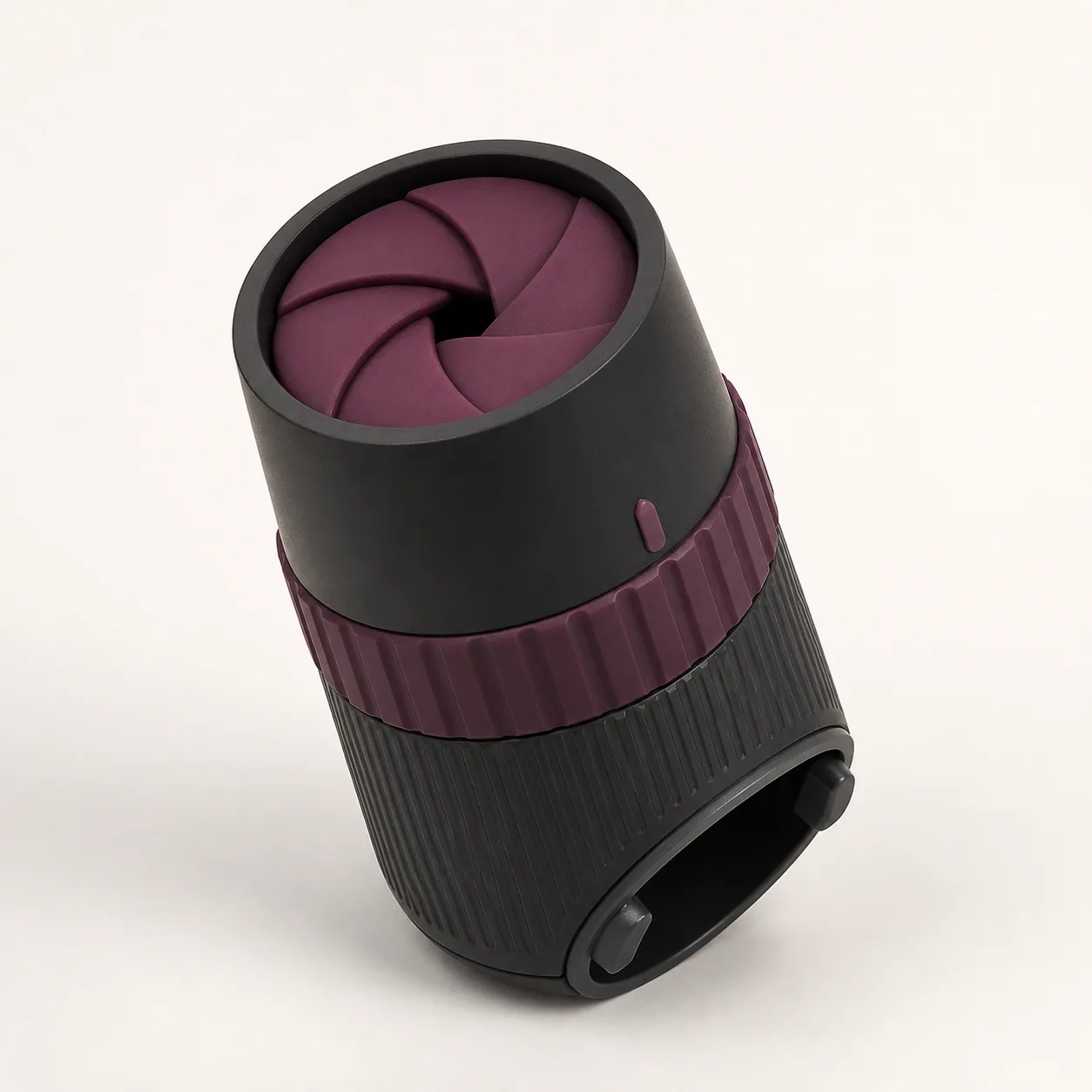
Six-Leaf Iris-Dial Manual Stroker with Removable Open-End Liner
A compact non-powered male stroker concept with six synchronized overlapping aperture leaves, a broad rotary adjustment collar and a quarter-turn removable open-end liner.
27,99 $
200 in stock
A six-leaf aperture changes the entrance profile
This iris dial manual stroker concept uses six overlapping rounded leaves inside a compact open-ended housing. Rotating the broad external collar is intended to move all leaves together, changing the central aperture without a motor, battery or separate controller.

The image does not establish aperture size, pressure, fit, material, watertightness or safe adjustment limits.
Trace the complete iris and liner assembly
Request exploded drawings and a component list for the six leaves, leaf carriers, guide slots, synchronization ring, adjustment collar, end stops, detents, bushings, housing halves, removable liner, rim, locking tabs, grip shell, lubricants, pigments and adhesives.
Confirm whether each leaf is a single soft part or a soft cover over a rigid carrier, because exposed edges and failure modes differ.
Measure every aperture setting directly
Record the minimum and maximum opening, intermediate diameters, roundness error, leaf overlap, travel per collar angle and clearance to the fixed outer rim. Use calibrated gauges at neutral temperature and after repeated cycles.
Do not describe a setting as loose, medium or tight until its geometry and fixture pressure have been measured.
Check that all six leaves move together
Mark the leaves for test identification and follow each tip while turning the collar slowly in both directions. Record lag, asymmetry, lateral drift, sticking, audible clicks and any leaf that reaches an end stop early.
A single stalled leaf can create a concentrated edge even when the aperture still looks roughly circular.
Map collar torque and detent stability
Measure the force needed to start and continue adjustment with the device empty, lightly loaded and damp according to the confirmed procedure. Check each detent for clear engagement and unintended movement under ordinary grip pressure.
Reject sharp torque spikes, free spinning, collar creep or a pointer that no longer matches the measured aperture.
Probe overlap seams for pinch and folding
Cycle standardized soft-film, hair and textile probes through the changing aperture on a guarded fixture. Inspect every overlap seam, reversing edge, carrier slot and the transition from leaf to fixed rim.
The leaves must not trap a thin probe, fold under a neighbor or expose an internal guide at any approved setting.
Measure radial pressure on a compliant fixture
Use traceable compliant cylinders across the verified fit range to map pressure around the full circumference at every approved dial position. Record peak pressure, sector-to-sector variation, relaxation over time and hysteresis after opening.
The smallest geometrically possible aperture is not automatically a permitted operating setting.
Keep adjustment unloaded and fully visible
Set the collar only while the device is empty unless final instructions and instrumented tests explicitly support another method. Check the pointer, aperture and leaf alignment before contact, and use compatible lubricant as documented.
Stop immediately for pain, numbness, coldness, color change, swelling, loss of sensation, leaf folding, collar movement or unexpected resistance.
Verify the open-end liner and locking tabs
Remove and install the liner only by the confirmed quarter-turn sequence. Measure tab travel, engagement depth, rim seating, rotational play and the gap between the liner and housing at both locks.
Reject a lifted rim, one-sided engagement, cracked tab, false stop or liner that twists while the collar is operated.
Challenge the liner against axial movement
With the empty product held in a fixture, apply small capped axial and twisting forces below documented limits. Record rim lift, tab flex, housing spread, collar interference and permanent displacement.
The weakest tab, rim or shell limit governs; two locks do not justify doubling a single-lock value.
Inspect grip transfer and shell deformation
Measure how hand pressure on the ribbed lower shell affects aperture roundness, collar torque and liner retention. Repeat at several grip locations so a flexible housing does not unintentionally tighten the leaf assembly.
Check seams and the collar gap for rubbing, pinching and contamination when the shell is squeezed.
Cycle the mechanism through its full range
Run controlled open-close cycles with periodic compliant-load checks. At defined intervals inspect leaf tips, overlaps, guides, detents, pointer alignment, collar play, liner tabs, rim seating and housing seams.
Track pressure drift and opening error as well as visible wear; a smooth dial can still hide an uneven iris.
Verify every contact and structural material
Obtain exact formulations for leaves, covers, carriers, liner, rim, shell, collar, tabs, guides, pigments, lubricants and adhesives. Review hardness, tear, fatigue, porosity, restricted-substance and skin-contact evidence for the ordered revision.
Silicone, body-safe, medical-grade, hypoallergenic and waterproof claims remain unconfirmed without exact-model documents and sample testing.
Disassemble only as far as cleaning requires
Remove the open-end liner by the approved sequence and clean its channel, both rims, the six leaf faces, overlap edges, fixed ring, collar gap, grip ribs and locking tabs by the confirmed method. Do not pry leaves apart or add lubricant to hidden guides unless instructed.
Immersion, boiling, dishwasher use, alcohol, bleach, oil and deeper mechanism disassembly require specific material and reassembly evidence. Dry all overlaps and lock recesses before storage.
Price the synchronized mechanism separately
An Alibaba manual masturbator listing currently shows a basic three-in-one cup at USD 4.19-5.80 with an MOQ of one piece. It is a category benchmark only and does not confirm this synchronized iris, removable open-end liner or approved supplier.
The procurement reference supports an EUR 27.99 planning price after allowing for China-origin freight, six-leaf synchronization checks, aperture and pressure mapping, collar torque and creep tests, pinch inspection, liner-lock retention, shell transfer, cycle life, material review, cleaning validation, protective packing and discreet fulfillment. Exact quotation, packed dimensions, weight, freight, duty, tax, insurance, payment fees and delivery terms remain pending.
Frequently asked questions
Can the dial be adjusted during use?
Not unless the final instructions and instrumented tests explicitly permit loaded adjustment; the default evaluation method sets the aperture while empty.
Does the smallest opening provide the strongest setting?
No. Only settings with verified geometry, pressure distribution, leaf alignment and adequate fit can be approved.
Why are six leaves tested individually?
One lagging, folding or lifted leaf can create an uneven pressure point even when the overall opening appears circular.
Is the liner removed from the bottom?
That is the illustrated concept, but the exact quarter-turn sequence and both tab engagements need supplier confirmation.
Can the iris mechanism be taken apart?
Not as a routine care step. Deeper disassembly requires a documented service process and requalification checks.
Which faults require retirement?
A torn or lifted leaf, exposed carrier, uneven aperture, creeping dial, lost detent, cracked tab, loose rim, rough seam, permanent pressure drift or residue beyond cleaning access.
Reviews
There are no reviews yet.