



Flexible C-Loop Strapless Couples Vibrator with Offset Dual Motors
August 14, 2026
Alternating Twin-Belt Automatic Stroker with Split-Service Sleeve Cassette
August 14, 2026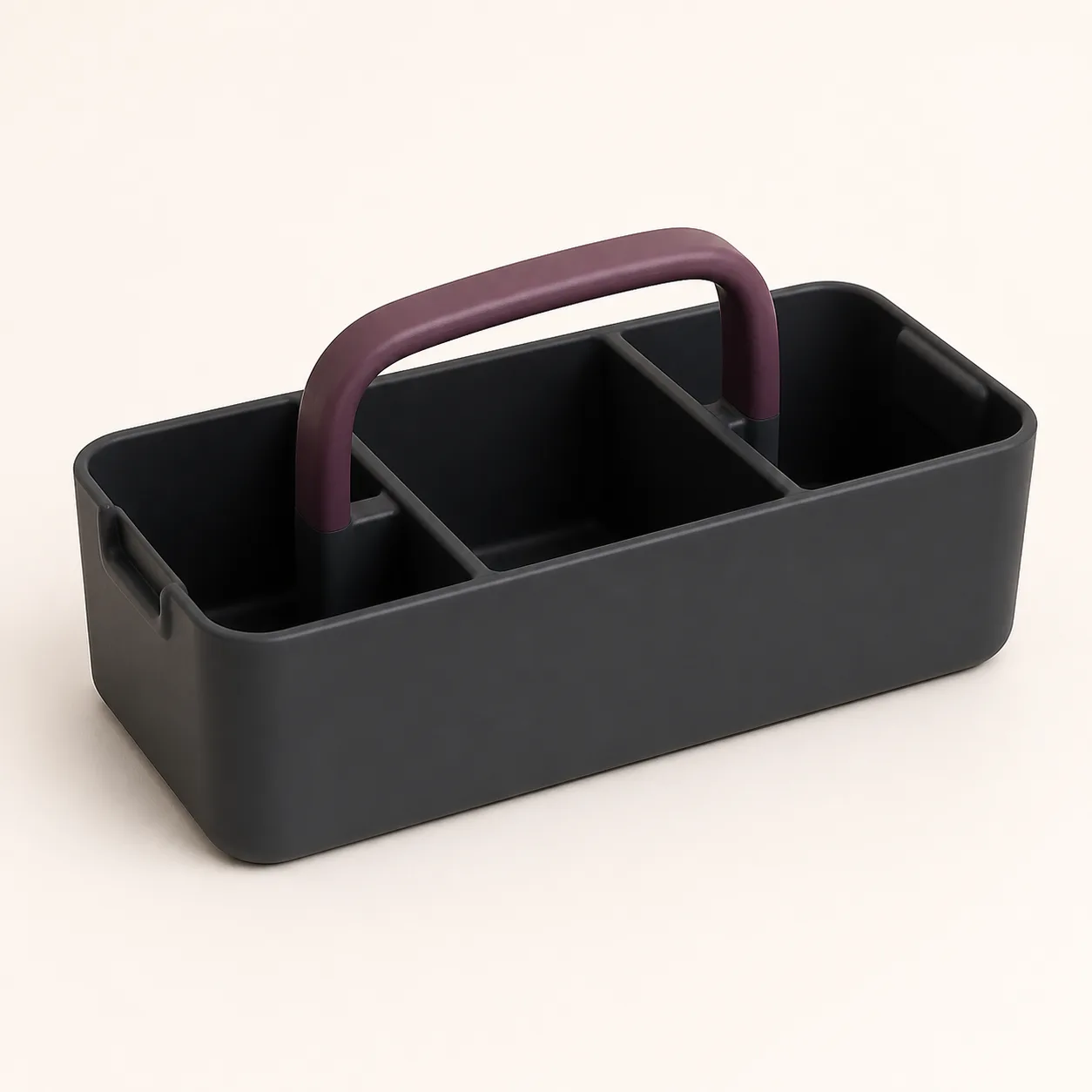
Three-Compartment Care-Cleaning Carry Caddy with Center Handle
A three-compartment carry-caddy concept for staging a small set of closed compatible supplies for one adult-care cleaning task.
14,99 $
200 in stock
A divided caddy can stage closed supplies for one cleaning task
This care cleaning carry caddy concept provides three opaque compartments around a central handle. It is planned for moving a small, preselected set of closed compatible cleaning supplies from controlled storage to a prepared adult-care washing station.

It is not a mixing vessel, waste container, wash basin, spill-control system or permanent chemical store.
Build the task inventory before assigning compartments
List the exact closed container, clean cloth, brush or other approved item required for one procedure. Exclude unrelated cleaners, open liquids, personal belongings and supplies for a different care stage.
Three spaces support organization only when each space has one documented purpose.
The rendering establishes no plastic type or carrying load
The charcoal body and plum handle are visual choices, not material specifications. The image does not confirm wall thickness, handle strength, chemical resistance, leak containment, impact behavior, load capacity or non-slip performance.
Use supplier documents and staged sample testing to define every limit.
Inspect the base, partitions and handle junctions
Check the empty caddy under bright light for cracks, sharp molding, stress whitening, bowed walls, rough seams, loose partitions and residue in corners. Examine where the handle meets the body and confirm no flex, gap or edge can trap a finger.
Withdraw the caddy if the base rocks or any joint changes during the approved hand check.
Resolve cleaning-product compatibility outside the caddy
Read every product label and safety document before selecting supplies. Keep substances that require separate storage, ventilation, temperature control or spill containment out of the same carry workflow.
A divider is not a chemical barrier and cannot make incompatible products safe together.
Keep every liquid in its original closed container
Confirm each cap, pump lock or closure is secure and the exterior is clean and dry. Do not decant, mix, dilute or carry an unidentified bottle in a compartment.
Place labels where the operator can verify identity without lifting several containers.
Load the base first and balance both sides
Set the caddy on a stable counter, place the heaviest approved item low and near the center, then distribute lighter items so the handle remains clear. Stay below confirmed compartment, handle and total-load limits.
Nothing should project into the hand opening or rise high enough to strike the wrist while walking.
Run a stationary lift trial before entering the route
Using the intended grip and footwear, lift the loaded sample only a short controlled distance over a clear test surface. Observe handle deflection, body twist, item movement and whether the load pulls the caddy off level.
Reduce the load or change the layout if the operator cannot keep the caddy stable without gripping the rim.
Clear the path and keep one hand free for doors
Plan the route around thresholds, rugs, wet floors, pets, people and narrow furniture gaps. Open doors before lifting when possible and never carry the caddy where the handle blocks vision of the floor.
Do not hold another object, phone or open container in the carrying hand.
Place the caddy on a fixed dry work surface
Lower it fully onto the designated counter before removing an item. Keep it away from the sink edge, heating equipment, floor, chair-transfer zone and any surface that cannot tolerate the selected cleaner.
Use one compartment at a time so closed reserve supplies remain separated from used tools.
Treat any leak as a stop event
If moisture, odor or residue appears, place the caddy down in the established response area and follow the product label and site spill procedure. Do not continue carrying, touch other compartments or wipe an unidentified liquid with a reusable care cloth.
The caddy’s walls do not establish containment or resistance to the leaking product.
Unload through the clean-to-used sequence
Move remaining closed clean supplies back to their approved zone before placing used washable tools in the assigned post-task container. Do not use an empty compartment as an improvised collection area unless that workflow has been separately validated.
Keeping transport stages distinct helps avoid carrying residue into storage.
Clean every compartment and handle surface
Empty the caddy completely and apply only the verified agent, cloth and contact time. Wipe the handle underside, divider edges, corners, recessed grips and exterior base, then rinse if the approved process requires it.
Do not immerse or machine-wash the caddy unless the production specification permits that method.
Dry corners and handle sockets before storage
Place the empty caddy in the confirmed orientation with airflow through all compartments and around the handle attachments. Inspect for retained moisture, tackiness, cracks, swelling, staining, odor or color transfer.
Store only after the complete dryness check, without closed containers left inside.
Sourcing needs handle-cycle and chemical-screening data
A Yiwu Xiyao Daily Use Products Factory portable cleaning-caddy listing shows USD 1.71-2.07 per piece with MOQ 1. That reference does not confirm this planned three-compartment layout, exact dimensions, materials, handle load, stability, leak behavior or cleaner compatibility.
The procurement reference supports inquiry only. The EUR 14.99 plan includes allowance for China-origin freight, edge and molding inspection, staged handle and load trials, compartment-balance checks, chemical-screening samples, cleaning tests, protective packing and discreet fulfillment; packed size, mass, freight, duty, tax, insurance, payment fees and destination terms remain pending.
Frequently asked questions
Can cleaners be mixed inside a compartment?
No. Never mix or dilute products in the caddy; follow each original label and use an approved vessel if required.
Does a divider separate incompatible chemicals?
No. Dividers organize space but do not provide chemical isolation or spill containment.
Can open bottles be carried?
No. The planned workflow is limited to identified original containers with confirmed closures.
May used tools go back beside clean supplies?
No. Keep clean, in-use and used stages separated through the documented workflow.
Can the caddy be left beside the sink?
Use only the designated stable dry surface and keep it outside splash and fall zones.
When should the caddy be withdrawn?
Withdraw it after cracks, sharpness, handle movement, bowed partitions, base rocking, staining, swelling, tackiness, color transfer or persistent odor.

Reviews
There are no reviews yet.