


Three-Compartment Care-Cleaning Carry Caddy with Center Handle
August 14, 2026
Frosted A6 Care-Log Pouch with Index Card Set
August 14, 2026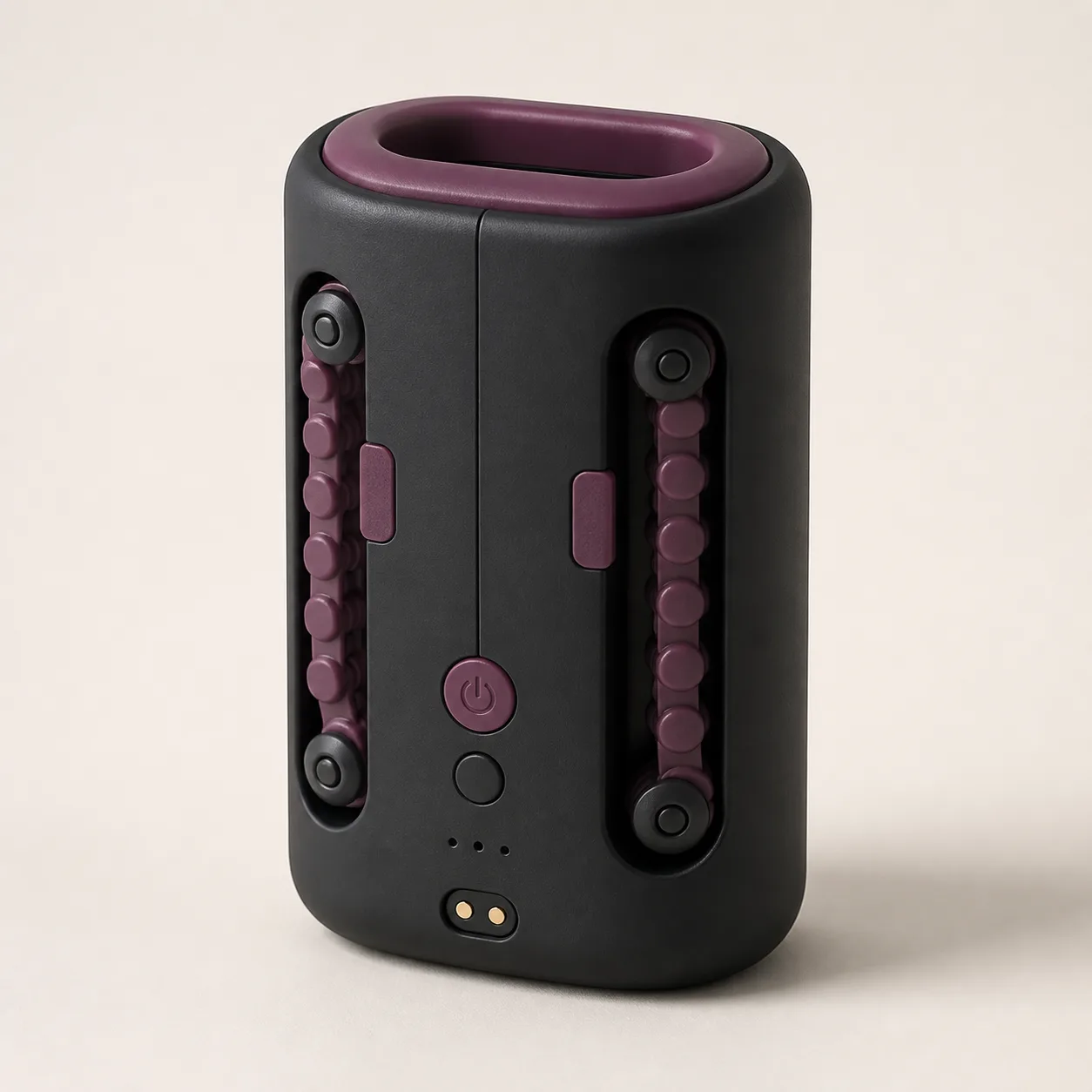
Alternating Twin-Belt Automatic Stroker with Split-Service Sleeve Cassette
An automatic stroker concept with two visible offset belt paths, a centered serviceable sleeve cassette and paired release tabs for separately testable drive behavior.
69,99 $
200 in stock
Two visible belt paths make alternating motion testable
This alternating belt automatic stroker concept places one loop drive on each side of a split-service shell. Offset lug positions provide a visual hypothesis for alternating motion, while a centered sleeve cassette and paired release tabs are intended to make drive engagement and maintenance separately auditable.

The image does not prove stroke length, phase, belt speed, actuator count, suction, heating, liner material, waterproofing, runtime or cleaning access.
Inventory both drive loops and the cassette interface
Request drawings and a bill of materials for the rim, liner, cassette frame, two belts, lugs, four rollers, axles, tensioners, guides, couplings, actuators, sensors, split shell, latches, tabs, controller, battery, buttons, indicators, contacts, pigments, seals, lubricants and adhesives.
Trace how each belt transfers movement to the cassette and identify every pinch guard and mechanical stop.
Measure the shell, pathway and belt geometry
Record body length, width and depth, opening dimensions, pathway depth, cassette clearance, belt pitch, lug spacing, roller diameter, axle spacing, window width, tab travel, control reach and mass.
Measure left and right belt datum positions before power is applied so phase drift can be detected later.
Characterize the left belt without averaging the pair
Use an optical encoder or high-speed video to log left-loop speed, direction, lug passage, startup, stop distance, reversal and position error at each confirmed program and charge level.
Measure belt tension and roller runout with the cassette unloaded, then under a small approved fixture load.
Characterize the right belt as its own drive path
Repeat the speed, direction, lug, reversal, tension and runout measurements on the opposite loop. Compare noise, current contribution and temperature near both rollers.
Reject belt wander, edge rub, missing lugs, roller stall or unexplained side-to-side differences.
Resolve phase, overlap and reversal timing
Synchronize both belt traces and document lead-lag time, overlap, cycle period, reversal interval and any program that moves both sides together. Repeat at full, middle and low indicated charge.
Alternating is a measurable timing relationship, not a marketing synonym for vibration or random motion.
Verify cassette seating before every powered test
Measure insertion force, latch depth, tab travel, audible or tactile confirmation, free play and resistance to false seating. Confirm the cassette cannot contact rollers or leave a belt partly engaged.
Power must remain disabled when the shell is open or the cassette is not fully locked.
Inspect the oval rim and internal pathway
Check the rim for smooth radii, secure bonding and a continuous transition into the liner. Use borescope views to inspect seams, folds, texture, cassette joints and the far end through its complete travel.
Confirm the pathway remains clear of belts, lugs, guides, axles and hard frame edges.
Map loaded travel with a standardized soft mandrel
Using compatible lubricant and a guarded test rig within supplier limits, measure actual travel, speed, movement force, reversal force, slip, sound and current under several low loads. Track left and right cassette displacement separately.
Stop for sudden resistance, exposed hard contact, liner twist, shell movement, belt knock or loss of synchronized control.
Log current and heat through a complete cycle
Run the highest verified program under approved compliant load and record battery current, controller response and temperature at both belts, all rollers, actuators, cassette frame, rim, shell, battery and charging contacts.
Define limits for continuous run time and cooldown only after repeated sample tests.
Audit controls, indicators and charging behavior
Document button functions, press duration, lockout, program order, speed steps, memory, indicator meanings, low-battery response, contact polarity, cable specification, charger input, charge time, runtime and operation during charging.
Keep the appliance off, closed and dry while charging unless exact-model instructions explicitly permit another state.
Test jam detection and safe stopping
On a guarded fixture, introduce small controlled resistance below confirmed limits to one side, then both. Measure detection time, stop distance, residual belt tension, alarm indication and restart requirements.
Verify that opening the shell, pressing either release tab or losing a sensor signal cannot leave a belt powered unexpectedly.
Remove the cassette for complete cleaning and drying
Confirm the exact power-off and release sequence, then inspect rim underside, liner, cassette frame, latch pockets, tab recesses and any shield between the wet zone and drive system. Belts, rollers, controller and battery should remain outside the cleaning path unless expressly designed otherwise.
Use only the verified cleaner and water exposure. Dry the cassette and all shell recesses fully before reassembly.
Cycle the drive, latches and materials as one system
Run repeated startup, alternating, reversal, low-load, jam-stop, cassette removal and latch cycles. At planned checkpoints inspect belts, lugs, rollers, axles, guides, guards, liner, rim, frame, latches, tabs, seams, buttons and contacts; track phase, speed, force, current, heat, wear and residue.
Obtain exact material, restricted-substance, skin-contact, electrical and battery evidence. Silicone, TPE, body-safe, medical-grade, hypoallergenic, phthalate-free, quiet and waterproof claims remain pending until supported.
Price two drive paths after jam and freight checks
An Alibaba automatic male stroker listing currently shows USD 17.23-18.49 with an MOQ of one piece. It is a category benchmark only and does not confirm this alternating twin-belt drive, service cassette or an approved supplier.
The procurement reference supports an EUR 69.99 planning price after allowing for China-origin freight, exact-part inventory, per-belt speed and tension maps, phase analysis, cassette seating tests, loaded travel measurement, current and thermal review, jam response, complete drive and latch cycling, materials and battery documentation, cleaning validation, protective packing and discreet fulfillment. Exact quotation, packed dimensions, weight, freight, duty, tax, insurance, payment fees and delivery terms remain pending.
Frequently asked questions
Do the belts move in opposite directions?
Direction and phase remain unconfirmed until synchronized measurements are completed on production samples.
Is the internal sleeve removable?
A service cassette is represented, but final removal steps, wet-zone separation and replacement availability require confirmation.
Does the device create suction?
No suction function is confirmed; pressure and airflow must be measured before any such claim is used.
Can it be used while charging?
Only if exact instructions explicitly permit it; otherwise keep it off, closed and dry during charging.
What happens if one belt stalls?
The controller should stop safely, but detection time, stop distance, indication and restart behavior need guarded testing.
Which faults require retirement?
A cracked shell, torn liner, false-seating cassette, damaged lug, wandering belt, seized roller, failed guard, intermittent control, unusual heat, battery swelling, corrosion or moisture in the drive bay.
Reviews
There are no reviews yet.