


Adjustable Waist-and-Thigh Strap-On Harness
August 14, 2026
Remote Low-Profile Ride-On Massage Cushion
August 14, 2026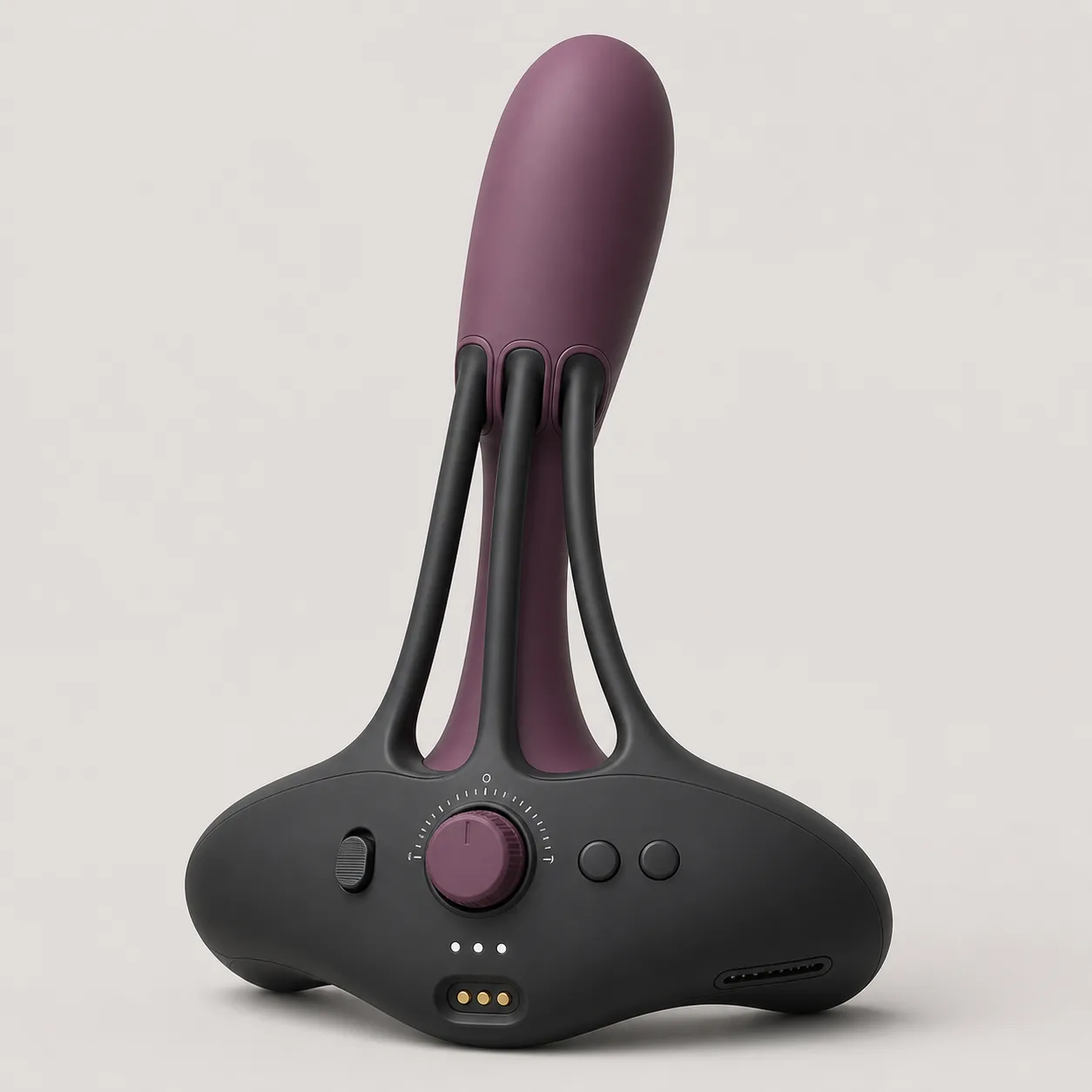
Three-Beam Parallel-Flex Prostate Vibrator with Wide Preload Base
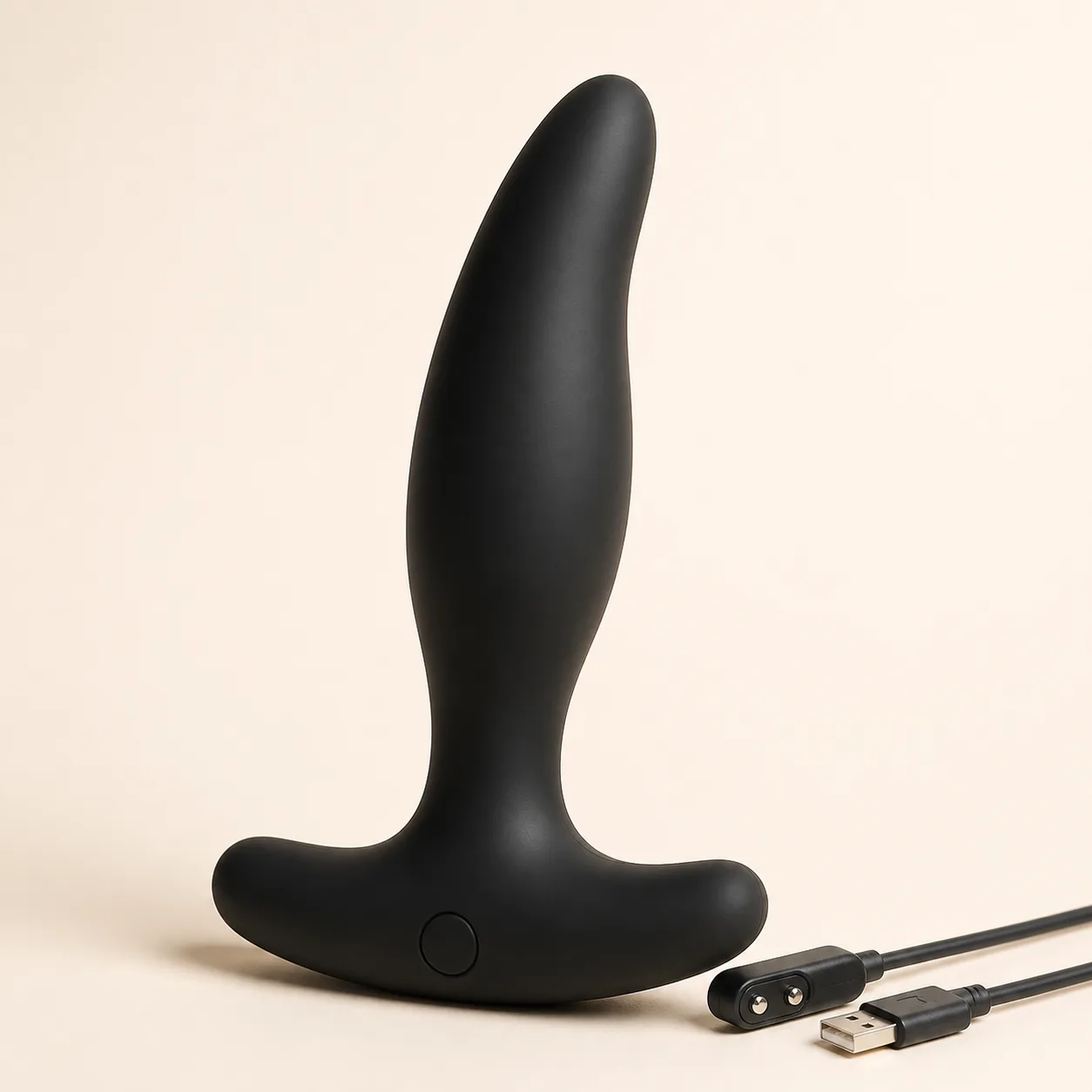
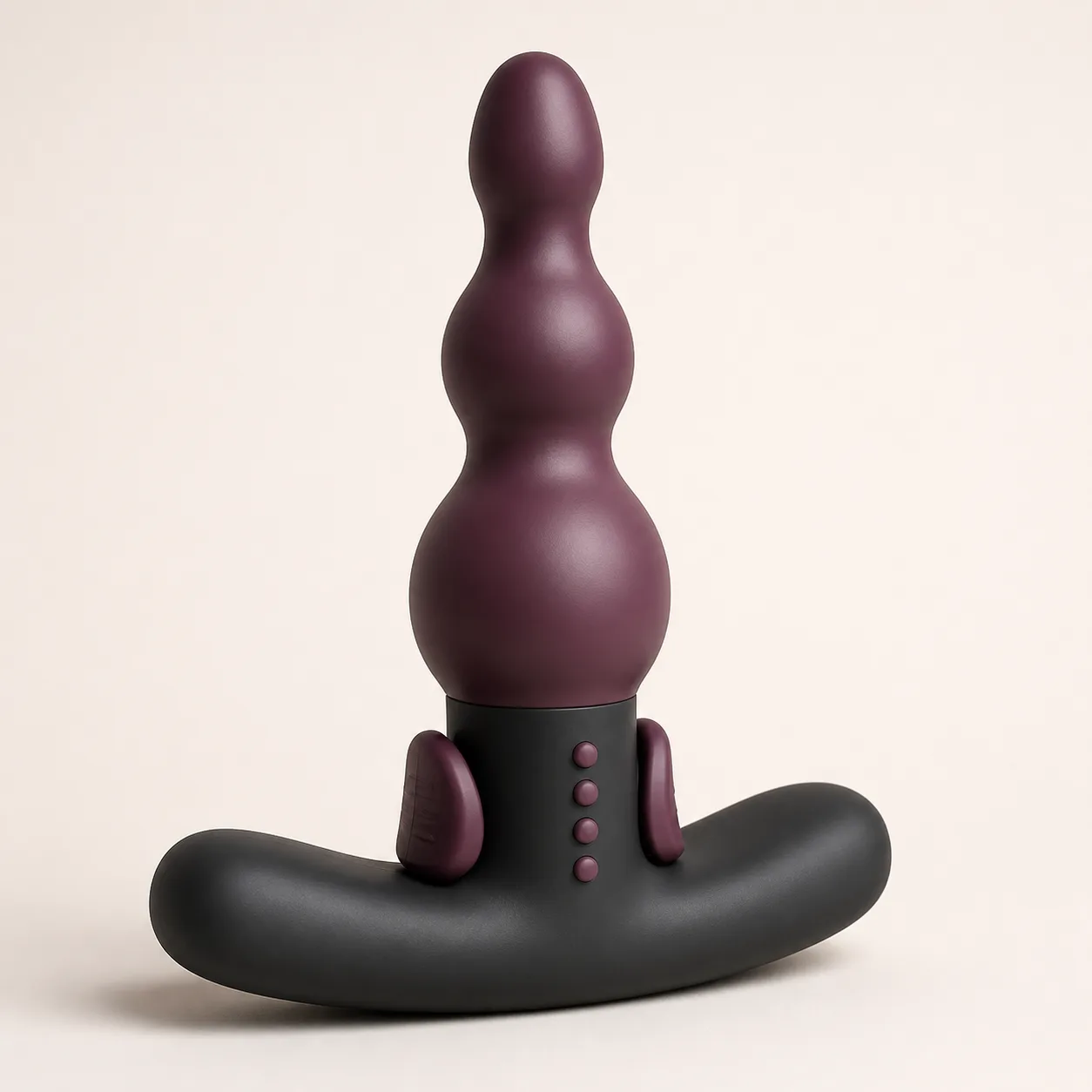
A rechargeable curved prostate vibrator concept supported by three external compliant beams above a wide retrieval base with lockable preload control.
54,99 $
200 in stock
Support one curved head on three flex beams
This three-beam parallel-flex prostate vibrator concept uses exactly three separated charcoal beams to support a smooth curved plum head above an exceptionally wide crescent retrieval base. A three-stop preload dial and separate lock tab are intended to adjust the compliant support response while the central neck maintains the visible body profile.

The image does not prove insertable dimensions, beam stiffness, preload control, head travel, output, base retention, material composition, sealing, charging safety or production availability.
Inventory all three load and vibration paths
Request an exploded bill of materials for tip skin, head carrier, central neck, beams B1 through B3, upper and lower anchors, guarded slots, internal reinforcement, actuator, moving mass, conductors, wide base shell, preload dial, three detents, linkage, hard stops, lock tab, two buttons, indicators, controller, cell, charging contacts, vent membrane, seals, pigments, lubricants and adhesives.
Link every part and junction to drawing revision, tolerance, batch and approved reference sample.
Measure insertable and external dimensions
Record total height, maximum intended insertable length, head axes, tip radius, body diameter by station, neck minimum section, beam projection, base span and thickness, dial and control positions, mass and center of gravity.
Publish a dimensioned drawing only after several conditioned samples are measured and the insertable boundary is explicitly identified.
Characterize the curved head and central neck
Capture the head centerline, curvature, cross-section ovality, taper, surface smoothness and transition into the neck. Measure skin hardness, compression, recovery, friction, seam position and local thickness.
Inspect for flash, voids, hard inclusions, thin regions, exposed carrier edges, neck whitening and pigment transfer.
Measure every beam independently
For B1 through B3, record free length, section, curvature, anchor position, axial stiffness, lateral stiffness, torsion, hysteresis, rebound and permanent set. Repeat in both principal bending directions and after controlled cleaning exposure.
Keep beam identities throughout all tests; apparent parallelism does not establish matched stiffness or fatigue life.
Inspect guarded slots anchors and clearances
Measure beam-to-slot, beam-to-neck, beam-to-base and beam-to-head clearance at neutral, preload extremes, centered force, offset force and powered operation. Use articulated probes and soft-film screening.
Reject an exposed anchor, sharp slot lip, beam rub, hair or film trap, internal hard contact or recess that cannot be cleaned and dried by the validated method.
Calibrate the three-stop preload dial
Measure dial angle, detent torque, backlash, hysteresis and its effect on beam load, head neutral position and small-force stiffness at all three marks. Approach every stop from both directions.
A position between detents must not create asymmetric beam loading, unexpected head shift or a false stable state.
Verify the lock tab and hard stops
Record tab travel, engagement depth, actuation force and resistance to accidental contact. Apply bounded head force, beam torsion and powered vibration while locked, then remeasure dial position and individual beam loads.
Confirm that the lock remains accessible outside the intended insertable boundary and that stops cannot be bypassed by off-axis force.
Map head displacement pressure and recovery
Use optical tracking and an instrumented compliant fixture to measure head translation, pitch, roll, contact area and peak pressure under centered, lateral and swept forces. Repeat at every verified preload stop.
Reject unstable snap-through, one-beam dominance, hard carrier pressure, head travel beyond the verified envelope, neck buckling or dial creep.
Map vibration across head beams and base
Measure three-axis acceleration, displacement, frequency, harmonics, rise and decay at the head center and edge, all three beams, neck, dial, base and controls. Test each program under no load and representative compliant loads.
Compare preload stops for output loss, phase change, beam resonance, base transfer, chatter and asymmetric heating.
Verify wide-base retrieval retention
Measure base span, center shield, thickness, edge radii, stiffness and deflection under centered and asymmetric low loads. Confirm that it remains substantially wider than the insertable body in every allowed orientation.
Inspect the beam roots, dial, lock, controls, contacts and vent while the base is flexed; no component should compromise the intended stopping geometry.
Verify controls charging power loss and shutdown
Document every button action, indicator pattern, lockout, charging polarity, specified lead, input limit, cell chemistry and capacity, protection circuits, charge time, runtime, low-voltage behavior and operation-during-charge interlock.
Interrupt power in every program and preload state and confirm a predictable off condition. Ingress claims remain pending until beam slots, neck, dial, buttons, contacts and vent pass appropriate tests.
Log current sound and temperature
Measure operating current, accessible temperature, actuator, beam root, controller and cell hot spots and A-weighted sound at a stated distance for every program and representative preload stop. Repeat with maximum approved head load, one protected beam restrained and low battery.
Investigate current spikes, beam chatter, neck resonance, dial drift, asymmetric heat, surface change or intermittent indicators.
Challenge one-beam faults then cycle and clean
In protected specimens, soften, stiffen or restrain one beam at a time while monitoring head pose, adjacent loads, pressure, vibration, current, heat, sound and shutdown. Stop before damage and quarantine units with anchor migration, slot contact or uncontrolled bending.
Cycle preload selection, locking, beam flex, output programs, controlled loading, charging, defined cleaning, measured drying and storage. Recheck dimensions, head surface, three beam curves, anchors, gaps, dial, lock, pressure, output, base geometry, controls, contacts and heat.
Build landed price after three-beam proof
An Alibaba silicone-prostate-massager page currently shows a rechargeable category example at USD 5.50-5.90 with MOQ four. It is a benchmark only and does not confirm this three-beam compliant structure, preload dial, wide base or an approved supplier.
The procurement reference supports an EUR 54.99 planning price after allowing for China-origin freight, exact-model sourcing, insertable profile and three-beam metrology, preload and lock calibration, displacement, pressure and vibration mapping, gap and base-retention review, electrical, current, sound and heat tests, protected fault and cycle work, protective packing and discreet fulfillment. Exact quotation, MOQ, materials, battery, packed size, weight, freight, duty, tax, insurance, payment fees, certifications and delivery terms remain pending.
Frequently asked questions
Do the three beams bend equally?
That cannot be assumed; B1 through B3 need separate stiffness, torsion, hysteresis and fatigue measurements.
What does the preload dial change?
It is intended to alter the support response at three stops, subject to measured beam load, head pose and stability.
Is this a beginner size?
No size level can be assigned until insertable length, head axes, taper, pressure and instructions are confirmed.
Can the beam slots pinch hair or film?
Every slot and moving gap needs articulated-probe and soft-film checks across flex, preload, vibration and wear.
Is the device waterproof?
No ingress claim is confirmed; beam slots, neck, dial, buttons, contacts and vent require evidence.
Which faults require retirement?
Cracked or permanently bent beams, anchor migration, slot rubbing, neck damage, unstable head movement, dial drift, failed locking, exposed contacts, abnormal heat, cell swelling or persistent residue.
Reviews
There are no reviews yet.