


Washable Tuck-In Wing Care-Surface Protector
August 14, 2026
Collapsible Care-Washing Zone Marker Cones, 3-Pack
August 14, 2026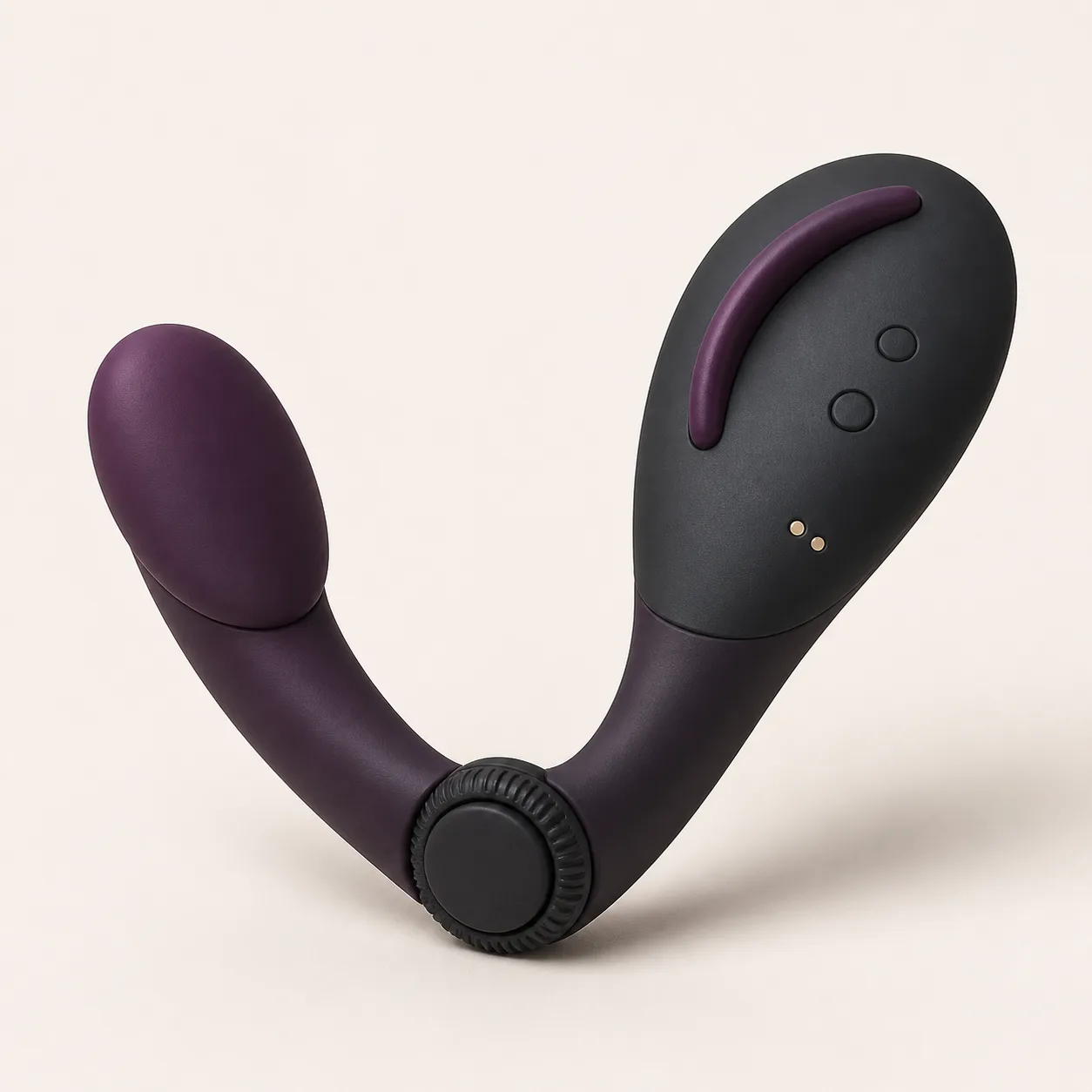
Ratcheting-Pivot Strapless Couples Vibrator with Asymmetric Heads
An asymmetric strapless couples vibrator concept with two short contact arms, a multi-position central ratcheting pivot, local controls and magnetic charging.
39,99 $
200 in stock
A mechanical pivot replaces an always-flexing center
This ratcheting strapless couples vibrator concept uses two short asymmetric arms joined by a visible charcoal pivot. One arm ends in a compact plum oval head; the other carries a larger charcoal teardrop head with a raised plum crescent, two local buttons and magnetic-charge contacts.

The visual defines the proposed geometry only and does not verify fit, insertable limits, hinge strength, materials, motor count, water resistance or shared-contact safety.
Count every repeatable pivot position
Move the clean dry sample through its complete arc before power is applied. Record each stable detent, the included arm angle and both mechanical endpoints with a calibrated angle gauge.
Decorative ridges around the pivot do not prove the number of usable settings.
Measure holding torque after cycle wear
Apply a controlled opening and closing load at both heads while the hinge rests in each detent. Repeat after a documented number of adjustment cycles to identify progressive loosening, skipped positions or sudden release.
An angle that cannot hold the qualification load must be excluded from the fit guide.
Inspect the hinge for pinch and residue gaps
Check the entire pivot perimeter at every angle for closing gaps, sharp ridges, exposed hardware, lubricant migration and recesses that cannot be reached during cleaning. Measure minimum clearance with non-damaging gauges.
Adjust the pivot only while the device is away from the body, powered off and dry.
Map the compact oval head independently
Record length, width, thickness, edge radius, usable contact area and distance from the pivot. Define its planned role and maximum insertable boundary only after exact-sample measurement.
The smaller head must not inherit dimensions or fit claims from the larger external assembly.
Measure the teardrop head and crescent ridge
Record overall footprint, thickness, ridge height, arc length, button position, charge-contact recess and pivot distance. Inspect the ridge bond and perimeter seam under angled light.
A raised ridge can concentrate contact pressure, so its geometry and force envelope belong in the product specification.
Build a fit chart without promising universal wear
Use soft fixtures to compare arm spacing, head alignment and pressure across every verified detent. Document which angles remain stable during gentle movement and whether either head rolls away from its intended position.
No strapless design fits every anatomy, posture or activity; discomfort, numbness, pinching or unexpected movement means stop.
Keep shared-contact hygiene explicit
Identify which surfaces may contact each partner or body area, use new compatible barriers when needed and clean the full device before reassignment. Do not move a surface between people or body areas without a fresh barrier and verified hygiene step.
Lubricant and barrier compatibility remain pending until all contact materials are confirmed.
Map both local buttons in every state
Document short press, long press and two-button actions from off, active, locked and low-battery states. Verify whether each button controls one head, both heads, intensity or pattern selection.
The complete device must power down through a simple local action without a phone or remote.
Separate head output before combined testing
Mount the two heads on matched soft fixtures and log vibration amplitude, frequency, pattern timing, noise and latency one side at a time. Then repeat every permitted combined state and pivot angle.
Independent motors and channels are not assumed until measured behavior proves them.
Verify shutdown after hinge movement. Operate at a low setting on a fixture, change the pivot only by the documented safe procedure and confirm that no button is pressed or command triggered by the moving arms. Test power-off at both endpoint angles.
A jammed control, unexpected restart or delayed stop disqualifies the sample.
Track battery drain across asymmetric loads
Measure runtime for the compact head alone, larger head alone and highest approved combined mode. Record low-battery indication, output reduction and shutdown across repeated charge cycles.
Battery chemistry, capacity, enclosure and protection circuits require supplier documents and inspection.
Qualify magnetic charging away from the pivot
Confirm input rating, polarity, alignment, cable retention, indication and completion time on a dry nonflammable surface. Inspect whether the open and closed arm positions strain the contacts or obstruct the charger.
Disconnect all charging equipment before operation, angle adjustment or cleaning.
Log heat at both heads, hinge and battery
Measure temperature at the compact head, crescent ridge, larger shell, both arms, pivot, buttons, battery region and contacts at fixed intervals. Repeat after the battery has aged through controlled cycles.
Stop after abnormal odor, swelling, unstable output, hinge noise, delayed controls or temperature beyond the documented limit.
Clean moving interfaces within verified ingress limits
Power off, disconnect charging equipment and follow the confirmed mild-cleaning method. Wipe both heads, arms and controls, then move the dry pivot through every approved detent to expose accessible shoulders without flooding the mechanism.
Dry seams, hinge gaps and contacts completely before storage; no immersion, boiling, bleach, alcohol, abrasives or dishwasher use is approved without exact-model evidence.
Price the hinge as a tested fit mechanism
An Alibaba product introduction lists a wireless U-shaped couples vibrator at USD 8.24-8.72 depending on quantity, with the first shown tier covering 5-99 pieces. It does not establish a ratcheting pivot or this asymmetric-head layout, so supplier identity, exact model match and quotation remain pending.
The procurement reference supports an EUR 39.99 plan after allowing for China-origin freight, detent and torque mapping, pivot-cycle and pinch-gap checks, head geometry and fit trials, hygiene, controls, output, battery, charging, temperature and ingress review, cleaning validation, protective packing and discreet fulfillment. Packed size, weight, freight, duty, tax, insurance, payment fees and destination terms require confirmation.
Frequently asked questions
How many pivot angles are available?
The exact count must be measured on the production sample; pivot ridges are not proof.
Can the angle be changed while worn?
No; power off, remove the device and adjust the dry hinge away from the body.
Do both heads have separate motors?
Independent motors or channels are not assumed until output mapping confirms them.
Is the smaller head insertable?
Its intended role and maximum boundary require exact dimensions and supplier instructions.
Can the product be immersed?
Not without exact-revision evidence covering the hinge, buttons, seams and charge contacts.
Which faults disqualify the device?
Pivot slip, pinch gaps, cracked arms, loose ridge, unstable fit, delayed shutdown, battery swelling, excessive heat, seal damage, trapped residue or unexpected activation.
Reviews
There are no reviews yet.