



WINGPOW BD03-13 Pressure-Sensitive Wand: Five Colours
August 14, 2026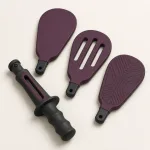
Cross-Pin Three-Panel Sensory Paddle with Flex-Limit Spine
August 14, 2026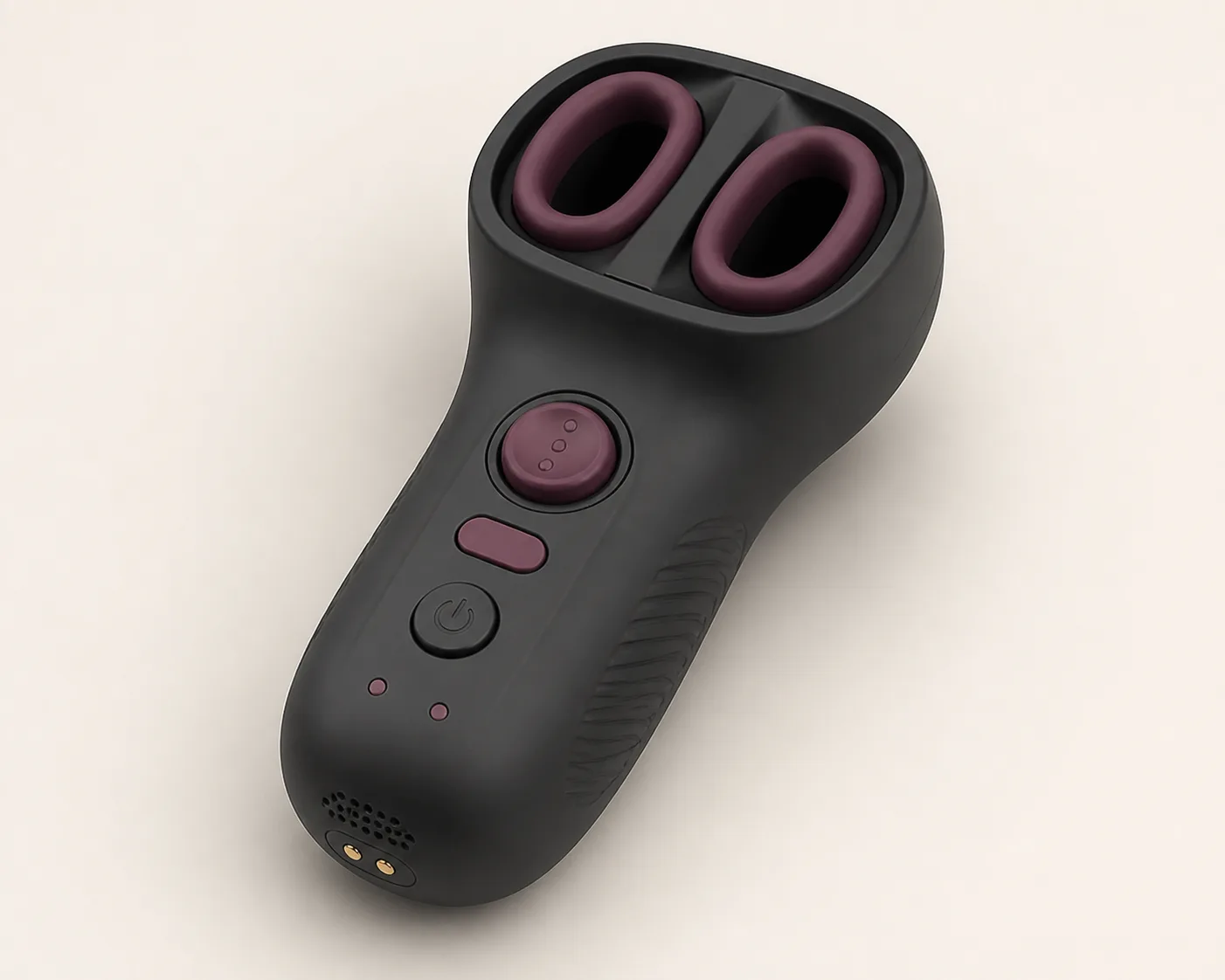
Twin-Aperture Differential Air-Pulse Massager with Flow-Balance Dial
A rechargeable external massager concept with two separately rimmed oval air-pulse apertures, a raised divider, three-stop flow-balance dial and immediate vent control.
58,99 $
200 in stock
Place two apertures on one compact head
This twin-aperture differential air-pulse massager concept presents one smaller and one larger oval opening side by side. Thick plum rolled rims and guarded moats isolate both chambers, while a raised center divider and three-stop flow-balance dial create distinct measurement questions.

The image does not establish pump count, airflow, pressure, pulse waveform, fit, material, sealing or manufacturing availability.
Inventory both pneumatic channels
Require a bill of materials for rims A and B, cup walls, chambers, membranes, valves, ducts, manifolds, filters, pump or pumps, motor, isolation mounts, divider, moats, balance mechanism, dial, detents, emergency vent, controller, cell, buttons, indicators, rear inlet, contacts, seals, shell, coatings, pigments, lubricants and adhesives.
Trace any shared manifold before calling the two apertures independent.
Measure aperture chamber and divider geometry
Record major and minor axes, rolled-rim thickness, opening area, chamber depth and volume, cup-wall thickness, moat width, divider height, head angle, dial recess, inlet area, grip dimensions, mass and balance. Use A/B identifiers throughout.
Repeat after bounded pressure cycling, cleaning, charging and storage to reveal rim or membrane drift.
Characterize both rolled rims and chambers
Measure hardness, compression, recovery, friction, edge blend, seal compliance and deformation for each rim. Inspect chamber surfaces, membrane seats and seams for flash, voids, thin zones, hard inclusions, tack, pigment transfer and trapped residue.
Compare the smaller and larger aperture without assuming that either corresponds to a particular fit.
Measure airflow pressure and pulse waveform
Use calibrated pressure and flow instruments to record static offset, peak positive and negative pressure, differential pressure, flow rate, pulse frequency, duty cycle, rise, decay and leakage at both chambers for every confirmed program.
Repeat open, sealed to standardized fixtures and with controlled leakage; state tubing volume and sensor response.
Identify pump valve and manifold allocation
Teardown must establish pump count, motor type, membrane or piston geometry, valve orientation, duct routing, shared volume and balance-dial linkage. Instrument both chambers simultaneously.
Two openings do not prove two pumps, and two indicators do not prove isolated pressure channels.
Resolve differential timing and cross-coupling
Synchronize chamber traces to measure command latency, phase, beat patterns, flow diversion, pressure drift and cross-talk across programs, dial states, battery level and temperature. Test one chamber open while the other is sealed.
Reject a state in which blocking one aperture drives the other beyond its accepted pressure envelope.
Calibrate the three-stop flow-balance dial
Record dial angle, detent force, backlash, indication and actual A/B pressure and flow at each stop approached from both directions. Repeat under symmetric and asymmetric chamber leakage.
Reject false seating, setting drift or a stop that changes total pressure without an obvious user cue.
Verify immediate venting and shutdown
Measure vent-button force, travel, recognition, time to ambient pressure, pump shutdown and reset from every mode and dial state. Confirm operation during low voltage, blocked inlet and one sealed aperture.
The fastest local pressure release must remain clear, reachable and independent of stepping through stronger modes.
Map contact pressure and rim capture
Use compliant fixtures to measure rim contact area, seal pressure, edge load, divider approach and head-shell contact at both apertures. Vary alignment and applied hand force within a bounded range.
Reject sharp rim collapse, hard divider contact, excessive capture, delayed venting or a seal that cannot be released promptly.
Screen separator moats and cleaning access
Probe the center divider, rim bases, moat valleys, chamber seams, dial recess, vent path, rear inlet and shell joints for pinch, residue and inaccessible moisture zones. Verify that both chambers can be inspected after cleaning.
Filters, valves and internal ducts require supplier-defined service limits; do not flood unverified pneumatic paths.
Verify controls grip and unintended activation
Document startup, levels, confirmed pulse patterns, dial rules, pause, immediate vent, stop, memory and travel lock. Measure button force, recognition, grip transfer and accidental activation in dry and damp handling tests.
Controls must remain distinguishable by location and action without relying on color alone.
Verify battery charging and ingress boundaries
Confirm cell chemistry, capacity, specified input, charge time, runtime, contact polarity, protection circuits, charge indication and charging interlock. Inspect pump-current peaks and conductor routing near pneumatic parts.
Map rims, chamber seams, balance dial, controls, vent path, rear inlet, shell seam and contacts. No water-resistance claim is accepted without exact-model evidence.
Log current sound heat faults and cycles
Measure current, A-weighted sound and temperatures at chambers, pump, valves, manifold, controller, cell, grip, inlet and contacts. Challenge a blocked inlet, obstructed chamber, stuck valve, dial mismatch, low voltage and power interruption in protected fixtures.
Cycle pressure, dial changes, venting, charging, approved cleaning, measured drying and storage. Retire for torn rims, membrane drift, valve sticking, pressure instability, dial drift, delayed venting, cracks, exposed contacts, abnormal heat, cell swelling or persistent residue.
Build landed price after pneumatic proof
An Alibaba dual-head-massager reference showed a 2-in-1 category example at USD 7.86-8.90 with MOQ two when recorded on 2026-08-06. It is a benchmark only and does not confirm this twin-aperture differential pneumatic design or an approved supplier.
The procurement reference supports an EUR 58.99 planning price after allowing for China-origin freight, exact-sample sourcing, aperture and chamber metrology, pneumatic teardown, synchronized pressure and flow mapping, dial and vent calibration, contact and cleaning review, charging, current, sound, heat, faults and cycle work, protective packing and discreet fulfillment. Exact quotation, MOQ, materials, battery, packed size, weight, freight, duty, tax, insurance, payment fees, certifications and delivery terms remain pending.
Frequently asked questions
Do the apertures use separate pumps?
Pump count, valves and manifold routing require teardown; two openings do not establish independent channels.
What does the balance dial change?
Actual pressure, airflow and phase at A and B for every stop remain pending calibration.
How fast does the vent release pressure?
Time to ambient pressure must be measured for all programs, dial states and fault conditions.
Can both apertures be used together?
Simultaneous pressure, cross-coupling, alignment and safe-contact boundaries require exact-sample testing.
Is the unit waterproof?
No ingress claim is confirmed for rims, chambers, dial, vent path, inlet, seams or contacts.
Which defects require retirement?
Torn rims, membrane or valve drift, unstable pressure, delayed venting, dial movement, cracks, heat, swelling or residue.
Reviews
There are no reviews yet.