


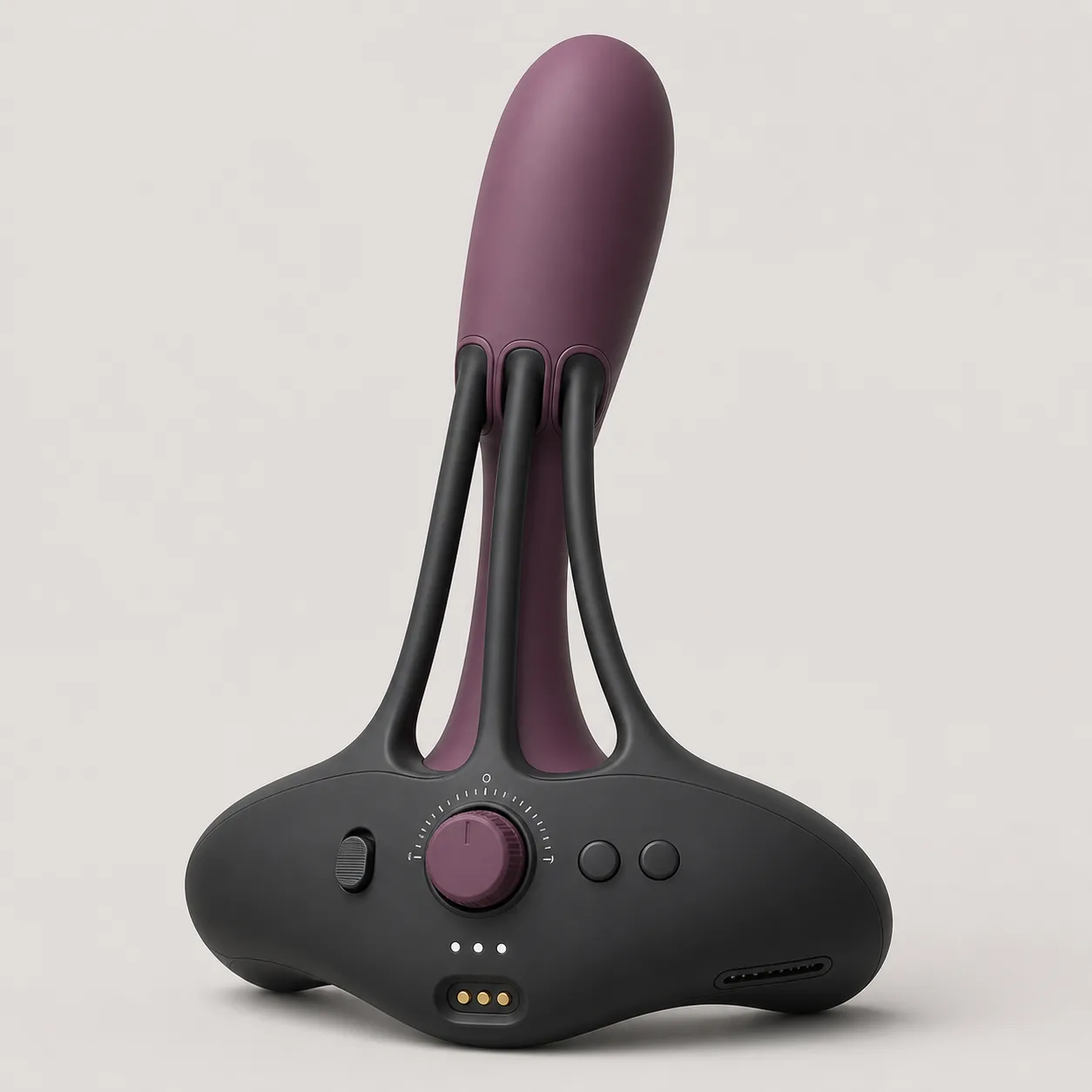
Twin-Aperture Differential Air-Pulse Massager with Flow-Balance Dial
August 14, 2026
Three-Shelf Hanging Closet Care-Supply Organizer
August 14, 2026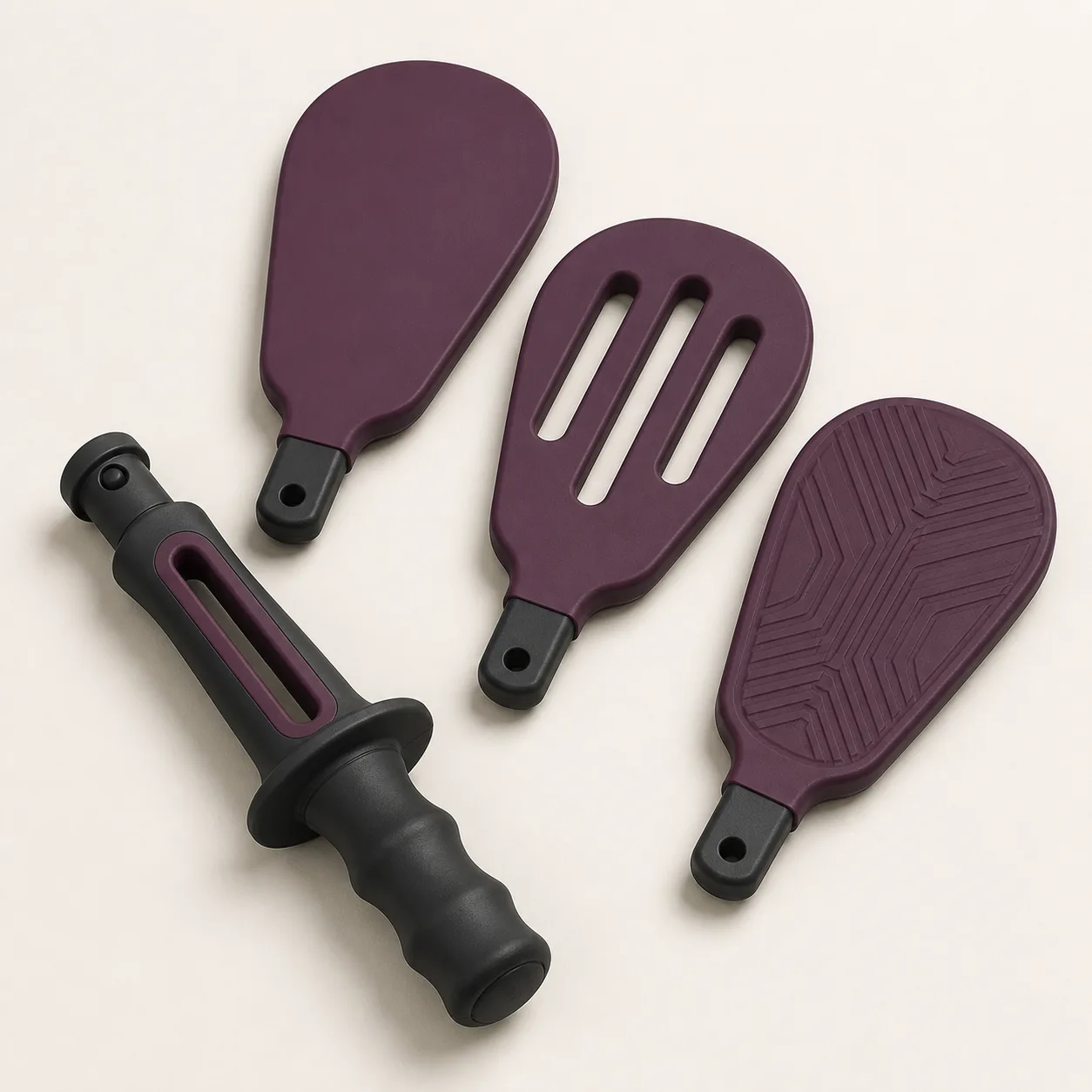
Cross-Pin Three-Panel Sensory Paddle with Flex-Limit Spine
A modular sensory impact paddle concept with one guarded flex-window handle and three cross-pinned interchangeable panels in solid, slotted and raised-rib profiles.
34,99 $
200 in stock
One guarded handle accepts three distinct paddle panels
This interchangeable sensory paddle concept pairs a charcoal contoured grip and deep-plum flex-limit spine with three removable rounded panels: solid, three-slot and shallow raised-rib. A shared coupling tongue and removable cross-pin secure one panel at a time.

The modular format creates useful comparison points, but it also makes coupling security and panel-specific impact testing essential.
Verify the complete four-piece system and retainer
Inventory the guarded handle, solid panel, slotted panel, raised-rib panel and cross-pin before use. Ask the supplier to identify any hidden bushing, spring, magnet, clip, adhesive, stiffener or reinforcement inside the spine and tongues.
A missing pin or mixed coupling revision must quarantine the whole set.
Measure mass, balance and contact geometry
Record handle length, grip circumference, guard diameter, spine width, flex-window length and total mass. For each panel, measure face area, thickness, edge radius, tongue projection, coupling-hole diameter, mass and assembled balance point.
Identical outlines do not guarantee identical swing behavior.
Map tongue seating before inserting the cross-pin
Slide each clean dry tongue into the handle socket to a measured hard stop. Check lateral play, shoulder flushness, insertion force and alignment of both pin holes under bright angled light.
The retaining pin must never be used to force a partly seated tongue into position.
Test cross-pin retention in every orientation
Insert the rounded pin through the aligned joint and confirm its documented locking feature. On a padded fixture, apply controlled axial pull, side load and twist below written supplier limits, then recheck pin migration and panel wobble.
Any pin that backs out, deforms or becomes tool-dependent fails the assembly.
Use the spine window as a measurable flex boundary
Clamp only the grip in a test fixture and apply increasing panel load within a documented range. Record deflection, recovery, contact with the window stop and permanent set for every interchangeable head.
The visible opening is not proof of a safe flex limit; qualification data must establish one.
Inspect every panel edge and surface transition
Pass a soft swab around the solid perimeter, all six slot edges, raised-rib intersections, tongue shoulders and molded seams. Look for burrs, voids, cracking, sharp texture peaks and uneven finishing.
Rounded artwork cannot substitute for physical edge inspection.
Compare the three panels on an instrumented target
Use the same calibrated fixture, travel arc and low test energy to compare peak force, contact duration, rebound, sound and face deformation. Record results separately rather than ranking panels by appearance.
The smooth face, vented face and ribbed face may distribute load differently even at the same swing speed.
Confirm the grip and guard support controlled handling
Measure dry and damp grip friction, rotation under light torque and clearance between the hand and guard. Practice pickup, panel alignment and immediate stopping without swinging near another person.
Retire a handle that twists inside the grip covering, exposes a hard edge or lets the hand slide past the guard.
Start with communication and a low test range
Establish explicit adult consent, boundaries, a clear stop word and a nonverbal stop signal before any activity. Begin with low-intensity external testing on an agreed lower-risk area and increase only through active feedback.
Stop immediately for unexpected pain, numbness, dizziness, breathing difficulty, broken skin or withdrawn consent.
Keep vulnerable anatomy outside the target plan
Do not strike the head, face, front or sides of the neck, spine, joints, kidneys, abdomen, chest, genitals, broken skin or any area with reduced sensation. Avoid use when judgment or communication is impaired.
This product page is not medical or impact-play training; users need competent instruction appropriate to their health and experience.
Change panels only during a complete pause
Place the handle down, end all motion, confirm both participants are ready and separate the product from the body before removing the pin. Inspect the next tongue and reassemble from the start.
Never swap a panel mid-swing, use a loose pin as a prop or operate the bare spine without an approved head.
Confirm materials and cleaner compatibility
Request composition for grip, guard, spine, socket, all panels, pigments, cross-pin, internal bushings and adhesives. Review hardness, restricted-substance and skin-contact evidence for the exact production revision.
Do not infer washability, porosity or disinfectant tolerance from color or texture.
Clean, dry and inspect the joint as separate parts
Disassemble the panel and follow verified mild-cleaning instructions for every surface. Use a soft swab around slot interiors, ribs, the tongue, socket floor, flex window and pin hole, then dry completely before reassembly.
No soaking, boiling, dishwasher, bleach, alcohol or abrasive scrubbing is approved without exact material evidence.
Plan price from a conventional paddle benchmark
An Alibaba showroom lists a luxury silicone BDSM paddle at USD 5.00-7.50 with a three-piece minimum. It is a category benchmark only and does not establish this modular cross-pin system, a legal supplier or a production quotation.
The procurement reference supports an EUR 34.99 planning price after allowing for China-origin freight, exact-model quotation, complete-part inventory, dimension and balance mapping, tongue and cross-pin retention, flex-cycle testing, edge inspection, instrumented panel comparison, material and cleaning review, protective packing and discreet fulfillment. Packed size, weight, freight, duty, tax, insurance, payment fees and destination terms require confirmation.
Frequently asked questions
Are all three panels used at once?
No. The concept accepts one fully seated and cross-pinned panel at a time.
Does the slotted panel guarantee a lighter sensation?
No. Each panel needs instrumented comparison because mass, flex, speed and contact geometry all affect response.
Can the cross-pin replace an incomplete fit?
No. Tongue shoulders and pin holes must align at the measured seating stop before the pin is inserted.
When should a panel be changed?
Only during a complete pause, away from the body, after inspecting the next coupling tongue.
Is the flex window a certified force limiter?
Not without fixture data. Deflection, stop contact, recovery and permanent set remain pending.
Which faults require retirement?
A migrating pin, cracked tongue, loose socket, permanent spine bend, sharp slot edge, lifted rib, twisting grip or damaged guard.
Reviews
There are no reviews yet.