


Cushioned Care-Preparation Lap Tray with Raised Edge
August 14, 2026
Three-Position Sliding-Fin Curved Vibrator with Dual Channels
August 14, 2026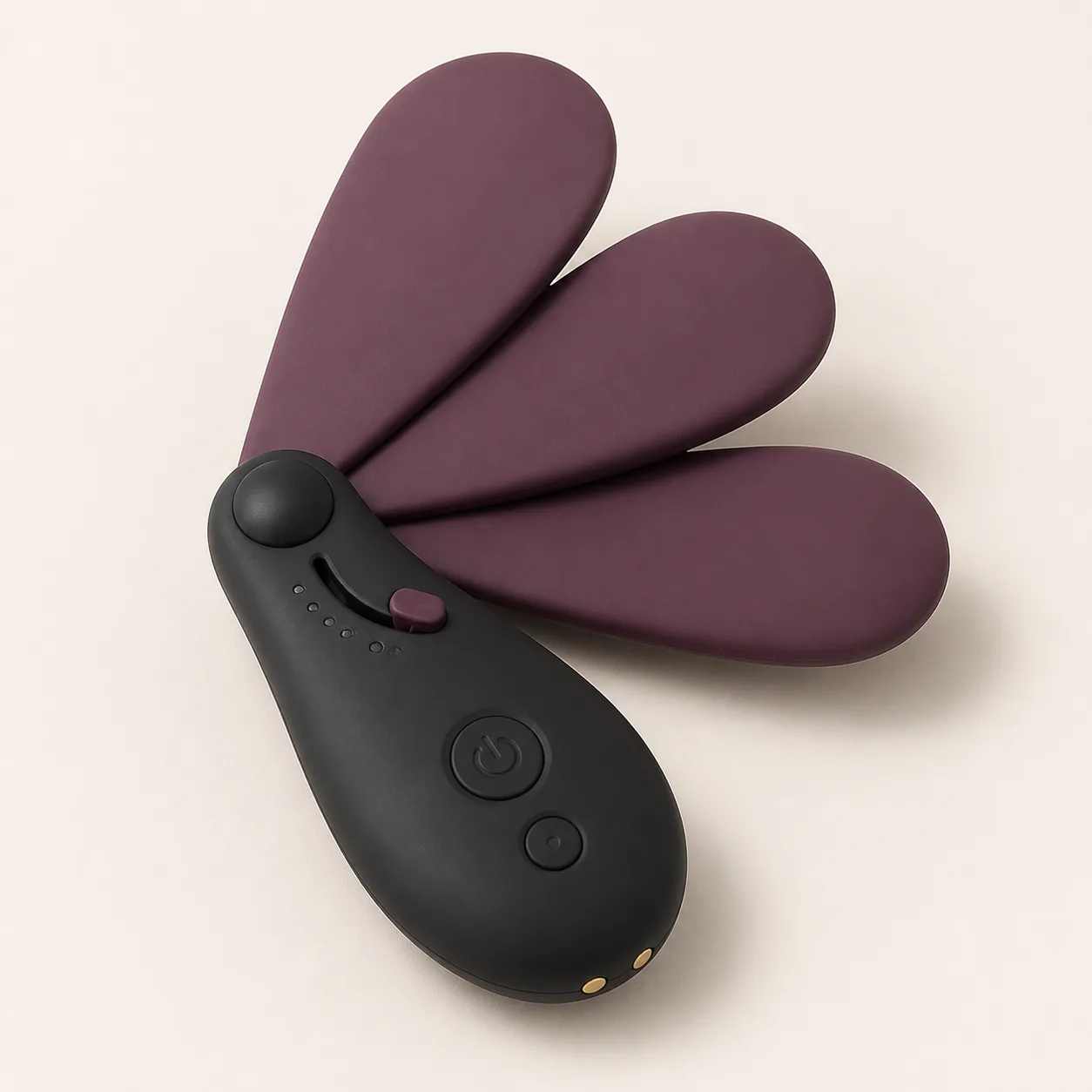
Three-Panel Fan-Fold Palm Vibrator with Indexed Radius Stops
A compact rechargeable palm vibrator concept with three overlapping contact panels and one indexed fan guide for separately testable span, hinge behavior and multi-panel output.
35,99 $
200 in stock
Spread three contact panels from one palm base
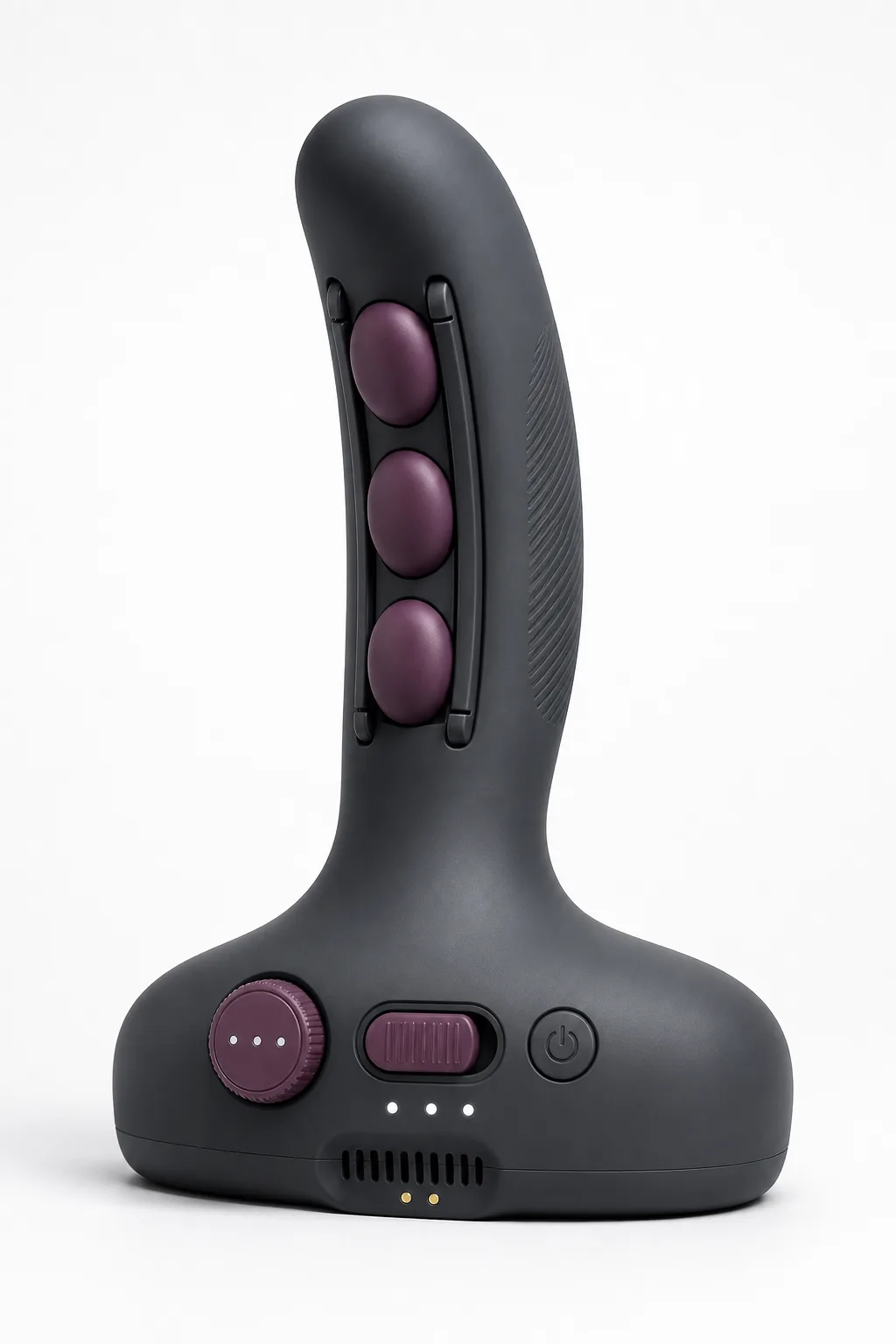
This fan fold palm vibrator concept connects three rounded plum contact panels to one shared pivot on a compact charcoal base. An arched guide and small slider provide visible adjustment references for a changing contact radius.

The image does not prove panel range, locking force, motor count, separate output, waterproofing, runtime, material or approved contact location.
Inventory each leaf and shared pivot
Request an exploded drawing and bill of materials for all three contact skins, panel cores, panel carriers, hinge eyes, common axle, bushings, thrust washers, guide rail, slider, pawl, detents, mechanical stops, base shell, actuators, controller, battery, buttons, indicators, charging contacts, pigments, seals, lubricants and adhesives.
Identify which parts carry mechanical load and which parts only provide a visible surface. Trace any conductors that cross the moving hub.
Measure folded and open envelopes
Record base length, width and height, each panel length, maximum width, thickness and curvature, hub diameter, axle diameter, panel overlap, folded stack height, guide radius, control reach and total mass.
Measure the overall contact span at every approved index position. Do not calculate the range from artwork or equal-looking gaps.
Map every panel angle from one datum
Place a fixture reference through the axle center and measure the angular position of each panel independently. Record neutral bias, spacing, symmetry and repeatability after opening and closing from both directions.
A single slider may control all leaves through unequal linkages, so the center panel cannot be used as a proxy for the outer two.
Verify the indexed slider and stops
Measure slider force, travel, detent depth, pawl engagement, rebound, accidental movement resistance and stop compression at every visible reference. Test with the panels unloaded and under small balanced and one-sided forces.
Reject a setting if the slider appears seated while any panel continues to move beyond the documented tolerance.
Characterize panel hinge torque
Measure breakaway torque, running torque, friction, lateral play and sound for each leaf through its verified travel. Repeat after temperature conditioning and planned cycle intervals.
Compare left, center and right hinge behavior to detect a dry bushing, bent washer, axle misalignment or one leaf carrying the full adjustment load.
Measure output panel by panel
Map amplitude, frequency, startup, decay, surface temperature and sound at the root, center and rounded end of each panel for every confirmed program and charge level.
Repeat at several fan angles so changes in joint compression or panel overlap are captured.
Analyze vibration crossing the shared hub
Use synchronized sensors on all three leaves, the hub and the grip. Compare phase and amplitude to distinguish direct actuation from vibration transferred through the axle.
Check whether one panel becomes dominant or whether the outer leaves cancel, amplify or lag the center leaf at particular settings.
Test contact spread under compliance
Press the open fan against a compliant instrumented surface at verified low loads. Record contact area, pressure distribution, panel deflection, angular drift, slider movement, vibration loss, current, sound and temperature.
Repeat with centered, left-biased and right-biased loading. Stop for leaf snap-through, hard collision, hinge lift, unstable spread, unusual noise or rising heat.
Review fold gaps and entrapment
Inspect every gap between leaves, around the axle, beside the guide and beneath the slider through the full approved adjustment. Use calibrated probes for pinch and entrapment screening.
Keep hair, jewelry, loose fabric and film away from the folding mechanism. Adjust only while stopped unless exact instructions and tests prove powered adjustment safe.
Assess grip and control reach
Measure grip pressure, slip, balance, button access and accidental slider contact with the fan folded, partly spread and fully spread. Include several verified orientations and dry or lightly damp test gloves.
Confirm that the widest configuration does not create enough leverage to rotate the base unexpectedly in the hand.
Confirm programs, indicators and charging
Document button sequences, program order, lockout, memory, low-battery behavior and every indicator state. Verify whether panel output is shared, zoned or fixed before making any control claim.
Confirm charger input, contact polarity, charge time, runtime, standby drain and operation during charging. Keep the device off and dry while charging unless exact-model instructions explicitly permit another condition.
Monitor current and heat across fan shapes
Run the highest verified program at each approved spread in free air and under compliant load. Log current and temperature at every panel, hinge, axle, guide, slider, actuator, controller, battery, grip and charging contact.
Check shutdown and restart behavior after a guarded low-force obstruction test below confirmed limits.
Cycle folding, output and cleaning
Run repeated fan opening, index selection, balanced loading, one-sided loading, output, control, charging and cleaning cycles. At planned checkpoints inspect panel bond, hinge torque, axle play, slider force, stop wear, gaps, output, current and heat.
Obtain the exact cleaning method and ingress rating before wet care. Clean panel overlaps, root gaps, axle edges, guide rail, slider recess, buttons and contacts with approved tools, then dry the folded layers fully.
Price after hinge and stop validation
An Alibaba mini palm massager listing currently shows USD 3.49-3.99 with an MOQ of one. It is a category benchmark only and does not confirm this three-panel fan mechanism, indexed guide or an approved supplier.
The procurement reference supports an EUR 35.99 planning price after allowing for China-origin freight, complete part inventory, folded and open metrology, per-panel angle maps, slider and stop tests, hinge torque, leaf output, cross-panel vibration, compliant contact mapping, pinch review, grip analysis, electrical and thermal testing, mechanism cycling, materials and battery evidence, cleaning validation, protective packing and discreet fulfillment. Exact quotation, packed dimensions, weight, freight, duty, tax, insurance, payment fees and delivery terms remain pending.
Frequently asked questions
Do the three panels adjust independently?
The concept shows one indexed guide; the production linkage and actual control of each leaf require verification.
Can the fan be adjusted while powered?
Keep it stopped during adjustment unless exact-model instructions and guarded tests confirm otherwise.
Does each panel have its own motor?
Motor count and zone control remain pending teardown and electrical inspection.
Are the visible dots exact angle marks?
No. They are references until every position is measured against the axle datum.
Can the folded gaps be rinsed?
Only after an ingress rating and approved cleaning method are documented; all overlaps must dry fully.
Which faults require immediate retirement?
A loose axle, cracked leaf, exposed core, failed stop, creeping slider, sharp gap, unstable output, unusual noise, heat, swelling or corrosion.
Reviews
There are no reviews yet.