



Three-Panel Fan-Fold Palm Vibrator with Indexed Radius Stops
August 14, 2026
Low-Profile Care-Washing Floor Runner
August 14, 2026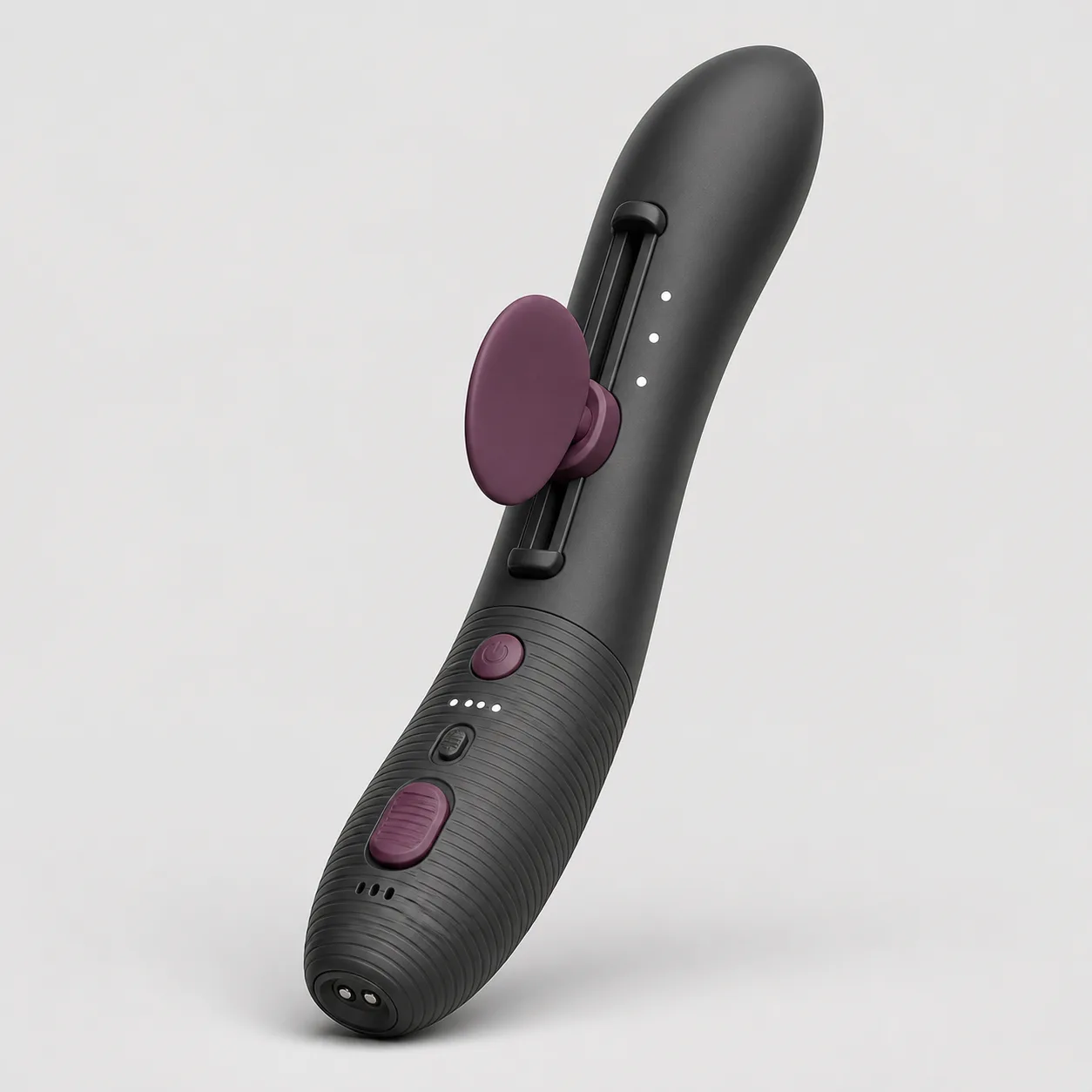
Three-Position Sliding-Fin Curved Vibrator with Dual Channels
A curved vibrator concept with one external flex fin on a three-stop rail, separate channel controls and a wide stop slider.
57,99 $
200 in stock
Add one movable fin without hiding the core
This three-position sliding-fin curved vibrator concept combines one slim charcoal curved body with exactly one broad smoky-plum oval fin on a guarded axial rail. Three white dots identify rail stops P1-P3, while a ribbed handle, main and secondary controls, wide stop slider, four indicators, vents and charging contacts remain visible.

The render proposes geometry only and does not prove travel, output, material, ingress or production claims.
Inventory body fin carriage and electronics
Require records for tip, surface layer, core, main actuator, fin actuator if present, moving masses, mounts, fin F1, carriage C1, rail, guides, P1-P3 detents, stops, controls, indicators, lock, controller, cell, vents, contacts, seals, pigments, lubricants and adhesives.
Trace load, vibration, heat and electrical paths before accepting dual-channel language.
Measure geometry at P1 P2 and P3
Record overall and insertable length, body diameter, curve radius, tip profile, fin dimensions and angle, carriage position, rail span, handle size, mass and balance at each stop.
Repeat after loaded output, sliding, cleaning and storage cycles.
Profile the rounded tapered tip
Map crown, edge continuity, hardness, friction, layer thickness, deformation, rebound and attachment to the core. Inspect curve transitions for thin zones and stress concentration.
Reject tack, pigment transfer, tears, delamination, hard exposure or permanent bend.
Characterize fin F1 independently
Measure length, width, thickness, edge radius, stiffness, torsion, rebound, residual set and attachment to C1. Repeat under centered and offset loading.
Reject edge collapse, carriage contact, cracking, whitening or persistent tilt.
Inspect carriage C1 and guarded rail
Measure lateral play, sliding friction, pull-off resistance, guide clearance, stop contact, debris generation and hidden fasteners. Probe gaps through full fin deflection.
Reject rail lift, binding, pinch access, skipped stops or uncontrolled travel.
Calibrate the three indexed positions
Measure carriage location, detent force, backlash, fin angle and body clearance at P1-P3 from both directions. Test with the fin unloaded and on standardized compliant fixtures.
The carriage must not drift during any verified program or obscure controls.
Map main-body output
Record acceleration, dominant frequency, harmonics, startup and decay at the tip, curve, rail roots and handle across every confirmed main-channel setting.
Compare unloaded and loaded fixtures without assuming motor count from control layout.
Map fin output and channel interaction
Measure output at F1, C1, rail, body and grip for every confirmed fin-channel state and P1-P3 position. Record phase, cross-coupling, cancellation and resonance.
Publish only channel behaviour demonstrated by exact-sample tests.
Measure contact pressure and fin stability
Use instrumented compliant forms to record engaged area, local pressure, fin deformation, carriage displacement, body rotation and slip at each position.
Avoid universal-fit or hands-free claims without bounded geometry and pressure evidence.
Verify controls stop lock and charging
Document startup, channel selection, programs, intensity, indicator meanings, stop priority, travel lock, cell architecture, input limits, charge time, runtime and protection circuits.
Exact values require supplier documents and direct measurement.
Log current sound heat and constrained faults
Measure current, A-weighted sound and temperatures at tip, actuators, fin, carriage, rail, controller, cell, vents, grip and contacts. Challenge fin obstruction, head restraint, partial detent, low voltage and power loss in guarded fixtures.
Reject abnormal heat, unexpected restart, tonal rattle or delayed stop.
Screen seams gaps cleaning and ingress
Probe tip and body seams, fin edges, carriage gaps, rail ends, detents, buttons, slider, lights, lock, vents, grip ribs and contacts for pinch, abrasion, residue and moisture traps.
No waterproof claim is accepted without exact-model evidence.
Cycle fin travel output and controls
Cycle P1-P3 movement, fin flex, loaded output, channel switching, stop, lock, charging, cleaning, drying and storage. Remeasure play, detents, output, sound and heat.
Retire for fin tears, carriage play, rail damage, position drift, control delay, heat, charging faults or cell swelling.
Build landed price after fin-rail proof
An Alibaba curved-vibrator listing showed an example at USD 7.49 for quantities from one to 99. It is a benchmark only and does not confirm this sliding-fin design or an approved supplier.
The procurement reference supports an EUR 57.99 planning price after provisional allowance for China-origin freight, exact samples, teardown, fin and carriage tests, position calibration, dual-output mapping, pressure, controls, charging, sound, heat, faults, cleaning and fatigue work, protective packing and discreet fulfilment. Exact quote, MOQ, dimensions, materials, cell, packed weight, freight, duty, tax, certification, payment terms and lead time remain pending.
Frequently asked questions
How far does the fin travel?
Actual C1 positions at P1-P3 require sample measurement.
Does the fin have its own motor?
Actuator allocation and channel independence require teardown and output mapping.
Can the carriage move during operation?
Detent force and drift must be tested across every confirmed program and load.
What does the stop slider control?
Priority across both channels and response time remain pending.
Is the device waterproof?
No ingress rating is claimed for rail, carriage, controls, vents or contacts.
Which defects require retirement?
Fin tears, rail play, carriage drift, heat, charging faults, noise or cell swelling.
Reviews
There are no reviews yet.