


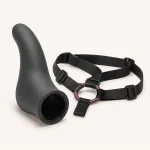
Adjustable Hollow Strap-On Harness Set with Reinforced Socket Sleeve
August 14, 2026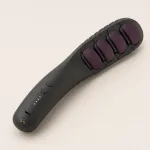
Four-Pad Lateral-Wave Bar Vibrator with Segmented Spine
August 14, 2026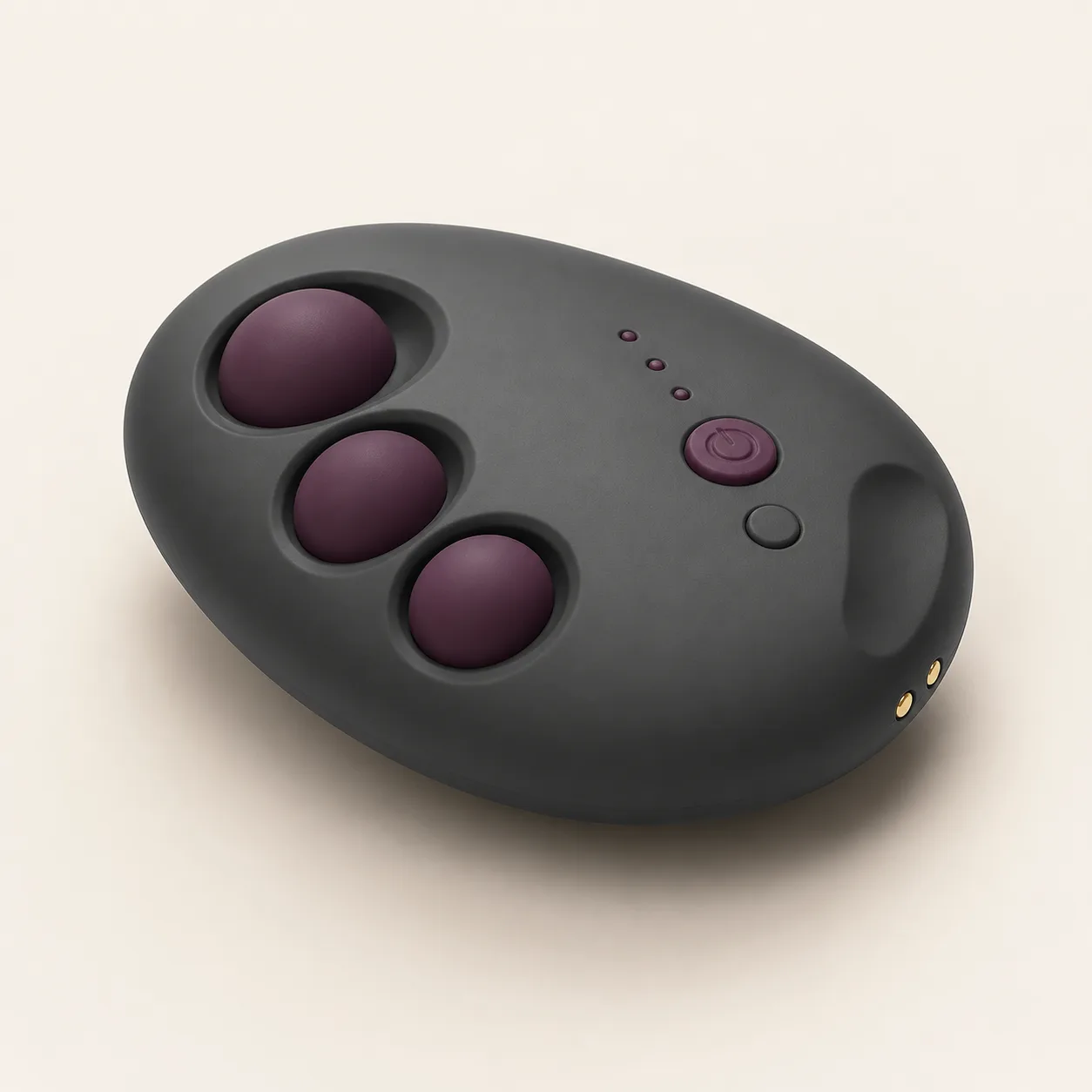
Three-Dome Sequential-Pulse Palm Vibrator with Isolation Channels
A compact rechargeable palm vibrator concept with three separate rounded contact domes, deep guarded isolation channels and forward, reverse and combined pulse programs pending verification.
32,99 $
200 in stock
Three isolated domes create a directional pulse concept
This three dome palm vibrator concept places three rounded contact zones along a gentle diagonal arc. Deep guarded channels separate the domes so a controller can be evaluated for forward, reverse and simultaneous pulse programs without the surfaces touching.

The image does not establish independent motors, sequence timing, material, vibration output, waterproofing or runtime.
Inventory each zone and its signal path
Request drawings and a bill of materials for all three domes, carriers, isolation channels, guard rims, actuators, couplings, controller, sensors, battery, shell, buttons, indicators, contacts, pigments, lubricants and adhesives.
Confirm whether zones use separate actuators or one shared mechanism with timed coupling, because testing and fault behavior differ.
Measure the diagonal contact layout
Record body length, width and depth, dome diameters and heights, center spacing, channel width and depth, guard height, finger-rest dimensions, control reach and device mass.
Measure every dome separately and compare alignment with the shell centerline.
Characterize dome one before the sequence
Run only programs that isolate the first zone, if supported, and measure amplitude, frequency, startup, decay, sound and surface temperature across charge levels. If isolation is unavailable, use synchronized sensing to separate its contribution.
Document shell vibration beside the dome to distinguish useful zone output from enclosure transfer.
Characterize dome two at the center
Repeat the same measurements for the middle dome under identical charge, fixture and temperature conditions. Record whether neighboring zones move passively when the center is active.
A central location can couple strongly into both channels and requires its own acceptance limits.
Characterize dome three without averaging. Measure the final dome for amplitude, phase, sound, heat and drift, then compare all three zones. Specify manufacturing tolerance rather than masking differences with a mean value.
Reject a zone that starts late, stalls, knocks or heats differently without a documented reason.
Map forward and reverse timing
Use synchronized sensors to record activation order, dwell, overlap, transition gaps and cycle length in every sequence program. Repeat at full, middle and low indicated charge.
Forward, reverse and wave labels need measurable definitions for the exact production revision.
Inspect isolation channels for pinch and residue
Probe both channels and all guard rims with standardized soft film, hair and textile fixtures while domes operate in every supported combination. Examine seams and any dome-to-shell movement.
Reject closing gaps, sharp rims, exposed carriers or recesses that cannot be seen, wiped and dried.
Compare free and compliant-contact output
Run the device in free air and against a compliant instrumented surface at several low verified loads. Record contact area, amplitude loss, sequence drift, current, sound and temperatures at all domes, shell and battery.
Define an approved contact envelope before publishing pressure or intensity claims.
Check simultaneous-mode current and heat
Operate the highest verified multi-zone program through a complete documented cycle. Log battery current, controller response, voltage drop and temperature at each dome, between channels, under the finger rest and near charging contacts.
Confirm shutdown and restart behavior if one zone is obstructed on a guarded fixture below supplier limits.
Keep the palm grip clear of contact zones
Hold only the designed back and finger rest so hand pressure does not cover indicators, buttons, channels or domes. Confirm that grip force cannot distort a channel or change a program.
Stop for discomfort, numbness, unusual heat, shell deformation, erratic timing, unexpected noise or loss of control response.
Audit controls, indicators and charging
Document button functions, press duration, lockout, setting memory, three indicator meanings, low-battery behavior, contact polarity, cable specification, charger input, charge time, runtime and operation during charging.
Indicator dots must not imply independent zones unless their actual status mapping is verified.
Cycle sequence programs and dome loads
Run repeated forward, reverse, simultaneous and transition cycles with periodic compliant-load checks. At defined intervals inspect domes, channels, guards, shell seams, buttons, indicators and contacts.
Track timing, vibration balance, current, noise and temperature drift as well as visible wear.
Verify contact, shell and battery materials
Obtain exact formulations for domes, guards, shell, buttons, indicator windows, internal supports, coatings, pigments, lubricants and adhesives. Request restricted-substance, skin-contact, electrical and battery evidence.
Silicone, body-safe, medical-grade, hypoallergenic, waterproof and submersible claims remain unconfirmed until exact-model documents and sample tests support them.
Clean both channels and all three dome rims
Power off and wipe dome tops, rounded rims, isolation channels, guard edges, shell seams, buttons, indicator dots, finger rest and charging contacts by the confirmed method. Rotate the device for full visibility without pressing domes into the shell.
Immersion, boiling, dishwasher use, alcohol, bleach, abrasive tools and oil in channels require explicit compatibility evidence. Dry channels and contacts completely.
Price the three-zone control above a basic palm toy
An Alibaba mini palm massager listing currently shows USD 3.49-3.99 with an MOQ of one piece. It is a category benchmark only and does not confirm this three-zone sequence controller, isolation channels or approved supplier.
The procurement reference supports an EUR 32.99 planning price after allowing for China-origin freight, zone inventory, independent output measurement, bidirectional timing, channel pinch inspection, loaded sequence tests, current and thermal review, controls and charging verification, material documentation, cleaning validation, protective packing and discreet fulfillment. Exact quotation, packed dimensions, weight, freight, duty, tax, insurance, payment fees and delivery terms remain pending.
Frequently asked questions
Do the three domes contain separate motors?
That remains unconfirmed; the production mechanism and zone coupling need supplier documentation and measurement.
What is a forward sequence?
It should mean repeatable activation from the first dome through the third, but exact dwell and overlap require testing.
Can two domes activate together?
Only supported programs may do so, and simultaneous current, heat and vibration balance must be verified.
Are the channels safe to press?
No. They are separation and cleaning features, not contact targets or finger grips.
May the device operate while charging?
Only if the confirmed instructions explicitly permit it; otherwise keep it off and dry during charging.
Which faults require retirement?
A lifted dome, enlarged channel, exposed carrier, timing error, stalled zone, cracked shell, failed control, unusual heat, battery swelling, corrosion or residue beyond cleaning access.
Reviews
There are no reviews yet.