


Black Spacerail Automatic Stroker with Clear Blue Drive Chamber
August 14, 2026
Five-Rib Sequential-Wave Pocket Vibrator with Three-Stop Phase Slider
August 14, 2026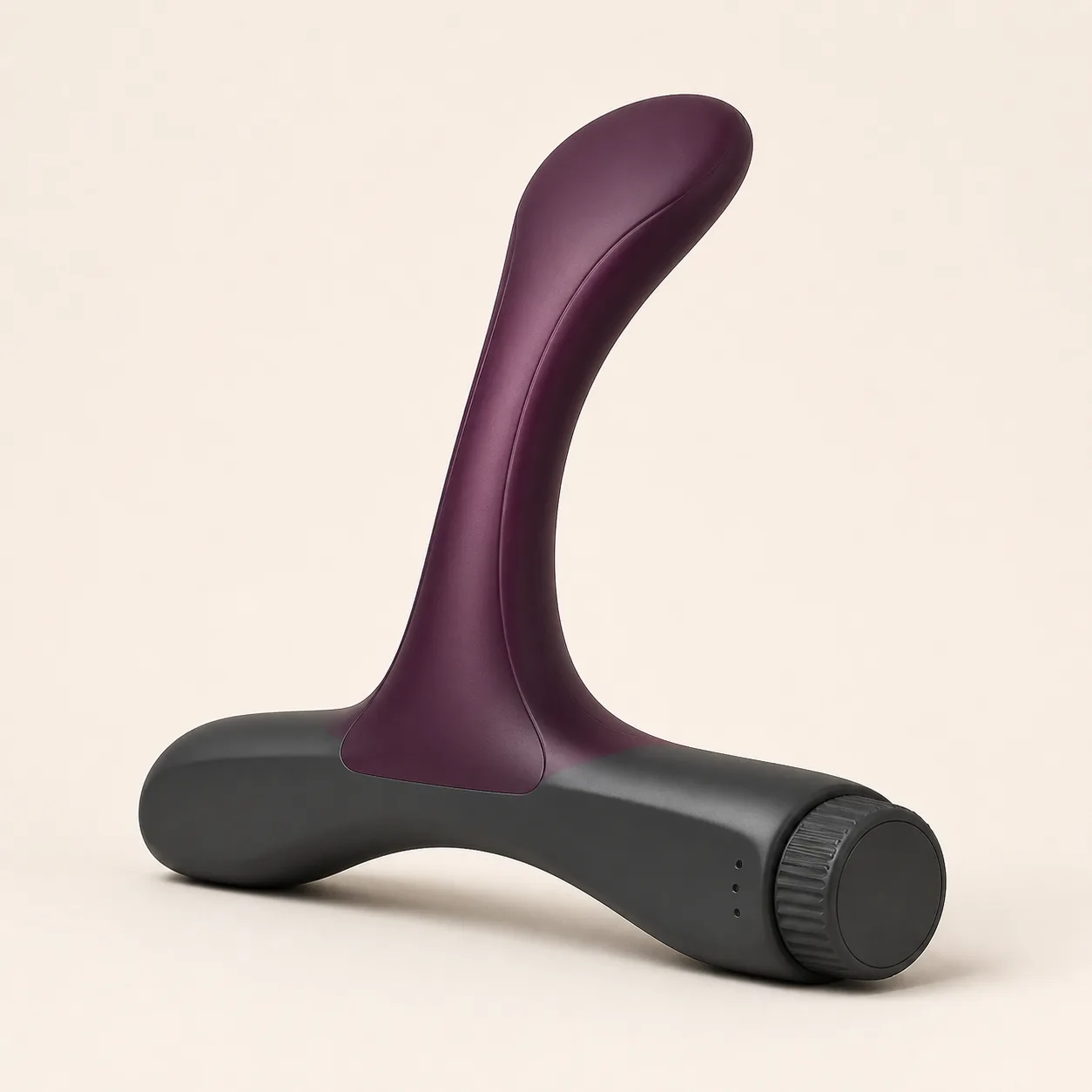
Three-Position Curvature Prostate Trainer with Wide Rocker Base
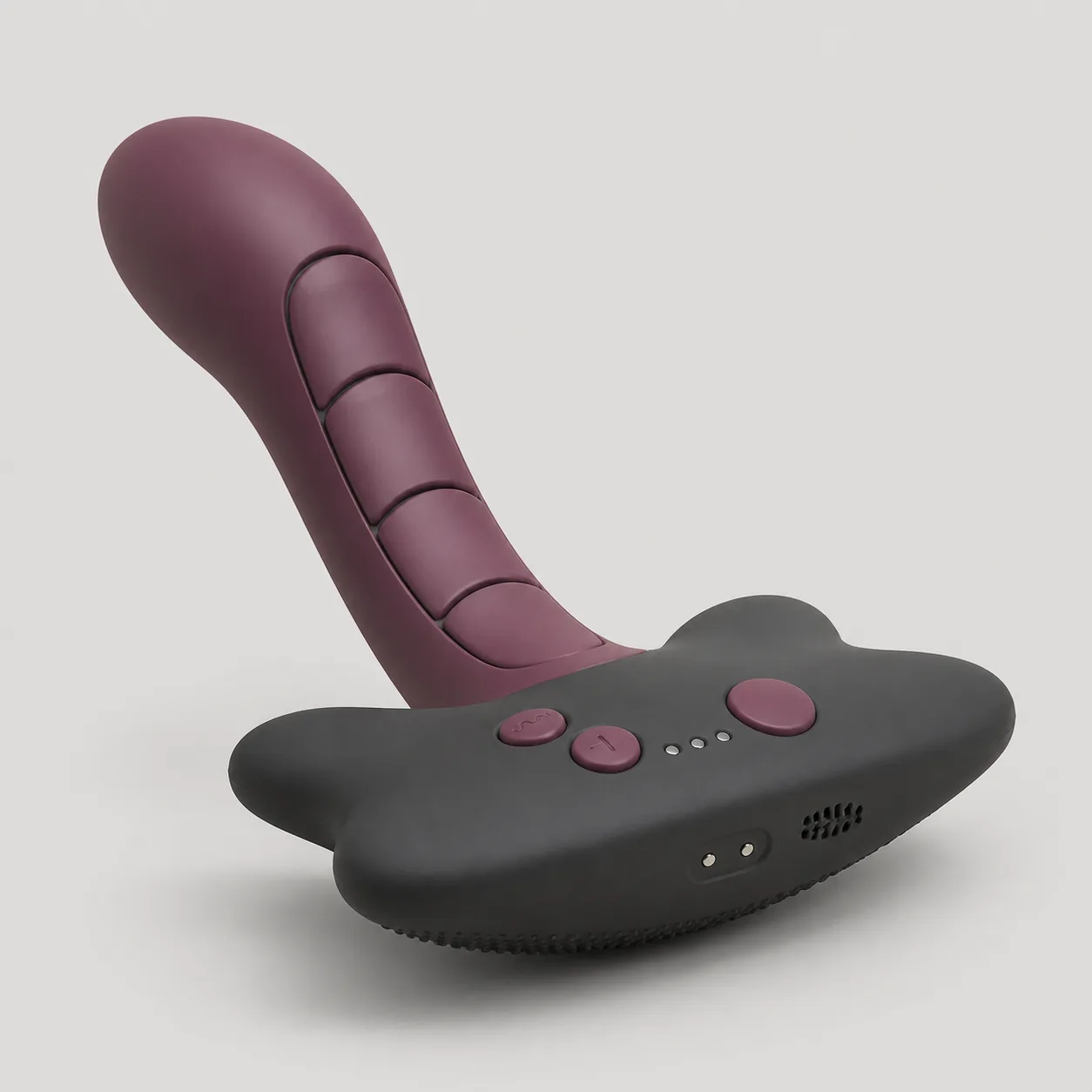
A non-powered adjustable-curvature prostate trainer concept with an offset oval head, external three-position dial and broad rocker safety base.
29,99 $
200 in stock
A non-powered trainer with a proposed three-angle dial
This adjustable curvature prostate trainer concept combines a deep-plum curved probe, a softly rounded offset head, a broad charcoal rocker base and a ridged external dial marked by three small position dots. It contains no motor, battery, charger, app or remote.

The image defines a sourcing target rather than proof of function. Production samples must establish whether the dial truly creates three stable curves and whether the base remains reliably external.
Map each detent before defining its purpose
With a clean dry sample away from the body, rotate the dial through its full permitted travel. Mark every repeatable stop, measure dial angle and photograph the probe profile against a fixed grid.
Three printed or molded dots do not prove three usable detents; a loose cosmetic index fails the concept.
Measure curve radius from the same reference plane
Support the base on a flat fixture and record probe centerline, tip offset, maximum height, minimum bend radius and head orientation at every verified setting. Use the same origin and camera distance for all profiles.
A useful comparison chart reports geometry rather than labels such as mild, medium or intense.
Test position retention under controlled load
Apply a documented lateral load to the head while the base is clamped in a soft fixture. Measure the torque needed to leave each stop, then repeat after a defined number of dial cycles.
Any sample that creeps, skips, releases suddenly or develops excessive play must be rejected.
Change curvature only after complete removal
Power is not relevant to this manual design, but adjustment still belongs outside the body. Remove the product, clean and dry the exterior as needed, then set the dial while watching the entire moving interface.
Never force the dial against resistance or try to correct an angle during use.
Inspect the flexure and dial for pinch gaps
Examine the stem-to-base transition, dial perimeter, index dots and underside at every setting. Record closing gaps, sharp edges, exposed hardware, trapped lubricant and cavities that cannot be reached during cleaning.
The internal flexure, linkage and mechanical stop design remain pending until a production sample can be opened or documented by the manufacturer.
Qualify the offset oval head as its own geometry
Measure head length, width, thickness, leading radius, trailing taper and offset from the shaft centerline. Check the perimeter seam under magnification and press the surface across a mapped grid to identify thin or unsupported zones.
No target-contact or health claim is inferred from the curved profile.
Track the shaft transition through all curves
Record usable length, minimum and maximum shaft diameter, taper rate and the location of maximum bending. Compare these values at every detent to detect wrinkling, buckling or local stress whitening.
Use only the supplier-defined boundary after exact dimensions and construction are confirmed.
Keep the wide rocker base outside the body
Measure full base span, minimum neck width, underside contour, dial projection and the distance from the shaft to each outer edge. Test gentle rocking on a soft fixture without allowing the base to fold or pass through the fixture opening.
The entire charcoal base and adjustment dial must remain external at all times.
Build a conservative progression chart
Start evaluation with the shallowest verified curve and abundant compatible lubricant. Advance only when insertion, removal and external-base stability remain comfortable and predictable.
Stop immediately after pain, bleeding, numbness, unusual resistance, loss of base control or any mechanical movement. Seek qualified medical advice for persistent symptoms or a retained object.
Confirm every contact material and lubricant pairing
Request composition for the plum surface, charcoal base, pigments, internal spine, dial, fasteners, adhesives and any overmold. Review restricted-substance and skin-contact evidence for the exact production revision.
Use only a lubricant confirmed compatible by both manufacturers. Material names, hardness, porosity and barrier compatibility are pending and must not be inferred from appearance.
Clean around the moving interface without flooding it
Follow the exact-model instructions. A provisional method is mild soap and warm water on accessible contact surfaces, followed by careful wiping around the dial while rotating it only through approved positions outside the body.
No immersion, boiling, dishwasher, bleach, alcohol, abrasives or shared use is approved without construction and ingress evidence.
Dry, store and recheck the mechanism
Dry the head, shaft, base, dial perimeter and underside completely. Store the trainer separately in a clean breathable pouch without weight on the curved stem or dial.
Before every use, inspect for cracks, swelling, sticky texture, odor, staining, loose parts, sharp edges, detent drift or residue. Retire any sample with an unresolved fault.
Price from a manual curved reference, not an exact match
An Alibaba showroom result lists a wholesale curved manual prostate stimulator at USD 1.48 with a 20-piece minimum. It does not establish this dial-adjustable construction, three stable positions or a specific legal supplier, so exact model sourcing and quotation remain pending.
The procurement reference supports an EUR 29.99 planning price after allowing for China-origin freight, exact-model quotation, profile mapping, retention and cycle tests, pinch-gap inspection, geometry and base checks, material review, cleaning validation, protective packing and discreet fulfillment. Packed size, weight, freight, duty, tax, insurance, payment fees and destination terms require confirmation.
Reject ambiguity at the most important safety points
Do not approve the product when the number of stops, adjustment method, insertable boundary, external-base dimensions, material identity or cleaning route remains unclear. Photograph and measure each production lot against the qualified sample.
This is an adult wellness product concept, not a medical device and not a treatment for any condition.
Frequently asked questions
Are three curvature positions guaranteed?
No. The dots show a proposed interface; repeatable detents and profile changes require sample measurement.
Can the dial be adjusted during use?
No. Remove the product fully and adjust the clean dry mechanism away from the body.
Does the trainer vibrate?
No motor or battery is planned for this manual concept.
How much of the product is insertable?
Only the supplier-defined probe boundary may be considered after dimensions are verified; the wide base and dial always stay external.
Which lubricant should be used?
Use only a lubricant confirmed compatible with the exact contact materials, which remain pending.
What faults require immediate retirement?
Cracks, sharp edges, swelling, sticky texture, loose parts, detent drift, sudden profile movement, trapped residue or a base that deforms under the qualification load.
Reviews
There are no reviews yet.