


300ml Manual Cleansing Bulb – Flexible Curved Nozzle
August 14, 2026
Rounded-Tip Rechargeable Mini Bullet
August 14, 2026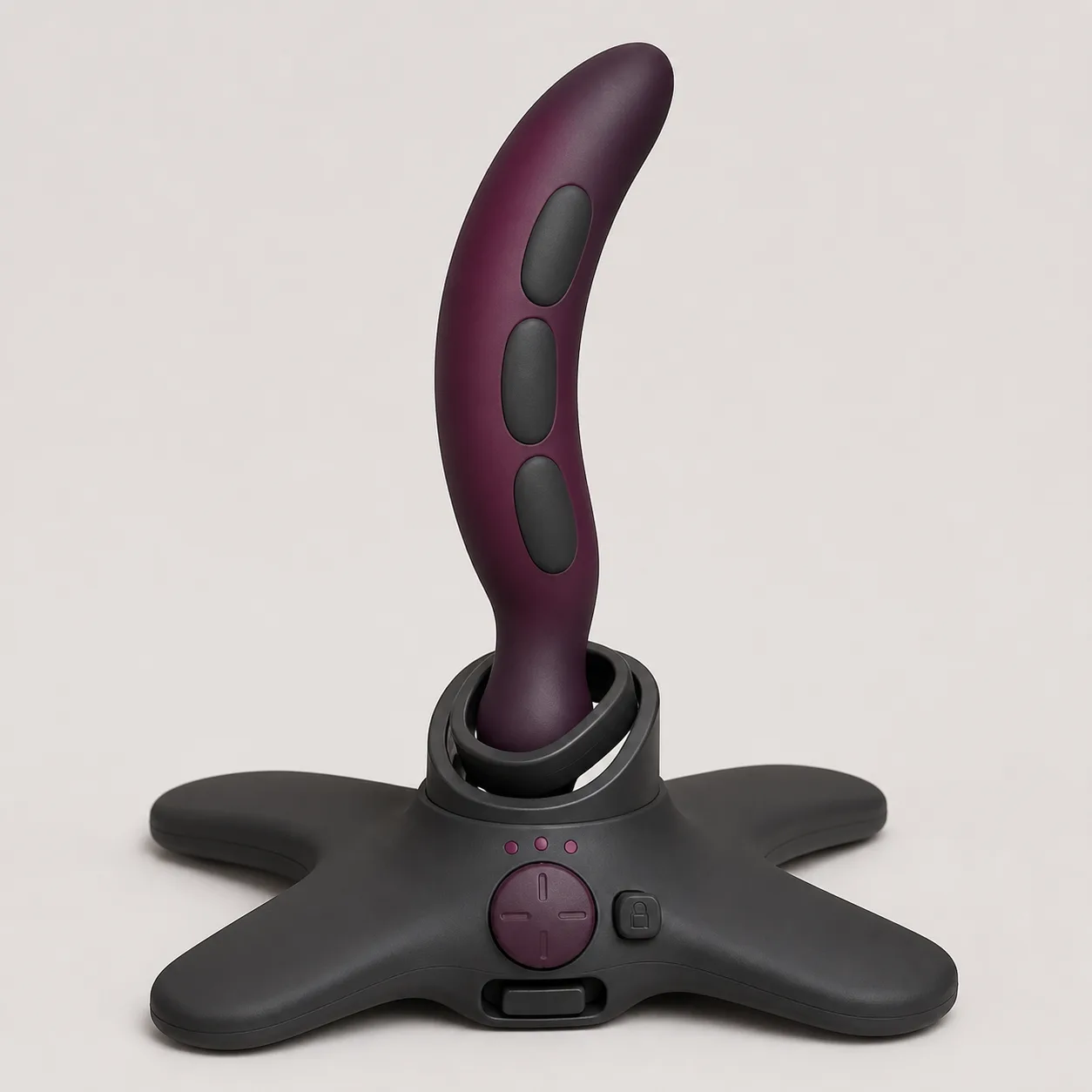
Three-Plane Gimbal Prostate Trainer with Four-Point Retrieval Base
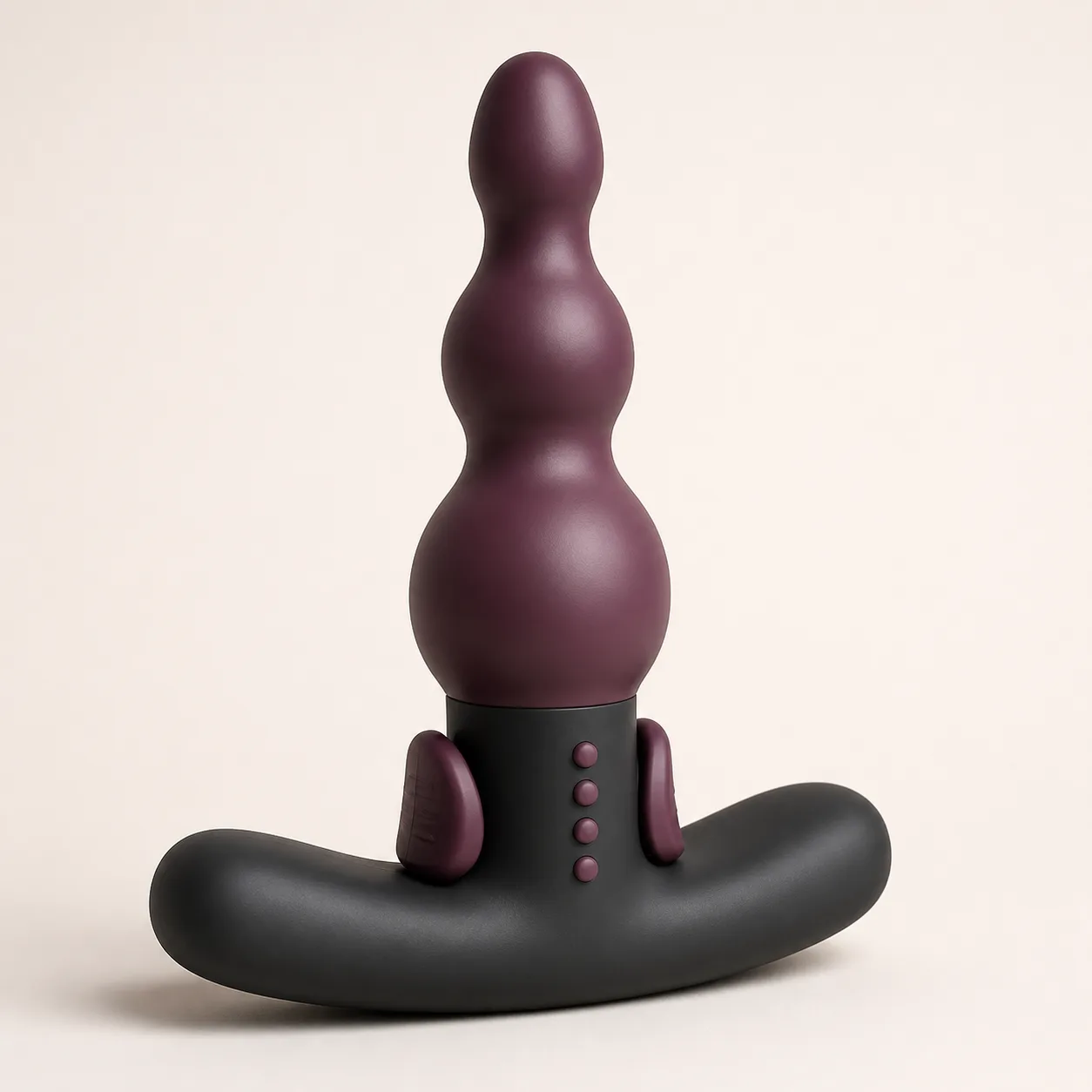
A non-powered curved prostate trainer concept with three compliance pads, a lockable external two-axis gimbal and exceptionally wide four-point retrieval base.
46,99 $
200 in stock
Set external angle through a guarded two-axis gimbal
This three-plane gimbal prostate trainer concept carries a smooth curved plum body through a guarded external collar above an exceptionally wide four-point base. Three charcoal compliance pads follow the inner curve, while a plum three-stop dial and lock tab set the intended external tilt plane.

The image does not prove insertable dimensions, gimbal range, pad compliance, lock strength, material composition, fit, cleaning access, base retention or production availability.
Inventory the trainer gimbal and base
Request an exploded bill of materials for the tip shell, curved body, pads P1 through P3, pad supports, center spine, narrow neck, inner and outer gimbal rings, trunnions, bushings, stops, three-position dial, lock tab, alignment dots, service latch, four base arms, reinforcement, pigments, lubricants, adhesives and concealed fasteners.
Trace every component to drawings, tolerances, batch records and the approved sample.
Establish all external dimensions
Measure total and proposed insertable length, tip axes and radius, centerline curvature, maximum profile, neck dimensions, gimbal height, base span across both axes, arm width and thickness, dial clearances, mass and center of gravity.
Record geometry at neutral and every approved external tilt setting.
Map the curved body profile
Use coordinate metrology to capture the centerline, cross-sections and surface transitions from tip to neck. Measure bending stiffness, torsional stiffness, permanent set and local hardness before and after conditioning.
No hard spine, seam or pad edge should print through the outer surface under conservative fixture load.
Characterize pads P1 P2 and P3
Measure pad length, width, crown, thickness, hardness, compression force, recovery, edge blend, bond area and position relative to the centerline. Compare the three pads separately under the same fixture conditions.
Inspect for lifting, trapped residue, color transfer, hard inclusions and an abrupt stiffness step.
Calibrate both gimbal axes
Measure pitch and yaw travel, breakaway torque, running torque, backlash, stop angles and cross-axis coupling. Approach every position from both directions and repeat under bounded axial and off-axis fixture loads.
The insertable body must not rotate into an undocumented plane or contact a hard collar edge.
Verify the three-stop tilt dial
Record dial angle, detent torque, hysteresis, repeatability and the actual trainer plane at all three marks. Confirm that each position settles completely and remains distinct after cleaning and cycle conditioning.
Any intermediate state that leaves the gimbal partly constrained requires redesign.
Challenge the lock tab
Measure tab travel, engagement depth, force and resistance to accidental contact. Apply conservative pitch, yaw and torsional disturbance while locked and monitor dial drift, ring play and stop loading.
The lock must remain external, visible and accessible without exposing sharp hardware.
Map pressure across the three pads
Use instrumented compliant fixtures at all approved tilt planes to record pressure, contact area, pad contribution and shear during slow controlled displacement. Compare neutral, pitch-biased and yaw-biased conditions.
Reject a setting that concentrates pressure at one pad edge, neck or gimbal collar.
Prove the four-point base remains external
Measure both base diagonals, minimum span, arm flex, twist resistance, edge radii and visibility under standardized coverings. Apply conservative axial, rocking and off-axis retention fixtures in every approved gimbal plane.
The base must remain substantially wider than the trainer profile and must not fold into a narrower shape.
Inspect collar gaps and service access
Probe neck-to-ring, ring-to-ring, trunnion, dial, lock and service-latch clearances while neutral, tilted, loaded and cycled. Use articulated gauges rather than fingers and inspect every recess after cleaning.
Service access must not release the insertable body, expose a retainer or create a loose small part.
Separate body flex from gimbal motion
Track the centerline and both ring angles under a calibrated external moment. Decompose total tip displacement into body bending, neck flex, gimbal pitch, gimbal yaw and base deformation.
This prevents a soft shell or flexible base from being misreported as controlled angular adjustment.
Verify material and cleaner evidence
Obtain composition, hardness, pigment, cure, restricted-substance and contact-safety evidence for every external and hidden component. Test seams, pad bonds, swelling, compression recovery, cleaner and lubricant compatibility, odor and color transfer.
Material claims remain pending until supported by batch-linked documents and sample results.
Challenge one stiff axis and cycle the trainer
Add bounded drag to one gimbal axis in a protected test specimen while monitoring dial force, cross-axis motion, pad pressure, neck bend, base load, gaps and lock retention. Stop before damage and quarantine any sample with ring seizure, stop climb or body separation.
Run repeated tilt selection, locking, conservative loading, cleaning, measured drying and storage. Recheck geometry, pad recovery, gimbal play, pressure, base retention, gaps, latch condition and residue paths.
Build landed price after gimbal proof
An Alibaba silicone-prostate-massager page currently shows a rechargeable category example at USD 5.50-8.90 with MOQ four. It is a benchmark only and does not confirm this non-powered gimbal trainer, three compliance pads, four-point base or an approved supplier.
The procurement reference supports an EUR 46.99 planning price after allowing for China-origin freight, exact-model sourcing, profile and pad metrology, two-axis calibration, tilt-dial and lock testing, pressure mapping, base-retention and gap review, material evidence, fault and cycle testing, protective packing and discreet fulfillment. Exact quotation, MOQ, materials, packed size, weight, freight, duty, tax, insurance, payment fees, certifications and delivery terms remain pending.
Frequently asked questions
What does the gimbal adjust?
It is intended to set the trainer plane externally; pitch, yaw and cross-axis coupling require measurement.
Do the three pads have different firmness?
No difference is confirmed; each pad needs independent compression and recovery data.
Can the dial move under load?
Detent and lock retention must be tested under conservative multi-axis fixture loads.
Why is the base four-pointed?
The broad X geometry provides visible retrieval span in two axes, subject to measured retention tests.
Can the gimbal pinch?
All collar, trunnion, dial and lock gaps need articulated checks in every approved tilt plane.
Which faults require retirement?
Pad lifting, ring seizure, growing play, stop climb, failed locking, neck cracks, base deformation, exposed hardware or persistent residue.
Reviews
There are no reviews yet.