


Black Air-Suction and Vibration Stroker with Removable Sleeve
August 14, 2026
Twin-Rail Sliding-Pod Strapless Couples Vibrator with Squeeze Locks
August 14, 2026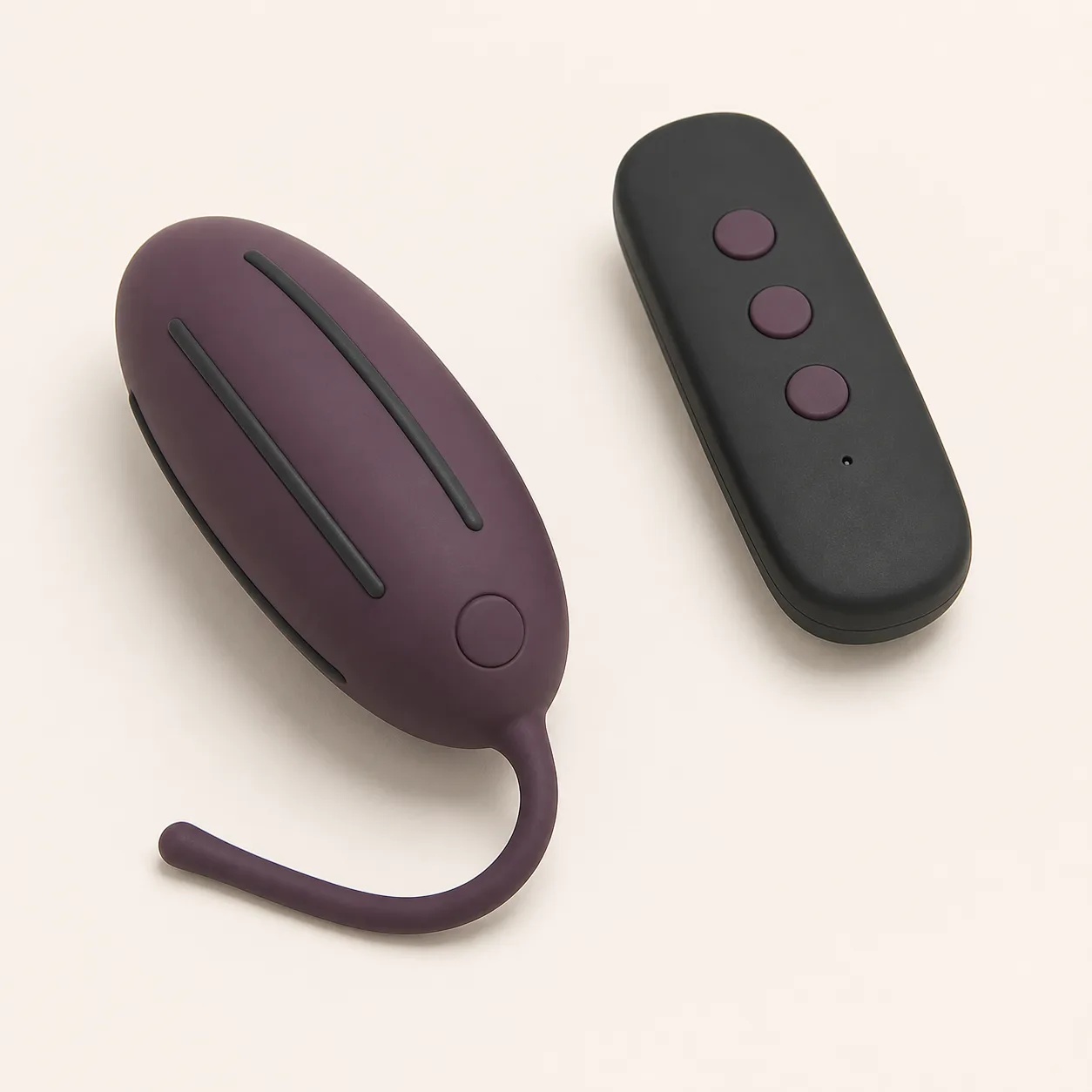
Three-Rail Wireless Remote Egg Vibrator
A two-piece wireless egg vibrator concept with three shell grip rails, one curved retrieval tail, a recessed body button and a separate three-button remote.
39,99 $
200 in stock
Separate visible design from unverified electronics
This three-rail wireless remote egg vibrator concept contains one smoky-plum oval device and one charcoal handheld remote. The device shows exactly three separate longitudinal grip rails, one curved retrieval tail and one recessed body button; the remote shows three distinct buttons and one indicator point.

The image establishes layout and component count only. It does not confirm dimensions, materials, motor output, radio range, battery, charging system, water resistance or wearability.
Inventory the two-piece control set
The proposed retail pack contains one oval device and one remote. A final bill of materials must state whether a charging lead, storage pouch, instructions or batteries are included, because none are shown in the product image.
Match device and remote identifiers by lot so control pairing can be checked without mixing components during inspection.
Measure the oval body and each grip rail
Record length, width, thickness, tip radius and the position of the body button and tail joint. For rails R1-R3, measure length, width, height, spacing, end radius and alignment from the same datum.
Reject sharp rail ends, molding flash, excessive height variation or gaps that cannot be cleaned. The rendering is not a dimensional reference.
Define surface feel with test data
Request the complete outer-material declaration, hardness, texture specification and pigment system. Measure surface friction and deflection on the shell, rails, tail and button surround rather than applying vague touch descriptions.
Silicone, body-safe, hypoallergenic and phthalate-free wording remains unavailable until traceable evidence supports the exact production material.
Verify the retrieval tail as a safety-critical part
Measure the tail’s full reach, cross-section, bend radius and connection geometry. Apply bounded cyclic flex and pull tests to the joint while inspecting for whitening, cracking, separation or permanent stretch.
Do not approve a sample whose tail cannot be grasped reliably, and never treat the tail as a suspension loop or load-bearing handle.
Map the body button functions
Create a verified state table for press duration, power, local mode changes, pairing and shutdown. Confirm that the recessed button can be found quickly without creating a hard or sharp surrounding ridge.
Mode count, memory behavior, lockout and emergency shutdown remain pending firmware and sample testing.
Map all three remote buttons independently
Label remote buttons C1-C3 during testing and document each short press, long press and combination. Check tactile separation, accidental activation, indicator meaning and low-battery behavior.
The image does not assign plus, minus or mode functions. Final instructions must match the exact remote firmware shipped with every lot.
Test radio control under realistic interference
Measure pairing time, direct-line range, obstructed range, latency, missed commands and unintended reconnection around common household wireless equipment. Repeat with fresh and partly depleted batteries.
No long-distance, app, Bluetooth or through-wall claim is made. The control protocol and effective range remain pending.
Characterize vibration at the device shell
Measure frequency and acceleration at the tip, rail zone, midpoint and tail joint for every verified setting. Record start-up surge, setting repeatability, heat rise and whether rail geometry changes measured transmission.
Words such as quiet, powerful or whisper-soft require a documented method and acceptance limit before publication.
Validate battery, charging and transport details
Confirm cell chemistry, rated capacity, charge input, connector type, full-charge time, operating time by setting, protection circuits and storage voltage. Obtain transport documentation for the exact cell and completed product.
The image shows no cable or charging contacts, so every power specification remains pending supplier evidence.
Prove water resistance rather than assuming it
Inspect the button, tail joint, shell seam and any charge port before and after the supplier’s declared ingress test. Repeat functional, electrical and drying checks after controlled exposure.
Do not immerse, shower with or wash an unapproved sample under running water. The final care method depends on verified ingress protection.
Run a conservative fit and removal trial
Use consenting adults, documented measurements and a stop-at-discomfort protocol when evaluating intended external or wearable positioning. The tail must remain accessible and the device must be removable without relying on remote operation.
Stop at pain, numbness, bleeding, loss of sensation, unexpected resistance or any device fault; persistent symptoms require appropriate medical advice.
Clean rails, button and tail joint completely
Follow the confirmed cleaner, water exposure, temperature and contact-time limits. Work along all three rail edges, around the recessed button and across the full tail joint, then dry every recess.
Boiling, bleach, soaking, dishwashers and abrasive tools are excluded unless the final material and ingress evidence expressly permits them.
Inspect, store and pair components by lot
Before storage, check the shell, three rails, seam, button, tail, remote case and buttons for cracks, swelling, tack, corrosion or odor. Store device and remote dry, powered down and separated from heat, sunlight and unverified materials.
Keep the matching lot or pairing code together so a remote from another batch is not assumed compatible.
Price from a cautious wireless-egg benchmark
An Alibaba remote-vibrating-egg category page displayed one smart wireless example at USD 4.20 to 4.90 with MOQ 10. It is a broad category reference only and does not identify this three-rail concept or confirm any of its electronics.
The public procurement benchmark supports an EUR 39.99 planning price after provisional allowance for China-origin freight, material review, measurement, rail and tail inspection, radio, vibration, battery, charging, heat, ingress, cleaning and packaging tests, discreet fulfilment and expected electronic handling loss. Exact supplier, quote, MOQ, specifications, packed weight, freight, duty, tax, certification, payment terms and lead time remain pending.
Frequently asked questions
How many grip rails are shown?
The oval device has exactly three separate charcoal longitudinal rails.
How many remote buttons are included?
The concept shows one remote with exactly three buttons; their final functions require firmware testing.
Is a charging cable included?
No cable is shown, and the charging system and pack contents remain pending supplier confirmation.
What is the wireless range?
No range is claimed until pairing, latency and interference tests are completed on production samples.
Is the device waterproof?
Water resistance and the permitted cleaning method remain unconfirmed until ingress tests are reviewed.
What material touches the body?
Exact shell, rail and tail composition requires traceable declarations and sample verification.

Reviews
There are no reviews yet.