



Three-Rail Wireless Remote Egg Vibrator
August 14, 2026
Dual-Pivot Angle-Lock Curved Vibrator with Tapered Oval Head
August 14, 2026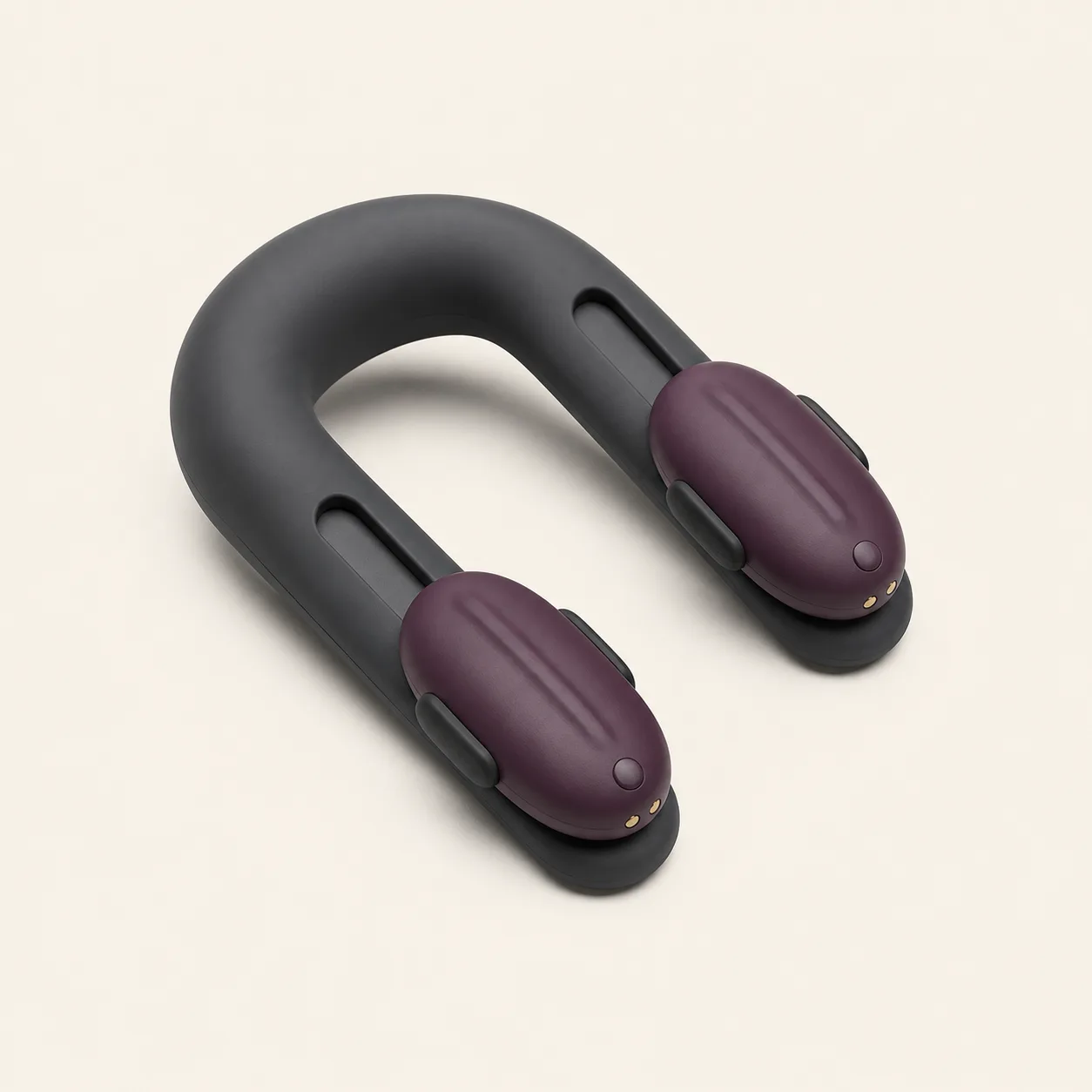
Twin-Rail Sliding-Pod Strapless Couples Vibrator with Squeeze Locks
An open-frame strapless couples vibrator concept with two independently sliding contact pods, separate guide rails, paired squeeze locks and local controls.
42,99 $
200 in stock
Independent sliding pods move contact position without bending the frame
This twin-rail strapless couples vibrator concept places one compact contact pod on each arm of an open U-shaped frame. Shallow longitudinal rails let the pods move separately, while paired squeeze locks are intended to secure each selected position before fitting.

The visual is a purchasing design brief, not proof of fit, material, motor output or rail strength.
Inventory the two rail systems separately
Request a bill of materials for the flexible frame, left and right rails, end stops, two pod carriers, four squeeze tabs, latches, springs, followers, bushings, seals, pod shells, contact ridges, buttons, motors, cells, charge contacts, fasteners and adhesives.
Left and right components need durable identity because mirrored parts may not be interchangeable.
Measure the frame before moving either pod
Record overall length, outer width, arm spacing, bridge radius, arm thickness, relaxed opening, frame mass and the distance between rail origins. Measure flex under low controlled displacement and again after repeated cycles to identify permanent set.
The open frame should have no hidden wire or rigid insert ending at a pressure point.
Map usable travel on both rails
With every lock released and the device unloaded, move each pod from its inner stop to its outer stop. Record center position, usable travel, minimum pod-to-bridge clearance, maximum projection, sliding force and any point where the carrier rocks or binds.
Mark forbidden partial positions where the latch cannot engage fully.
Prove paired squeeze locks engage together
Measure tab force, travel and timing on both sides of each pod. A pod should move only while both intended tabs are pressed and should resist axial, lateral and twisting fixture loads once both tabs are released.
One-sided engagement, delayed rebound or a tab hidden against the frame fails qualification.
Challenge rail end stops without treating them as settings
Move an empty pod gently against each stop and apply a low axial force below the written test limit. Inspect stop deformation, carrier lift, rail cracking and escape clearance, then repeat after the planned movement-cycle test.
An end stop contains the carrier during adjustment; it is not evidence that the final notch is suitable for use.
Inspect carrier gaps for pinch and residue
Measure the clearance around each pod carrier, squeeze tab, rail edge and end stop throughout travel. Use standardized hair and soft-film probes to identify closing gaps, while keeping all human contact outside the mechanism.
Reject sharp rail lips, exposed springs, abrupt shear points or recesses that cannot be cleaned and dried.
Verify pod orientation cannot be reversed accidentally
Confirm that each carrier seats only with its intended contact face and button direction. Attempt wrong-way assembly with a low capped force and document whether keys prevent engagement before contacts, seals or latches are damaged.
If pods are factory-captive, confirm that users are not expected to remove them for cleaning.
Compare output at every locked position
On calibrated compliant fixtures, record vibration amplitude, frequency, transfer into the frame, sound and surface temperature with the pods near, middle and far on their rails. Test each pod alone and both together.
Rail position must not loosen the motor, interrupt power or create an unguarded resonance at the carrier.
Keep local shutdown reachable for both partners
Document button force, short and long presses, lockout, mode sequence, memory and full-off action for each pod. Verify that one pod can stop without requiring the other pod, a phone, remote or charging dock.
Movement, pressure or a failed wireless link must never disable the local off control.
Qualify shared fit on instrumented soft forms
Start with both pods in their least projecting verified positions and the frame at its relaxed opening. Compare pressure, stability, pod migration and frame twist across graded paired soft forms before considering consensual human evaluation.
Stop for pinching, unstable movement, numbness, pain, coldness, color change, swelling, loss of sensation or any lever that becomes unreachable.
Separate rail adjustment from active use
Power the device off, remove it, unload the frame, press both locks on one pod and reposition it by the carrier rather than the contact ridge. Release both tabs, confirm engagement, then repeat for the other side.
Never slide a pod while the frame is fitted, vibrating, wet or carrying pressure.
Verify materials across flexible and moving boundaries
Obtain exact formulations for the outer contact surfaces, frame core, rail, carrier, tabs, seals, pigments, lubricants, charge contacts, magnets if present and adhesives. Review hardness, flex fatigue, tear, corrosion, restricted-substance and skin-contact evidence for the ordered revision.
Silicone, ABS, body-safe, medical-grade, waterproof and hypoallergenic claims remain pending until exact-model documentation is assessed.
Clean rails without washing contamination into pod seams
Switch both pods off and move them only through the documented cleaning positions. Wipe exposed rail sections, carrier shoulders, tab gaps and frame surfaces by the confirmed method, then dry every recess before storage.
Immersion, boiling, dishwasher use, alcohol, bleach, oil cleaners and carrier disassembly are not approved without specific compatibility and ingress evidence.
Price two movable motor pods above a fixed U-frame
An Alibaba U-type wireless-vibrator results page updated in July 2026 lists a wireless U-shaped couples product at USD 10.39-14.98 with an MOQ of one. It is a current category benchmark only and does not establish this twin-rail design, its legal supplier or production quote.
The procurement reference supports an EUR 42.99 planning price after allowing for China-origin freight, exact component and dimension checks, twin-rail travel maps, four-tab latch and retention testing, pinch-gap inspection, output and thermal comparison across positions, shared-fit evaluation, material review, cleaning validation, protective packing and discreet fulfillment. Packed size, mass, freight, duty, tax, insurance, payment fees and delivery terms remain pending.
Frequently asked questions
Can either pod slide while the device is fitted?
No. Switch off, remove and unload the frame before moving one pod with both squeeze tabs pressed.
Do the two pods share one control?
The concept gives each pod a local button so either side can stop independently; the exact control map needs sample testing.
Are the pods removable?
Not by default. Supplier instructions must state whether they are captive and how rail recesses are accessed safely.
Does a rail endpoint count as a safe position?
No. Only fully locked positions that pass retention, pressure, fit and pinch-gap checks may enter the approved range.
Can the whole frame be immersed?
Not unless exact ingress evidence covers both pod seams, charge contacts, rails and moving carriers.
Which faults require retirement?
A loose carrier, cracked stop, sticky tab, exposed spring, torn surface, jammed pod, hot contact, unstable output, corroded charge dot or residue beyond cleaning access.
Reviews
There are no reviews yet.