


Remote Telescopic Thrusting Vibrator
August 14, 2026
Three-Size Elliptical T-Base Anal Plug Set
August 14, 2026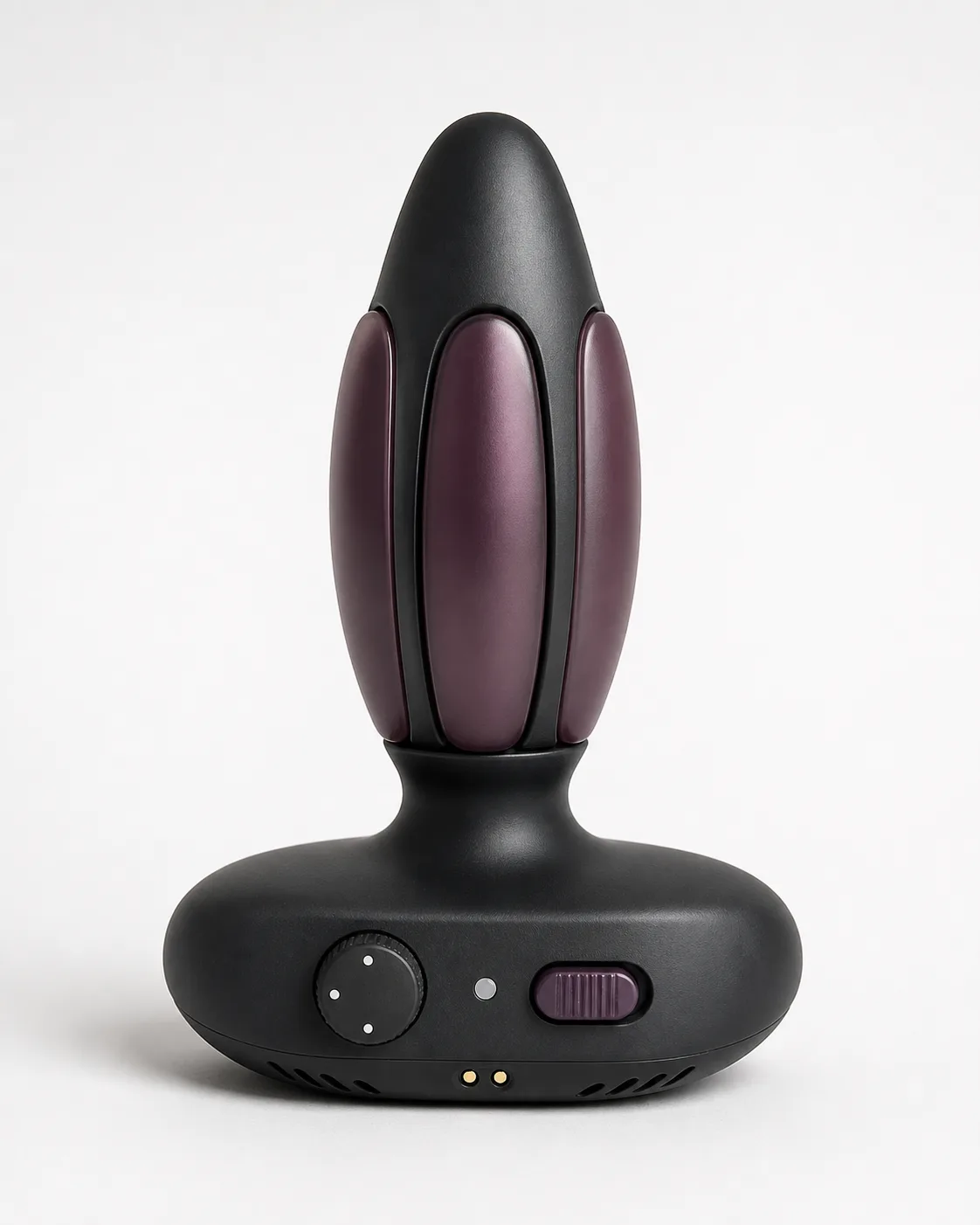
Four-Petal Pressure-Indexed Expanding Anal Plug with Rapid-Vent Base
An expanding anal plug concept with four guarded longitudinal petals, three indexed pressure stops, a broad flared base and a separate rapid-vent control.
54,99 $
200 in stock
Inspect a four-petal expander from nose to safety base
This four-petal pressure-indexed expanding anal plug concept places exactly four smoky-plum longitudinal petals below a rounded charcoal nose. Recessed guards separate the petals, while a narrow neck meets a broad oval flared base with a three-stop index dial and separate rapid-vent slider.

The render does not prove inflation, expansion range, pressure, control independence, anatomy fit, materials, ingress or manufacturing availability.
Inventory the body pressure path and controls
Require a bill of materials for nose skin and core, petals P1-P4, membranes or actuators, backing elements, seam guards, neck, internal spine, ducts, manifold, pump, valves, pressure sensor, relief path, dial, detents, vent slider, controller, cell, indicator, contacts, vents, flange shell, seals, coatings, pigments, lubricants and adhesives.
Trace every pneumatic and electrical dependency before accepting a four-channel claim.
Measure neutral geometry and base proportions
Record overall length, insertable length, nose diameter and radius, petal start and end positions, neutral shaft diameter, neck minimum diameter, flange length, width, thickness and edge radius, dial and slider projection, mass, center of gravity and resting stability.
Repeat measurements after bounded pressure, thermal, cleaning, charging and storage cycles.
Map nose petal neck and flange transitions
Profile the nose-to-petal shoulder, every petal edge, all recessed seams, the petal-to-neck taper and the neck-to-flange fillet. Compare circumferential smoothness in every dial state.
Reject sharp steps, exposed hard edges, unstable bulges, thin zones, delamination, pigment transfer or a neck transition that concentrates bending.
Characterize petals P1 through P4 separately
For each petal, log relaxed shape, commanded displacement, compliance, hysteresis, rebound, leakage, angular alignment and pressure response. Preserve P1-P4 identity in every trace rather than averaging the four stations.
Reject wrinkling, twisting, delayed deflation, backing contact, asymmetric drift or any petal that stays proud after venting.
Identify pump valve and sensor allocation
Teardown must establish pump type, valve topology, manifold volume, duct routing, relief valve, sensor placement and the physical path from the index dial to P1-P4. Instrument supply and petal pressure at the same time.
Four visible petals do not prove four valves, equal delivery or independent control.
Calibrate all three pressure-index stops
Measure dial angle, detent force, backlash and actual petal pressure and displacement at each stop approached clockwise and counterclockwise. Test empty, on calibrated compliant fixtures and with offset loading.
Define permitted tolerance bands and reject false seating, drift or any stop that exceeds the accepted expansion envelope.
Verify the separate rapid-vent path
Measure slider force, travel, recognition, pump shutdown, valve state, time to ambient pressure, residual diameter and reset behavior from every dial state. Repeat at low battery, with a blocked inlet and with one restricted duct.
Deflation must not depend on moving through a stronger setting or reaching a software menu.
Quantify expansion diameter and symmetry
Use optical metrology and instrumented rings to measure diameter, circumference, petal rise, ovality, radial runout and axial migration at every pressure stop. Report unloaded and loaded values separately.
Check expansion and venting at room and elevated stabilized temperatures without inferring a safe user limit from nominal geometry alone.
Test flange retention and neck bending
Measure flange flex, edge pressure, pull-through resistance, neck bending moment, residual set and housing movement on standardized fixtures. Test centered, angled and side-loaded conditions within approved laboratory bounds.
A visually broad base is not proof of retention; dimensions, stiffness, load direction and the full expanded profile all matter.
Screen surface pressure seams and pinch zones
Map local pressure over the nose, P1-P4, guarded seams, lower petal ends, neck and flange fillet. Probe gaps while stationary, inflating, holding and venting.
Reject seam-edge peaks, accessible shear points, exposed mechanisms, hard backing contact or a pressure state that traps a test fixture after venting.
Validate cleaning gaps and ingress boundaries
Inspect recessed seams, petal guards, neck junction, dial, slider, indicator, shell line, air inlets and charging contacts for residue and moisture traps. Define wiping, washing, drying and inspection methods for the exact sample.
Do not immerse the base or flood vents, seams or controls without verified exact-model ingress evidence.
Verify controls battery charging and shutdown
Document startup, dial behavior, vent priority, pressure indication, low-voltage response, charging interlock and any travel lock. Confirm cell chemistry, capacity, input limits, charge time, runtime, polarity, protection circuits and contact spacing.
Test shutdown and vent behavior during charging interruption, controller reset and depleted-cell conditions.
Log current sound heat faults and cycle wear
Measure current, A-weighted sound and temperatures at the pump, valves, manifold, petals, neck, controller, battery, vents and contacts. Challenge blocked airflow, obstructed petals, stuck valves, sensor faults, restrained dial, low voltage and power loss in protected fixtures.
Cycle inflation, holds, venting, dial changes, neck loading, charging, cleaning, drying and storage. Retire samples for torn petals, rising asymmetry, seam lift, leaks, sticking valves, dial drift, delayed venting, flange cracks, abnormal heat, cell swelling or persistent residue.
Build landed price after fail-safe proof
An Alibaba wholesale page showed an inflatable anal-plug category example at USD 2.39-3.13 with MOQ one. It is a benchmark only and does not confirm this four-petal indexed design or an approved supplier.
The procurement reference supports an EUR 54.99 planning price after allowing for China-origin freight, exact-sample sourcing, four-petal teardown, geometry, pressure and symmetry mapping, dial calibration, rapid-vent testing, retention, surface pressure, gap, cleaning, charging, current, sound, heat, protected faults and cycle work, protective packing and discreet fulfillment. Exact quotation, MOQ, materials, battery, packed size, weight, freight, duty, tax, insurance, payment fees, certifications and delivery terms remain pending.
Frequently asked questions
Do all four petals expand?
The image is conceptual; P1-P4 displacement and pressure require instrumented sample tests.
Are the petals independently controlled?
Pump, manifold, valve and sensor allocation remain unverified.
How large is each indexed setting?
Neutral and loaded diameter, circumference, ovality and tolerance bands are pending.
Does the rapid vent fully deflate the body?
Time to ambient pressure and residual petal rise must be measured across all states and faults.
Is the base waterproof?
No ingress rating is claimed without exact-model evidence for seams, vents, controls and contacts.
Which defects require retirement?
Tears, seam lift, pressure imbalance, leaks, stuck valves, delayed venting, flange cracks, heat, swelling or residue.
Reviews
There are no reviews yet.