



100ml Intimate Device Cleaner Spray – Care Essential
August 14, 2026
SS0220 Ribbed-Head 10-Mode Rechargeable Wand
August 14, 2026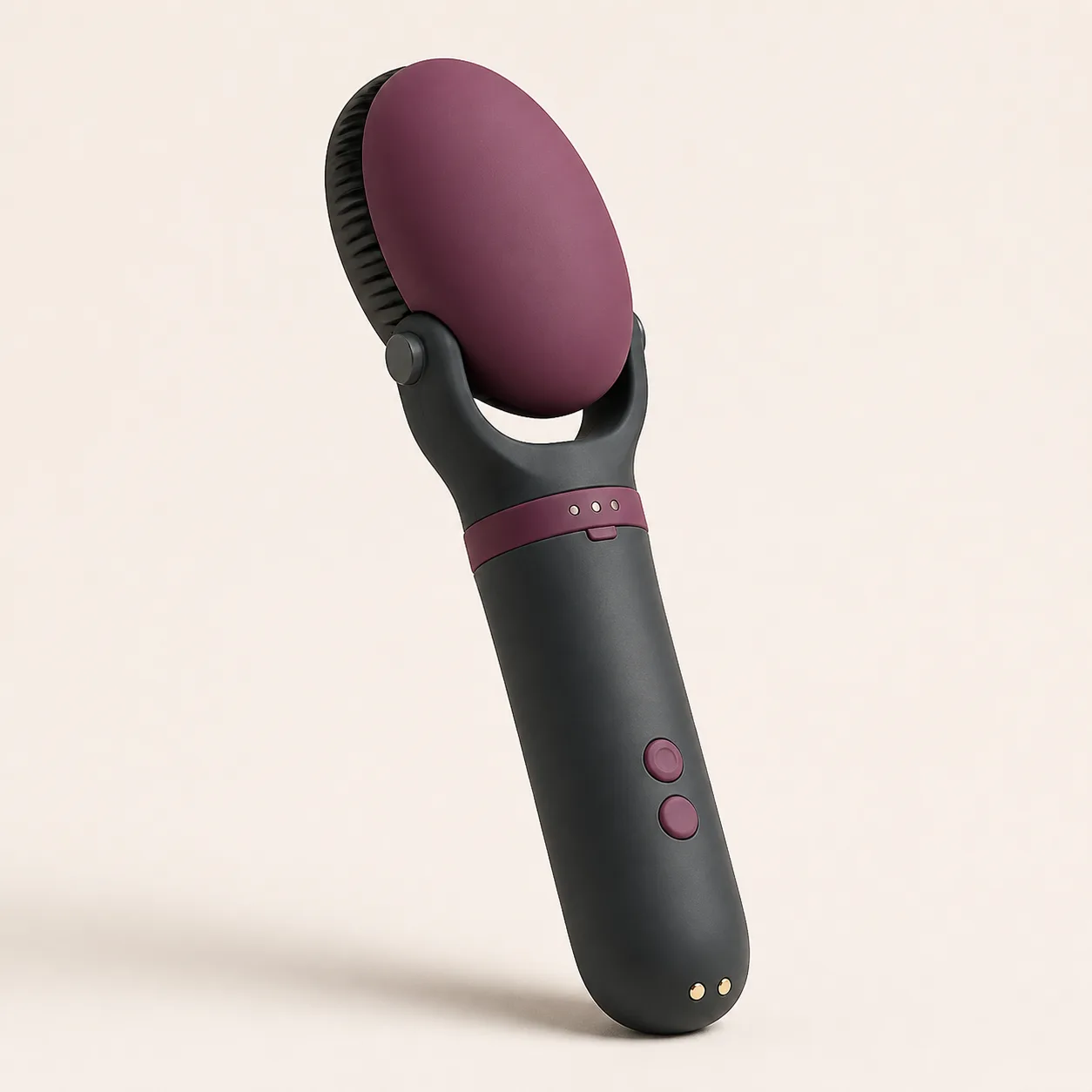
Reversible Twin-Face Oval Wand with Three-Stop Tilt Neck
A rechargeable wand concept with one fixed reversible oval head, smooth and ribbed contact faces, plus an indexed tilt collar for separately testable angles.
42,99 $
200 in stock
A fixed flip head changes surface without loose attachments
This reversible oval wand massager concept holds one non-removable oval head in a fork yoke. A broad smooth face and a shallow ribbed reverse face can be evaluated separately, while an indexed collar below the yoke represents three candidate neck angles pending confirmation.

The image does not prove face material, rotation range, three locking positions, motor count, output, waterproofing, runtime or approved body use.
Inventory two faces and two separate pivots
Request drawings and a bill of materials for the smooth face, ribbed face, head carrier, axle, yoke arms, bushings, flip stops, tilt collar, neck joint, lock tab, handle shell, actuators, controller, battery, buttons, contacts, pigments, seals, lubricants and adhesives.
Confirm whether head rotation and neck tilt use independent locks or share one mechanism.
Measure the head, yoke and handle from fixed datums
Record head length, width, thickness, face curvature, rib height and spacing, axle diameter, yoke gap, collar dimensions, handle length and circumference, control reach, charging-contact position and mass.
Measure overall reach at every verified tilt position and with each face oriented forward.
Characterize the broad smooth face by area and output
Map surface radius, usable contact area, amplitude, frequency, startup, decay, sound and temperature across the smooth face at every confirmed program and charge level.
Measure edge output and carrier vibration so the active area is not overstated.
Characterize the ribbed reverse face independently
Record rib count, height, pitch, tip radius, valleys, seam access and contact-area change under low compliant loads. Repeat the same vibration, sound and thermal map used for the smooth side.
A textured face can alter pressure and cleaning access even when driven by the same actuator.
Map the head flip from face to face
Rotate the head only through supplier-approved travel on a guarded fixture. Measure breakaway torque, running torque, stop angle, detent or latch engagement, free play and final face alignment in both directions.
Reject a head that can overrotate, collide with the yoke or stop between secure positions.
Build a face-and-tilt position matrix
For each verified neck angle, document which head faces can be locked without shell contact, covered controls or excessive cable strain. Record head centerline, handle axis and available yoke clearance.
Three indicator dots are not proof of three usable positions until every combination is tested.
Measure tilt-lock force and stability
Operate the low collar tab with the head unloaded and under small approved fixture loads. Record release force, angular travel, latch depth, rebound, one-handed access and resistance to accidental movement.
Confirm the neck cannot collapse suddenly if the lock is only partly engaged.
Inspect pinch clearances around axle and collar
Probe axle gaps, yoke arms, head edges, collar seams and lock-tab travel with standardized soft film and hair fixtures through the complete flip and tilt range.
Exclude positions that close on a probe, expose a hard edge or create a recess that cannot be seen and cleaned.
Compare free-air and compliant-load output
Run each face at confirmed settings in free air and against an instrumented compliant surface at several low loads. Record amplitude loss, contact spread, current, sound, temperature and any change in head or neck position.
Define a tested contact envelope before publishing pressure, intensity or stability language.
Keep grip force separate from head adjustment
Measure handle pressure distribution, control reach and device balance at all verified orientations. Confirm normal grip force cannot operate the collar tab, rotate the head, cover vents or bridge charging contacts.
Stop for loss of grip, unexpected head movement, numbness, discomfort, unusual heat or erratic controls.
Audit controls, charging and lockout behavior
Document button functions, press duration, program order, intensity steps, setting memory, travel lock, low-battery signal, contact polarity, cable specification, charger input, charge time, runtime and operation during charging.
Keep the product off and dry while charging unless exact instructions explicitly permit another condition.
Cycle both mechanisms with electrical checks
Run repeated face flips, tilt changes, lock engagements and compliant-load vibration cycles. At planned checkpoints inspect axle, bushings, yoke arms, head bond, collar, neck, wiring, buttons and contacts.
Track torque drift, free play, latch depth, output, current, sound, heat, cracks, whitening and intermittent power.
Verify materials and clean every rib and joint
Obtain exact formulations for both contact faces, carrier, axle, yoke, bushings, collar, neck, shell, buttons, seals, coatings, pigments, lubricants and adhesives plus restricted-substance, skin-contact, electrical and battery evidence.
Use only the verified cleaning method. Wipe rib valleys, face edges, axle ends, yoke gaps, collar seam, tab, buttons and contacts, then dry fully. Immersion, boiling, alcohol, bleach, abrasives and oils require explicit compatibility evidence.
Price the reversible mechanism after durability tests
An Alibaba rechargeable dual-sided wand listing currently shows USD 6.09-7.29 with an MOQ of one piece. It is a category benchmark only and does not confirm this fixed flip head, three-stop tilt neck or an approved supplier.
The procurement reference supports an EUR 42.99 planning price after allowing for China-origin freight, exact-part inventory, two-face output maps, flip torque and stop tests, face-and-tilt matrix, lock-force measurement, pinch-clearance inspection, loaded electrical and thermal review, joint cycle life, materials and battery documentation, cleaning validation, protective packing and discreet fulfillment. Exact quotation, packed dimensions, weight, freight, duty, tax, insurance, payment fees and delivery terms remain pending.
Frequently asked questions
Is the oval head removable?
No removable head is represented; the production attachment and service method still require confirmation.
Do both faces vibrate differently?
The surfaces differ, but actual amplitude, frequency and contact behavior must be measured on each face.
Are there exactly three neck angles?
The three dots are a design cue only until stable positions, stops and lock strength are verified.
Can the head rotate while running?
Do not adjust it under power unless exact instructions and sample testing explicitly permit that action.
Can the whole wand be immersed?
Ingress protection is unconfirmed; keep axle, collar, seams and charging contacts away from immersion until verified.
Which faults require retirement?
A loose axle, cracked yoke, failed stop, unstable tilt lock, lifted face, exposed wire, split seam, erratic control, unusual heat, battery swelling or corrosion.
Reviews
There are no reviews yet.