


Three-Recess Vibration-Damped Grip Wand with Upright Charging Dock
August 14, 2026
Turtle Mini Body Massager – Four-Roller Manual Design
August 14, 2026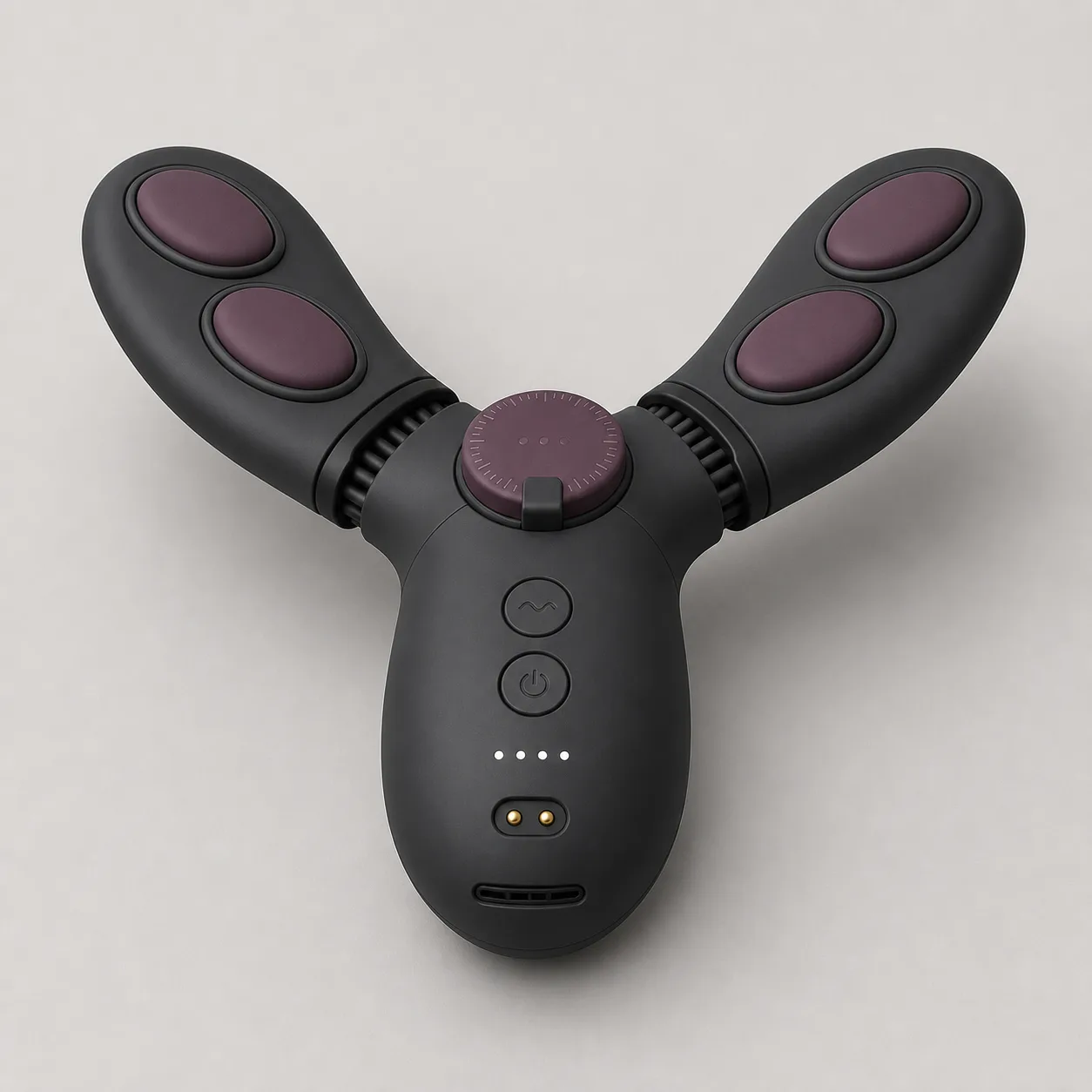
Four-Pad Split-Yoke Couples Vibrator with Three-Stop Span Dial
A Y-shaped couples vibrator concept with four guarded contact pads, two flexible wings and a lockable three-stop span dial.
69,99 $
200 in stock
Distribute four contact pads across a split yoke
This four-pad split-yoke couples vibrator concept divides a central charcoal control hub into two blunt flexible wings. Each wing carries two raised plum oval contact pads, making exactly four guarded faces, while a central three-stop span dial and separate lock tab are intended to index the opening between the wings.

The image does not prove adjustment range, retention, pad output, dimensions, material composition, sealing, charging safety, sound level or production availability.
Inventory both wing and drive paths
Request an exploded bill of materials for central hub, frame, left and right wings, flexible hinge zones, pad skins A1 through A4, pad carriers, guard rims, actuators, counterweights, mounts, span dial, three detents, links, hard stops, lock tab, two buttons, indicators, controller, cell, charging contacts, vent membrane, conductors, seals, pigments, lubricants and adhesives.
Trace every component to a drawing revision, tolerance, approved batch and reference sample.
Measure the complete Y-shaped geometry
Record hub axes, wing length and width, relaxed included angle, tip spacing, pad centers, pad projection, hinge thickness, dial diameter, control reach, contact recess, vent area, mass and center of gravity.
Compare left-right symmetry, wing twist, hub flatness and pad coplanarity before and after defined thermal and humidity conditioning.
Characterize all four pad faces
For A1 through A4, measure major and minor axes, crown, edge blend, texture, hardness, compression curve, recovery and friction. Inspect guard-rim height, surface seams, voids, hard inclusions, thin regions and pigment transfer.
Keep each pad identity through electrical and pressure testing; matching color does not establish matching response.
Map wing flex and hinge-zone strain
Measure force versus wing displacement at several span angles, plus torsion, rebound, hysteresis and permanent set. Track hinge-zone strain, internal frame movement, whitening, guard clearance and conductor bend radius.
Repeat under symmetric and one-wing loads so a compliant side cannot drive the opposite tip into an unintended hard position.
Calibrate the three-stop span dial
Measure dial angle, detent torque, backlash, hysteresis and resulting tip spacing at all three marks. Approach every stop from both directions and quantify how wing load changes the selected geometry.
A partially seated position must not masquerade as a stable stop or permit sudden span change during vibration.
Verify the lock tab stops and moving gaps
Record lock travel, engagement depth, actuation force and resistance to accidental brushing. Apply bounded wing flex, hub torsion and powered vibration while locked, then remeasure dial position and tip spacing.
Use articulated gauges around the hinge zones, dial, tab, pad rims, controls, charging recess and vent through the full adjustment envelope.
Map output at every pad station
Measure three-axis acceleration, displacement, frequency, harmonics, rise, decay and repeatability at the center and perimeter of A1 through A4. Test every program at all span stops, battery states and representative compliant loads.
Document whether the four pads share one actuator path or have separate sources; appearance alone cannot establish motor count or independence.
Resolve phase balance and cross-coupling
Synchronize the four output traces to measure relative phase, beat frequency, startup skew, drift and program transitions. Track hub and wing-root acceleration to identify unintended structural amplification or cancellation.
Compare equal and asymmetric pad loading and investigate a face that falls out of phase, becomes dominant or transfers excessive vibration into a control area.
Map contact pressure and span retention
Use paired compliant fixtures to record contact area, peak pressure, load sharing and tip migration at each span stop. Test centered, offset and rotated configurations without assigning an unverified body-fit claim.
Reject guard-rim contact, unstable wing roll, progressive tightening, dial creep, hard hinge contact or loss of a clearly accessible release state.
Evaluate hub grip and local controls
Measure dry and damp grip friction, pressure distribution, button reach and accidental dial or lock contact in several hand fixtures. Confirm that either control can stop the device without covering the vent or charging recess.
Button symbols, presses, lockout and indication must remain understandable when the wings are flexed or the hub is held off axis.
Verify charging power loss and local shutdown
Document charging polarity, specified lead, input limit, cell chemistry and capacity, protection circuits, charge time, runtime, low-voltage behavior and operation-during-charge interlock. Interrupt power in every mode and span position and confirm a predictable off state.
Ingress and washability claims remain pending until hinge zones, dial, lock, controls, contacts, vent and pad interfaces pass suitable tests.
Log current sound and temperature
Measure operating current, accessible temperature, actuator and cell hot spots and A-weighted sound at a stated distance for every program and span stop. Repeat under equal load, one-wing load, one protected pad obstruction and low battery.
Investigate current spikes, hinge chatter, shell resonance, pad imbalance, dial movement, asymmetric heat or intermittent indicators.
Challenge faults then cycle clean and inspect
Simulate false detent seating, lock wear, one restrained wing, one obstructed pad, vent blockage and bounded conductor strain in protected samples. Stop before damage and quarantine units with uncontrolled motion, cracks, exposed parts or failed shutdown.
Cycle span selection, locking, wing flex, output programs, compliant loading, charging, defined cleaning, measured drying and storage. Recheck geometry, pad surfaces, hinge strain, detents, lock force, output balance, pressure, controls, contacts, temperature and seams.
Build landed price after four-pad proof
An Alibaba wireless couples-vibrator page currently shows a category example at USD 2.85-3.56 with MOQ one. It is a benchmark only and does not confirm this split-yoke geometry, four-pad architecture, span dial or an approved supplier.
The procurement reference supports an EUR 69.99 planning price after allowing for China-origin freight, exact-model sourcing, four-pad and wing metrology, span and lock calibration, output, phase and pressure mapping, electrical, current, sound and heat tests, protected fault and cycle work, protective packing and discreet fulfillment. Exact quotation, MOQ, materials, battery, software if any, packed size, weight, freight, duty, tax, insurance, payment fees, certifications and delivery terms remain pending.
Frequently asked questions
Can the wing spacing be adjusted while running?
That procedure is unconfirmed; dial force, locking, moving gaps and powered stability must be tested before instructions are set.
Do all four pads have separate motors?
Motor count is unknown until teardown and synchronized output measurements identify each drive path.
What do the three dial stops mean?
They are intended to index wing span, subject to measured tip spacing, detent accuracy, load stability and repeatability.
Can one wing close unexpectedly?
False seating, lock wear, asymmetric loading and vibration need deliberate tests across the full span envelope.
Is the device waterproof?
No ingress claim is confirmed; hinges, dial, lock, buttons, contacts, vent and pad interfaces require evidence.
Which faults require retirement?
Wing cracks, permanent hinge set, loose pads, guard damage, dial creep, failed locking, exposed contacts, abnormal heat, cell swelling or persistent residue.
Reviews
There are no reviews yet.