



White Lace-Bust Satin Spaghetti-Strap Nightdress with Blue Bows
August 14, 2026
Split-Crescent Alternating-Rocker Wand Massager
August 14, 2026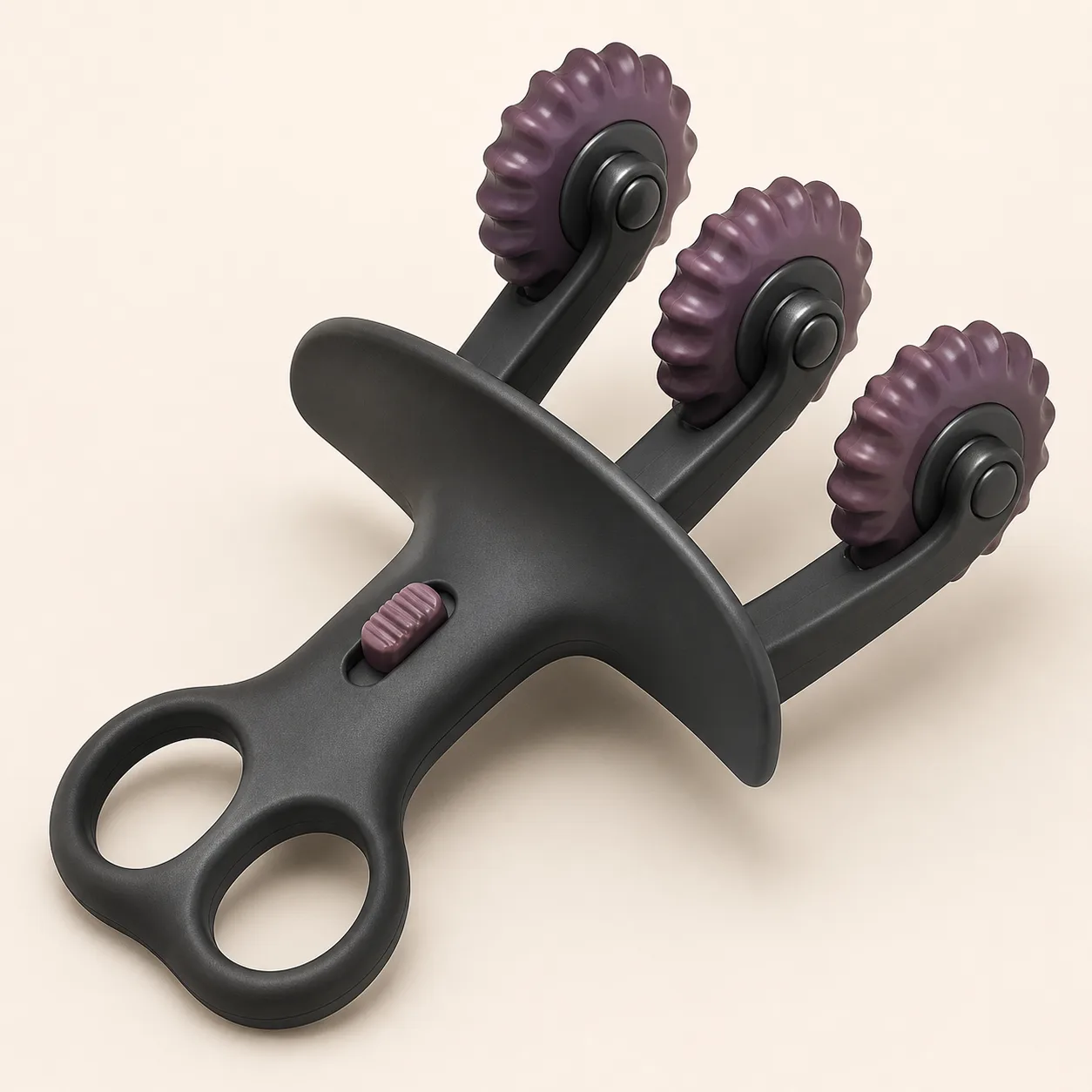
Three-Wheel Staggered-Track Sensory Roller with Independent Arms, Curved Hand Shield and Twin Finger Rings
A manual BDSM sensory-tool concept with three rounded-scallop wheels on staggered independent arms, one curved hand shield, one slider and two oval finger rings.
44,99 $
200 in stock
Roll three staggered sensory tracks from one guarded handle
This three-wheel staggered-track sensory roller concept separates three smoky-plum rounded-scallop wheels onto three independent charcoal arms. One curved shield protects the grip area, two oval finger rings stabilise the handle and one plum slider is reserved for a lock function pending mechanical tests.

The rendering establishes visible architecture only. Tooth dimensions, rolling force, lock action, materials and safe-use limits remain pending evidence.
Keep the inventory to one complete manual tool
The planned sales unit contains one non-powered roller. A case, cleaning brush, spare wheel, lubricant, cuff, chain and replacement axle are excluded unless the approved packing list changes.
No battery, motor, remote or application is part of the concept.
Mount exactly three wheels on separate axle stations
Label wheels W1, W2 and W3 and record diameter, thickness, runout, lateral play and mass. Each station should roll independently so one stalled wheel does not hide a fault in the others.
No fourth wheel or smooth guide disc is included.
Offset three arm lengths into a gentle diagonal track
Measure the forward offset, lateral spacing, parallelism and height of every arm relative to the shield. Map where the three tracks overlap or separate at different handle angles.
The staggered layout differs from a pair of parallel wheels and must be assessed for unintended concentration at the leading track.
Round every shallow scallop instead of using sharp points
Profile each wheel around its full circumference, recording scallop count, crown radius, valley radius, pitch and local hardness. Screen for mould flash, chipped edges and uneven coating before and after rolling cycles.
The design does not include needles, blades or pointed spikes, and it is not intended to cut or break skin.
Validate guarded axles and low-friction wheel rotation
Measure breakaway torque and running torque for W1, W2 and W3 dry and after approved cleaning. Check axle caps, washers, bushings and arm slots for migration, wobble, seizure or pinch gaps.
Bearing type, lubrication and serviceability remain pending supplier drawings and teardown samples.
Use one broad curved shield between wheels and grip
Record shield span, depth, edge radius, flex and clearance from all three arms. Apply foreseeable forward loads and confirm that the shield does not crack, fold toward the wheels or expose a sharp joint.
The shield is a hand-position boundary, not protective equipment.
Stabilise the grip with two oval finger rings
Measure both ring openings, wall thickness, separation and edge finish across production samples. Test a range of adult hand sizes without assuming that every user can place two fingers comfortably.
Users should release the tool rather than forcing fingers through rings that bind, numb or restrict circulation.
Define the plum slider only after lock testing
Document slider travel, detent force, locked and unlocked states, visual feedback and failure behaviour. Cycle the mechanism while pulling and twisting the handle to detect false seating or accidental movement.
No wheel brake, transport lock or exposure-control claim is made until the mechanism is verified.
Map force pressure and trace spacing before publishing intensity
Use compliant test surfaces to measure handle force, wheel load and local pressure at multiple angles and speeds. Compare single-track entry, all-three-wheel contact and uneven loading caused by the staggered arms.
Intensity, precision and uniform-pressure claims remain withheld without repeatable data.
Set conservative consensual-use boundaries
Begin with minimal pressure and slow movement on intact external skin, maintaining a clear stop signal and continuous consent. Avoid the eyes, face, front and sides of the neck, broken or irritated skin, prominent bones and areas with reduced sensation.
Stop immediately for sharp pain, numbness, tingling, discoloration, swelling, dizziness or skin damage. This tool is not a medical or therapeutic device.
Screen gaps hair traps and cleaning access
Probe clearances around each axle cap, wheel, arm root, shield edge, slider and finger-ring junction. Check whether hair, fibres or skin can enter a moving gap under foreseeable angles and loads.
Do not use the roller if a wheel binds or if a gap can trap tissue.
Verify materials coatings adhesives and corrosion resistance
Request traceable composition for wheels, arms, axles, caps, shield, slider and handle, including coatings, pigments, lubricants and adhesives. Test restricted substances, abrasion, colour transfer and corrosion after repeated cleaner exposure.
Metal, stainless steel, ABS, latex-free, hypoallergenic and body-safe claims remain withheld without evidence.
Clean dry store and inspect all three tracks
Use only a validated cleaner and moisture limit. Rotate W1, W2 and W3 while cleaning every scallop and axle boundary, then dry the shield, slider, rings and arm roots completely before storage.
Stop using the tool if a wheel chips, seizes or wobbles; an axle shifts; an arm or shield cracks; the slider drifts; corrosion appears; or residue cannot be removed.
Price from public sensory-roller references and validation reserves
An Alibaba BDSM pinwheel page displayed a sensory-roller category example at USD 6.20 to 6.60 with MOQ 1. This is a broad benchmark, not a quotation for the three-arm staggered design or an approved supplier.
The public procurement benchmark supports an EUR 44.99 planning price after provisional allowance for China-origin freight, three-wheel inventory, scallop metrology, independent torque tests, staggered-track mapping, shield and grip validation, lock cycling, material and corrosion evidence, protective packing, discreet fulfilment and expected mechanism loss. Exact supplier, quote, MOQ, dimensions, materials, packed weight, freight, duty, tax, certification, payment terms, lead time and production availability remain pending.
Frequently asked questions about the three-wheel roller
How many rolling wheels are included?
Exactly three rounded-scallop wheels are proposed on three separate arms.
Are the three wheels arranged in parallel?
No. Their arm lengths create a staggered track whose spacing and pressure still require measurement.
Does the tool have sharp needles?
No needles or blades are included; every shallow scallop is intended to have a rounded crown pending inspection.
What does the slider control?
A lock function is proposed, but its states, retention and failure behaviour remain pending physical tests.
Is the tool powered?
No. The planned unit is manual and excludes batteries, motors, remotes and cables.
What material is used?
No wheel, axle, arm, shield or handle material is claimed until traceable specifications and samples are verified.
Reviews
There are no reviews yet.