


Three-Roller Bridge Wand Massager with Independent Axle Gaps
August 14, 2026
Four-Leaf Overlap-Shear Wand Massager with Three-Stop Travel Collar
August 14, 2026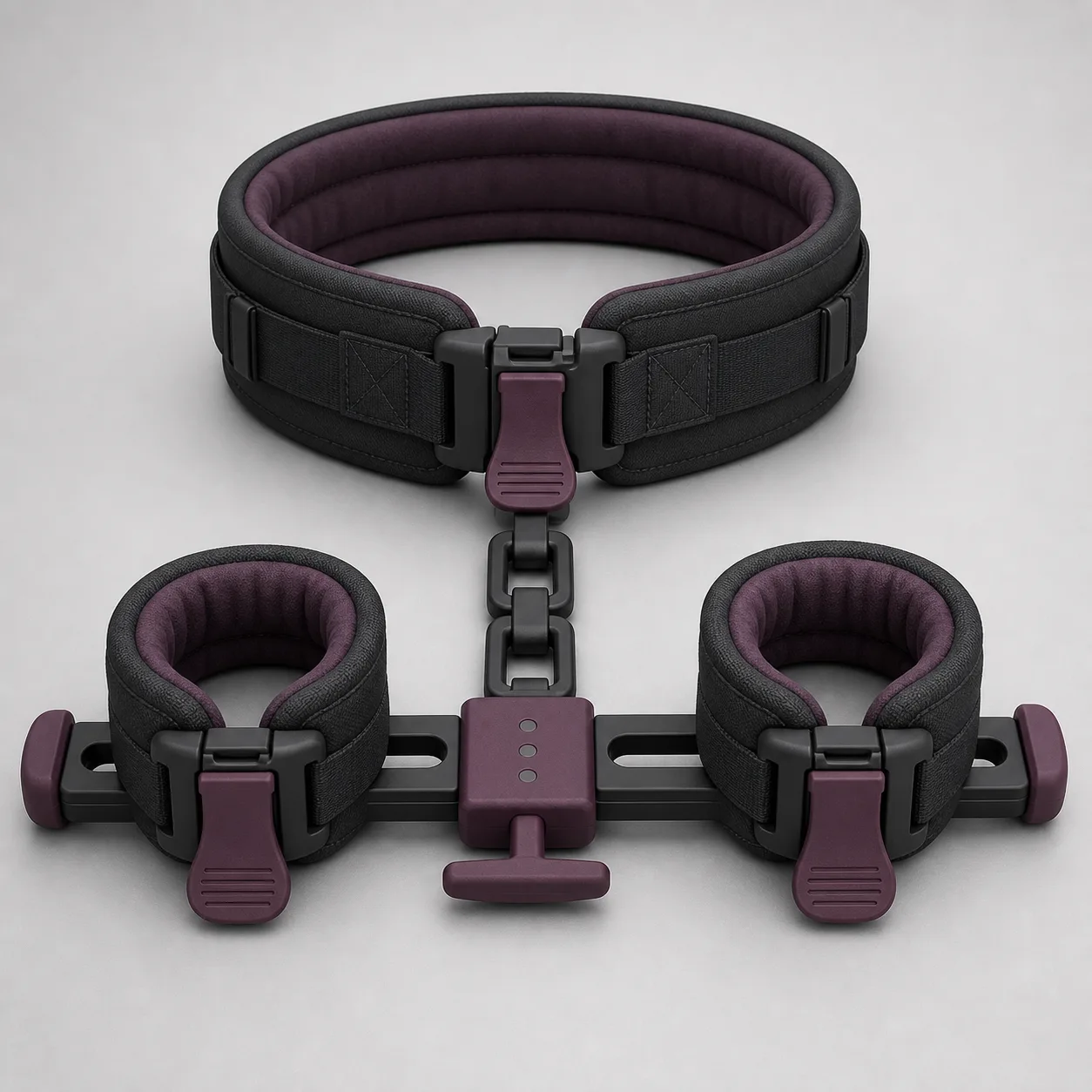
Three-Link Floating Posture Collar Restraint with Twin Sliding Wrist Cuffs
A connected padded restraint concept with one collar, two sliding wrist cuffs, an articulated bridge, three spacing positions and multiple quick releases.
59,99 $
200 in stock
Connect one padded collar to two sliding cuffs
This three-link floating posture collar restraint concept connects a broad padded collar to exactly two wrist cuffs through a short articulated bridge and transverse guarded rail. Each cuff has its own oversized release tab; a central three-position spacing slider and separate master pull-release bar are intended to control the rail assembly.

The image does not prove fit range, posture geometry, load distribution, release timing, material composition, hardware strength or production availability. This concept is not intended for suspension.
Inventory the entire connected assembly
Request a bill of materials for collar shell, lining, padding, binding, adjustment webbing, main buckle, collar pull tab, rear reinforcement, three bridge links, pins, guards, transverse rail, two cuff carriages, end stops, spacing slider, three detents, master release bar, cuff shells, cushions, adjustment ladders, cuff buckles, individual release tabs, thread, coatings, pigments and adhesives.
Map each component to drawing revision, tolerance, batch, stitch specification and approved sample.
Measure collar geometry and adjustment overlap
Record collar width, padding thickness, inner circumference range, adjustment increment, minimum overlap, edge radii, buckle dimensions, tab reach and rear attachment position. Check closed circularity and local thickness around reinforcement.
Verify that adjustment tails, buckle wings and the bridge attachment do not create hard pressure points or obscure the collar release.
Characterize both wrist cuffs independently
For the left and right cuffs, measure internal circumference range, width, cushion thickness, edge blend, ladder pitch, closure overlap, release travel and tab projection. Compare padding compression, recovery, rotational slip and closure force.
Reject exposed reinforcement, inward cushion folds, sharp ladder edges, false latching or unequal fit between the matched cuffs.
Map carriage travel along the guarded rail
Measure rail length, usable travel, carriage alignment, lateral play, friction, end-stop clearance and cuff center spacing at every permitted position. Apply low controlled axial, side and twisting loads to each carriage separately and together.
Check every carriage, slot, stop, slider and cuff-root gap with articulated probes through full travel and rotation.
Calibrate all three spacing positions
Measure slider travel, detent force, latch depth, hysteresis, rebound and resulting cuff spacing at each mark. Approach every position from both directions and inspect for an apparently seated but incompletely engaged state.
The selected spacing must remain stable under the stated low-load envelope without allowing a carriage to climb a stop or cross the center block.
Characterize the floating three-link bridge
Measure link lengths, pin diameters, joint angles, axial play, lateral play, yaw, pitch, roll and end clearances. Track rail orientation as the collar fixture and cuff rail move through the proposed supervised envelope.
Identify link stacking, joint inversion, guard contact, pin migration, excessive slack and any geometry that transfers concentrated force into the collar rear.
Time all three individual quick releases
Measure opening direction, pull force, travel, response time and dry and damp access for the collar buckle and both cuff tabs. Test each release unloaded and under low controlled load from several reachable directions.
One release must not tighten or jam another closure, and every opened part must visibly disengage without a hidden second action.
Verify the master pull-release bar
Document exactly what the central bar releases, its direction, force, travel, response time and reset sequence. Challenge side pull, partial pull, rail twist, carriage contact and one falsely seated spacing detent.
The bar must remain distinguishable from the spacing slider and accessible without reaching beneath a loaded rail or guarded slot.
Map pressure and circulation indicators
Use instrumented cylindrical fixtures to map circumferential pressure at collar and cuffs across their confirmed fit ranges. Repeat after padding compression, rail offset and low asymmetric load.
Instructions must require continuous monitoring for numbness, tingling, discoloration, cold skin, swelling, breathing difficulty, dizziness, pain or distress, with immediate release at any warning sign or withdrawn consent.
Trace low-load distribution through the posture path
Instrument collar rear, all bridge joints, rail center, both carriages and cuff roots to measure force distribution under small symmetric and asymmetric inputs. Record dynamic peaks from slow supervised movement.
No test result should be extended to suspension, body-weight restraint, impact loading or unattended use; those conditions remain outside the proposed scope.
Inspect textiles stitching and rigid hardware
Verify textile composition, weave, abrasion, colorfastness, sweat and cleaner compatibility, padding density and recovery, thread specification, stitch count, seam allowance and reinforcement placement. Inspect pins, buckles, rail, carriages, stops and coatings for burrs, cracks, corrosion and loose parts.
Load ratings, material identity and restricted-substance status require traceable supplier and laboratory evidence.
Write an emergency-first supervised protocol
Define informed consent, a sober observer, communication method, a tested stop signal, release rehearsal, accessible shears, circulation intervals, maximum session limits and clear exclusion conditions. Keep the collar and every release visible and reachable.
Never use for suspension, sleep, transport, intoxication, unattended restraint, breathing restriction or any situation where rapid voluntary withdrawal cannot be honoured.
Challenge faults then cycle clean and inspect
Simulate false latch seating, rising joint play, one jammed carriage, stop compression, tab obstruction and off-axis master pull in protected fixtures. Stop before damage and quarantine assemblies with delayed opening, pin movement, torn stitching or deformed hardware.
Cycle fit adjustment, closure, spacing selection, bridge articulation, low-load movement, every release, cleaning, measured drying and storage. Recheck dimensions, padding, pressure, latches, detents, joints, rail, carriages, stops, seams and coatings.
Build landed price after release proof
An Alibaba bondage-cuff page currently shows an adjustable PU wrist or ankle cuff category example at USD 0.67-0.69 with MOQ one. It is a benchmark only and does not confirm this connected collar, articulated bridge, sliding-cuff rail or an approved supplier.
The procurement reference supports an EUR 59.99 planning price after allowing for China-origin freight, exact-model sourcing, collar and cuff fit metrology, padding and pressure review, rail and bridge characterization, spacing calibration, individual and master-release testing, textile and hardware evidence, protected fault and cycle work, protective packing and discreet fulfillment. Exact quotation, MOQ, materials, load limits, packed size, weight, freight, duty, tax, insurance, payment fees, certifications and delivery terms remain pending.
Frequently asked questions
Is this assembly suitable for suspension?
No. The proposed scope excludes suspension, body-weight loads, impact loading and unattended restraint.
What does the center spacing slider change?
It is intended to index cuff-center spacing at three positions, subject to measured travel, detent security and low-load stability.
Does the master bar open every closure?
Its exact function is unconfirmed and must be mapped separately from the collar and individual cuff releases.
How should fit be checked?
Confirmed circumference limits, pressure mapping and frequent circulation checks are required, with immediate release at any warning sign.
Can one person use it alone?
No; the concept requires a sober, attentive observer, rehearsed releases, continuous communication and accessible safety tools.
Which faults require retirement?
Torn padding, stretched anchors, false latching, delayed release, pin migration, growing joint play, jammed carriage, crushed stop, corrosion or persistent residue.
Reviews
There are no reviews yet.