


Three-Wheel Staggered-Track Sensory Roller with Independent Arms, Curved Hand Shield and Twin Finger Rings
August 14, 2026
Twin-Scale Sliding Hobble Strap with Independent Ankle Cuffs
August 14, 2026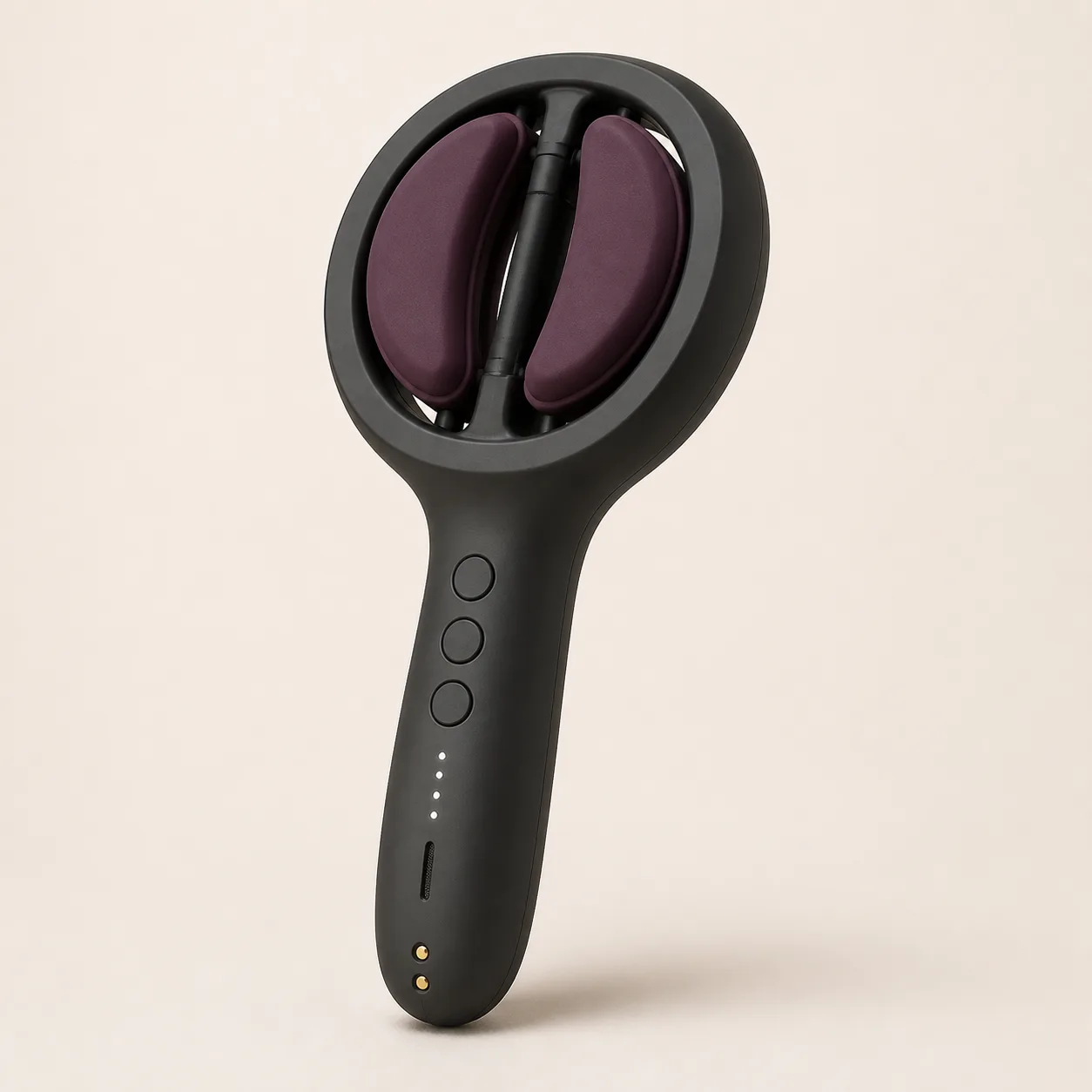
Split-Crescent Alternating-Rocker Wand Massager
A rechargeable wand concept with two mirrored crescent pads proposed to rock alternately inside a broad oval protective rim.
48,99 $
200 in stock
Divide the wand face into two mirrored crescents
This split crescent wand massager concept places two separate crescent-shaped contact pads inside a broad oval rim. Each half is proposed to rock around its own transverse axle, with alternating timing across a guarded central spine rather than a single flexible dome.

The image does not prove rocker travel, independent actuation, alternating timing, output, gap protection, ingress rating, runtime, materials or supplier approval.
Inventory the complete split head
Request an exploded drawing and bill of materials for both crescent skins, cores, carriers, transverse axles, pins, bushings, stops, guards, center spine, outer rim, frame, actuators, counterweights, links, sensors, controller, neck, handle shell, buttons, indicators, vent, cell, contacts, conductors, seals, pigments, lubricants and adhesives.
Identify shared shafts or cams that could couple the two sides.
Measure the oval head geometry
Record outer length, width and depth, rim projection, crescent face area, thickness, inner and outer radii, center-gap width, axle position, neutral tilt, guard clearance, neck angle, handle dimensions, control positions, vent area, contact spacing, mass and center of gravity.
Compare left and right components rather than assuming perfect mirror symmetry.
Map both rocker mechanisms
Track inward and outward angle, face displacement, axle play, stop contact, carrier tilt, actuation force, hysteresis and neutral-position error for each crescent. Repeat under no load and standardized compliant preload.
Reject a carrier that binds, contacts the rim or parks against only one side of its guard.
Verify alternating timing
Record startup, peak tilt, crossover, dwell, decay and neutral parking for both halves. Repeat across programs, intensity levels, charge states, temperatures and compliant loads.
Log phase drift, skipped movement, asymmetric overlap and transitions that drive both inner edges toward the spine together.
Separate rocking from vibration output
Measure three-axis acceleration, dominant frequency, harmonics, rocker angle, sound, current and handle transfer at each crescent. Compare isolated, synchronized and alternating operation where supported.
Visible pad travel alone does not establish vibration amplitude or frequency.
Map pressure across both crescents
Use instrumented compliant surfaces to record contact footprint, peak and edge pressure, shear, rocking and migration as handle angle and preload change. Include centered, off-center and single-half contact.
Set limits from inner-edge peaks, rim contact and mechanism strain rather than average face pressure.
Probe the guarded center gap
Measure crescent-to-spine, crescent-to-rim, carrier-to-guard, axle-end and stop clearances throughout full travel and loading. Use articulated probes from front, rear and side approaches.
Reject a gap that pinches hair, film or loose material, traps debris, hides a cracked carrier or closes under preload.
Validate the outer protective rim
Measure rim stiffness, edge radius, face projection, hard-stop margin and deformation under centered and asymmetric loads. Confirm the rim prevents mechanism contact without becoming the dominant pressure edge.
Inspect the rim-to-neck load path after drops and repeated head loading.
Balance the handle for angled contact
Record wrist moment, grip friction, center-of-pressure shift and control reach at multiple head orientations. Measure vibration transfer into the handle while one or both crescents are loaded.
Test dry and damp hands without using the moving rim as a grip.
Document the three-button control map
Verify startup hold, intensity adjustment, rocker or program selection, alternate-direction choice if present, pause, immediate stop, memory, lockout and indicator meanings. Confirm a jam fault cannot be cleared without inspection.
Four visible lights prove no fixed program count.
Verify battery and charging limits
Confirm cell chemistry, capacity, protection, charger input, contact polarity, charge time, runtime method, storage voltage, charging interlock and transport paperwork. Inspect conductor routing through the neck into both head channels.
Test contact contamination and low-voltage shutdown without claiming waterproofing.
Test heat and half-head obstruction
Log temperature at both crescents, axles, spine, rim, neck, handle, controls, vent, contacts, actuator zones and cell. Obstruct one crescent and then both inner edges using protected fixtures.
Verify current limiting, shutdown, neutral release, cool-down and restart behavior without forcing a stalled rocker by hand.
Cycle alternating motion with cleaning
Run repeated isolated, synchronized and alternating programs, compliant loading, immediate stops, charging, cleaning, measured drying and storage. At checkpoints repeat head geometry, rocker play, phase, output, pressure, gap, rim, sound, current and heat tests.
Validate access beneath both pad edges, along the center spine, around axle guards, inside rim channels, at the neck, controls, vent and contacts.
Price after split-head fatigue testing
An Alibaba magic-wand-vibrator showroom currently displays a rechargeable portable wand category example at USD 1.49-1.99 with MOQ three. It is a sourcing benchmark only and does not confirm this split-crescent rocker head, alternating drive or guarded central spine.
The procurement reference supports an EUR 48.99 planning price after allowing for China-origin freight, exact-model sourcing, teardown, split-head metrology, rocker kinematics, alternating-phase analysis, per-half output, pressure maps, center-gap and rim inspection, handle transmission, controls, battery, thermal and obstruction review, combined cycle life, material evidence, cleaning validation, protective packing and discreet fulfillment. Exact quotation, MOQ, packed size, weight, freight, duty, tax, insurance, payment fees and delivery terms remain pending.
Frequently asked questions
Are both crescent pads independently driven?
That remains pending teardown, per-half current and isolation measurements.
Do the halves always alternate?
Supported modes, phase timing and neutral parking require instrumented verification.
Can the center gap pinch?
Every inner-edge and spine clearance needs full-travel, loaded probe testing.
Does the rim contact the body?
Its projection, deformation and pressure share must be mapped under representative loads.
Is the head waterproof?
No ingress claim is made for multiple moving pads, axles and guarded channels.
Which faults require retirement?
A loose pad, seized rocker, widening axle play, closing gap, cracked spine, deformed rim, exposed conductor, swollen cell, erratic timing or abnormal heat.
Reviews
There are no reviews yet.