


Four-Channel Cross-Hub Under-Mattress Restraint with Padded Cuffs
August 14, 2026
Four-Sector Load-Balancing Ankle Cuffs with Captive Swivel Link
August 14, 2026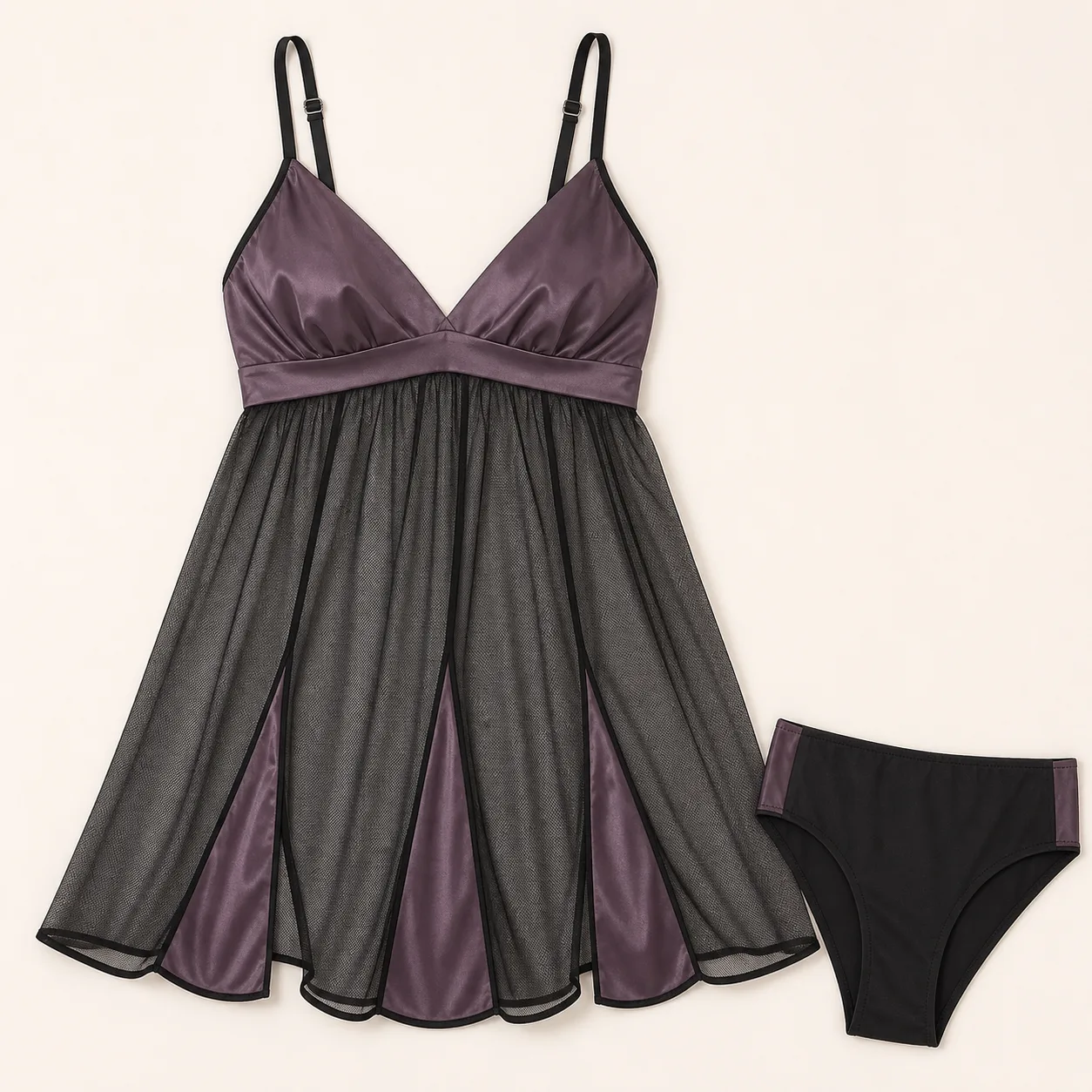
Three-Gore Adjustable Mesh Babydoll Set
A two-piece black mesh babydoll concept with a smoky-plum bust band, three satin skirt gores, adjustable shoulder straps and a matching brief.
36,99 $
200 in stock
Read the three-gore silhouette at a glance
This three-gore adjustable mesh babydoll set is a two-piece lingerie concept built around one black mesh chemise and one matching brief. A smoky-plum bust band anchors the shape, while exactly three separate satin gores interrupt the skirt with controlled colour and three softly divided hem sections.

The rendering communicates design intent only. It does not establish fibre composition, final opacity, size range, colour accuracy or manufacturing readiness.
Confirm what belongs in the two-piece set
The proposed pack contains one chemise and one closed brief. Stockings, jewellery, robes, hangers and decorative props are not part of the concept. Before ordering, the purchase specification should name every included component, its colour code and its individual inspection criteria.
A sealed sample pack must also show whether labels, care information and size markings are attached to each garment or supplied only on the outer pack.
Translate flat measurements into useful sizing
For the chemise, record bust width, underbust width, waist sweep, hem sweep, centre-front length, centre-back length and the minimum and maximum strap setting. For the brief, measure waist, hip, front rise, back rise, gusset width and leg opening under a documented low-tension method.
Supplier letters such as S, M or L are insufficient without the corresponding garment dimensions, permitted tolerances and body-measurement guidance.
Map fit preferences before publishing a chart
Some shoppers may prefer a closer bust band and a floating skirt, while others may select more room through the band. Graded samples should therefore be reviewed for band stability, cup coverage, skirt drape, brief rise and elastic pressure across the complete proposed range.
Final fit guidance remains pending pattern grading and consenting-adult apparel trials; no universal fit promise is made.
Evaluate the plum bust band as a structural zone
Inspect the band for width consistency, lining layers, stretch direction, seam bulk and stability after cyclic extension. Compare left and right cup alignment, neckline binding and the centre join under the same flat-lay conditions used for measurement.
The visible satin-like finish is not evidence of a particular fibre, weave or lining construction. Those attributes require a bill of materials and fabric test reports.
Examine mesh drape without guessing performance
Record the mesh mass per area, aperture, stretch, recovery, snag resistance and light transmission. Evaluate how gathering beneath the band changes spacing and transparency, then repeat after wash and wear simulations.
Photographic appearance can vary with lighting, tension and background, so exact coverage and breathability claims stay unconfirmed until samples are tested.
Understand the purpose of three satin gores
Gores G1, G2 and G3 should be documented separately for width, length, shade, edge piping and seam allowance. Their spacing should remain visually balanced across sizes without narrowing the surrounding mesh into weak stress channels.
Inspect each lower point for twisting, puckering and exposed thread ends, and confirm the divided hem hangs evenly after laundering.
Review two adjustable shoulder straps
Measure both straps through their complete adjustment range, then test slider grip, elastic recovery and anchor reinforcement. Hardware edges should be smooth, corrosion resistance should be documented and adjustment should not produce sharp folds beside the neckline.
The exact metal finish, coating and load tolerance remain pending supplier disclosure and sample inspection.
Inspect the matching brief as its own garment
The brief needs a separate size specification covering waistband tension, leg elastic, rise, gusset dimensions, internal seams and side binding. Confirm that the smoky-plum side accents match the chemise under standardized lighting.
Gusset layers, fibre content, hygiene liner and coverage are not inferred from the rendering and must be approved from physical samples.
Test movement, stretch and recovery together
Use repeated low-force extension cycles on the bust band, mesh, straps, waistband and leg openings. Record permanent growth, elastic waviness, seam distortion and slider movement, then compare results after the proposed care cycle.
Movement review should cover sitting, walking and gentle torso rotation under a controlled apparel protocol without turning fit observations into medical or comfort guarantees.
Assess seams, piping and contact surfaces
Check stitch density, skipped stitches, seam allowance, thread ends and piping continuity at cups, band, gores, hem, strap anchors and brief openings. Internal surfaces should be inspected for abrasive ridges or exposed hardware.
Set measurable acceptance limits for seam strength and visual defects before any production batch is approved.
Check opacity, dye behaviour and care together
Run dry and damp rub tests, wash testing and a perspiration-simulant check on the black mesh, plum sections, binding and elastic. Record colour transfer, shade change, shrinkage, mesh distortion and hardware discolouration.
Care wording must follow the weakest verified component. Hand-wash, temperature, drying and detergent advice all remain pending validated material data.
Prepare a sample-approval file
The approval pack should include front and back photographs, graded measurements, tolerance tables, fibre declarations, trim specifications, colour references, care label, country of origin, safety information and signed inspection results.
Supplier identity, exact model, available colours, production status, quality certificates and legal-market suitability are still pending confirmation.
Protect both garments through packing and fulfilment
Specify a snag-resistant individual pouch, protective folding method, moisture control, lot code, size identification and an inspection seal appropriate for intimate apparel. Measure the completed pack instead of estimating freight from garment appearance.
Packed weight, carton quantity, freight class, China-origin shipping cost and warehouse handling procedure remain pending.
Set a planning price from a cautious benchmark
An Alibaba babydoll-lingerie category page displayed one sheer babydoll example at USD 2.97 to 3.60 with a three-set minimum. This is a broad category reference only; it is not a quote for this three-gore design and does not identify an approved factory.
The public procurement benchmark supports an EUR 36.99 planning price after provisional allowance for China-origin freight, graded samples, fit review, fibre and dye checks, stretch, seam, colourfastness, wash and packaging tests, discreet fulfilment and expected apparel handling loss. Exact purchase price, supplier, MOQ, size range, colours, composition, packed weight, freight, duty, tax, certification, payment terms and lead time remain pending.
Frequently asked questions
How many garments are included?
The concept contains exactly two pieces: one mesh babydoll chemise and one matching brief.
How many coloured skirt inserts are shown?
Exactly three separate smoky-plum satin gores are spaced through the lower skirt.
Can the shoulder straps be adjusted?
The concept shows two adjustable straps; their final range and slider holding force require sample testing.
What is the fabric composition?
No fibre claim is made until traceable supplier declarations and fabric samples are reviewed.
Which sizes will be available?
The sellable range and measurement chart remain pending graded samples and fit approval.
Are stockings or accessories included?
No. The proposed set is limited to the chemise and matching brief shown in the flat lay.
Related products
-
ESSENTIAL LINGERIE UNDERWEAR
89,00 $ -
CLASSIC LINGERIE BRA
119,00 $


Reviews
There are no reviews yet.