



Three-Stop Cam-Compression Wand Massager with Adjustable Head Collar
August 14, 2026
Three-Gore Adjustable Mesh Babydoll Set
August 14, 2026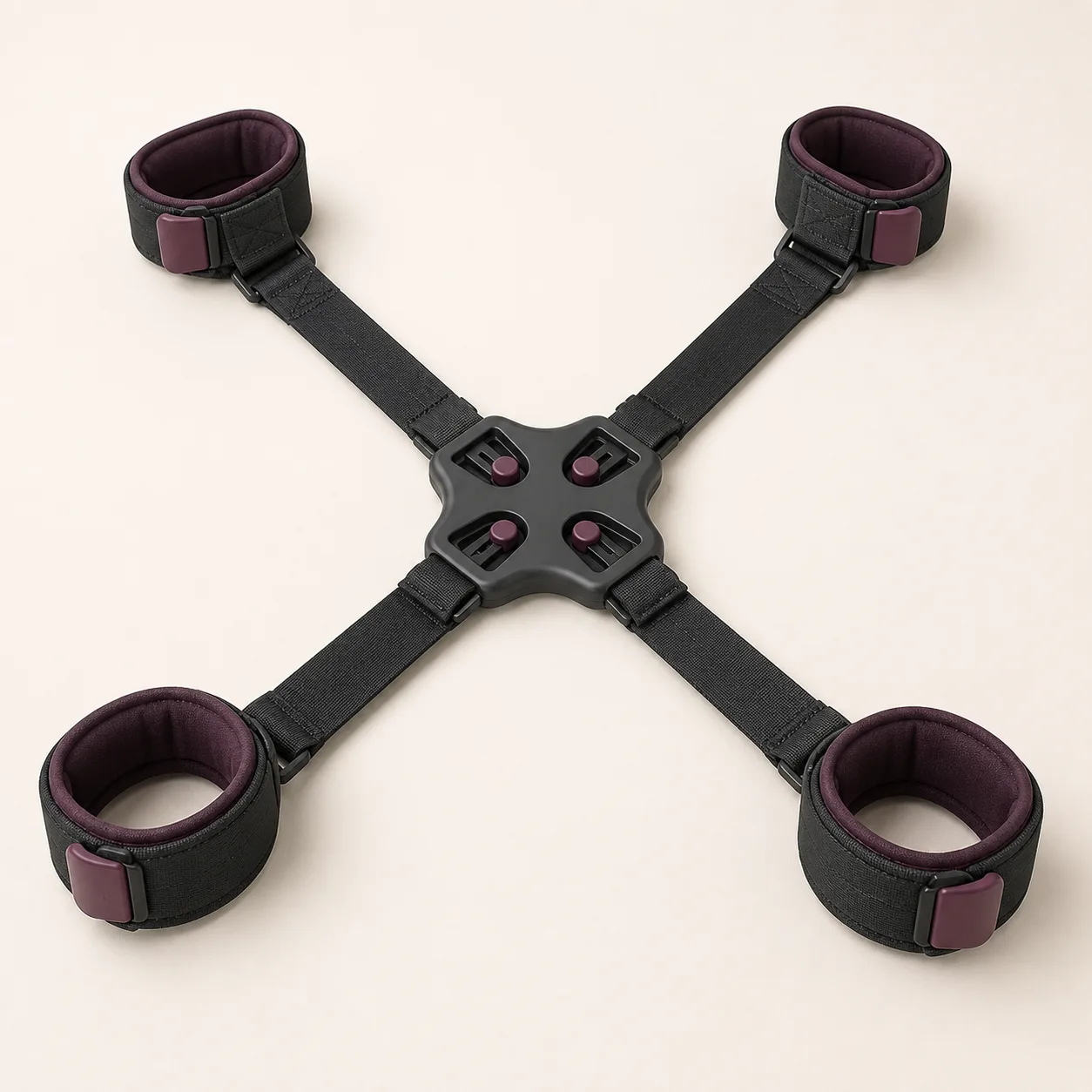
Four-Channel Cross-Hub Under-Mattress Restraint with Padded Cuffs
A connected four-point restraint concept with four padded quick-release cuffs and separately routed webbing channels in a central sliding-cam hub.
34,99 $
200 in stock
Four hub channels keep every strap path visible
This cross hub bed restraint concept routes four connected webbing straps through separate sliding channels in one rounded central hub. Each path can be measured from its own blunt stop to a padded cuff, reducing ambiguity about which adjustment changes which corner.

The image does not establish load rating, escape resistance, mattress compatibility, medical use, suspension capacity, exact fit or approved materials.
Inventory the connected assembly before installation
Request drawings and a bill of materials for the hub shell, four channel liners, cams, levers, stops, webbing runs, folds, stitching, connectors, two cuff sizes, padding, lining, closures, release tabs, binding, thread, pigments, coatings and adhesives.
Confirm that no strap end can pull through the hub or detach from a cuff under its documented low working limit.
Separate the narrower and broader cuff pairs
Measure each cuff independently for internal circumference range, width, padding thickness, closure overlap, release-tab reach and connector orientation. Verify whether the narrower pair and broader pair have different approved locations.
Labels such as wrist and ankle require measured fit ranges rather than visual assumptions.
Measure hub geometry and all four routes
Record hub length, width, thickness, channel spacing, entry radius, slider travel, stop clearance and central rigidity. Measure usable strap length from each cuff connector to its channel stop.
Document both free length and length remaining after the assembly is routed under a verified mattress size.
Map the upper-left channel from stop to stop
Move the first plum cam through its full confirmed travel while the other straps remain slack. Record lever force, latch depth, webbing displacement, slip, rebound and unused tail management.
Inspect the channel for glazing, cut fibers, folded edges or a false-seated cam.
Map the upper-right channel without assuming symmetry
Repeat the same measurements on the opposite upper route. Compare both channels at equal strap extension and low controlled tension.
Reject unexplained force differences, diagonal feed or a lever that can be covered by neighboring webbing.
Map the lower-left channel under its own alignment
Measure travel, holding, release force and tail clearance for the first broader-cuff route. Observe whether the webbing enters the hub squarely when the cuff connector is rotated through its documented range.
A twisted strap can change both effective length and edge pressure.
Map the lower-right channel and final stop
Complete the four-route map with the second lower strap. Confirm that its stop remains blunt, retained and visible at maximum approved extension.
Compare all four levers after cycling so one weak channel is not hidden by system-level averages.
Test cam release force before any consensual use
Measure each lever with no load and with several low verified strap loads. Record actuation direction, travel, force, one-handed access and whether tension must be reduced before release.
A separate safety cutter suited to the webbing should be immediately accessible; never rely on one release method.
Distribute load without using the hub as an anchor
Use an instrumented fixture and a representative mattress substitute to map tension at all four routes under small controlled movements. Check hub shift, strap migration, webbing abrasion and differences between opposing channels.
The hub is a routing device, not a lifting, suspension, fall-arrest or body-weight anchor.
Fit cuffs without impairing circulation or access
Use only a verified fit range and confirm space, padding contact, closure security, rotation and release-tab access on non-human gauges before any consensual trial. During use maintain active communication and frequent circulation checks.
Stop immediately for pain, numbness, tingling, swelling, discoloration, coldness, panic, breathing difficulty or inability to operate a release.
Route beneath a compatible mattress without traps
Confirm mattress width, depth, edge radius, frame gaps, moving components, heat sources and sharp hardware. Keep webbing flat, outside hinges and mechanisms, and clear of neck, head, chest and walking paths.
Never install on reclining, folding, powered or damaged furniture unless the exact system and furniture are expressly approved together.
Cycle adjustment, low load and rapid release
Run repeated strap-setting, low-load, movement and full-release cycles on a guarded fixture. At planned intervals inspect cams, channels, stops, webbing, stitches, cuff connectors, padding, closures and tabs.
Track slip, force drift, elongation, fraying, heat glazing, stitch movement, padding compression and delayed release.
Verify materials and clean every contact surface
Obtain exact compositions for webbing, hub, liners, cams, stops, cuff shell, lining, padding, binding, thread, closures, coatings, pigments and adhesives. Request abrasion, colorfastness, restricted-substance, corrosion and skin-contact evidence.
Clean cuffs and straps by the confirmed method, keeping residues out of cam channels. Dry padding, webbing folds, stitch rows and hub recesses fully before storage. Machine washing, soaking, bleach, heat and oils require explicit compatibility evidence.
Price four independent routes after release testing
An Alibaba premium bed restraint listing currently shows USD 4.46-5.37 with an MOQ of one piece. It is a category benchmark only and does not confirm this four-channel hub, cuff configuration or an approved supplier.
The procurement reference supports an EUR 34.99 planning price after allowing for China-origin freight, exact-part inventory, four-route measurement, cam retention and release tests, cuff fit gauges, under-mattress routing review, low-load distribution, complete-assembly cycling, material documentation, cleaning validation, protective packing and discreet fulfillment. Exact quotation, packed dimensions, weight, freight, duty, tax, insurance, payment fees and delivery terms remain pending.
Frequently asked questions
Is the central hub a load-rated anchor?
No. It is a routing concept and has no suspension, lifting, fall-arrest or body-weight rating.
Can every strap be adjusted separately?
That is the intended layout, but each cam, stop and usable travel range require sample verification.
Will the system fit any mattress?
No. Mattress and frame dimensions, gaps, moving parts and routing clearance must be checked for the exact installation.
Are all four cuffs the same size?
The concept shows two narrower and two broader cuffs; final ranges and approved placement remain pending.
What backup release is needed?
Keep an appropriate webbing cutter immediately accessible and maintain an alert, capable observer who knows the release plan.
Which faults require retirement?
A slipping cam, cracked hub, missing stop, cut or glazed webbing, moving stitches, exposed hardware, crushed padding, failed closure or release tab that cannot be reached and opened promptly.
Reviews
There are no reviews yet.