


Cross-Lock Twin-Bar Couples Vibrator with Four Contact Pads
August 14, 2026
Twin-Ridge S-Curve Couples Vibrator
August 14, 2026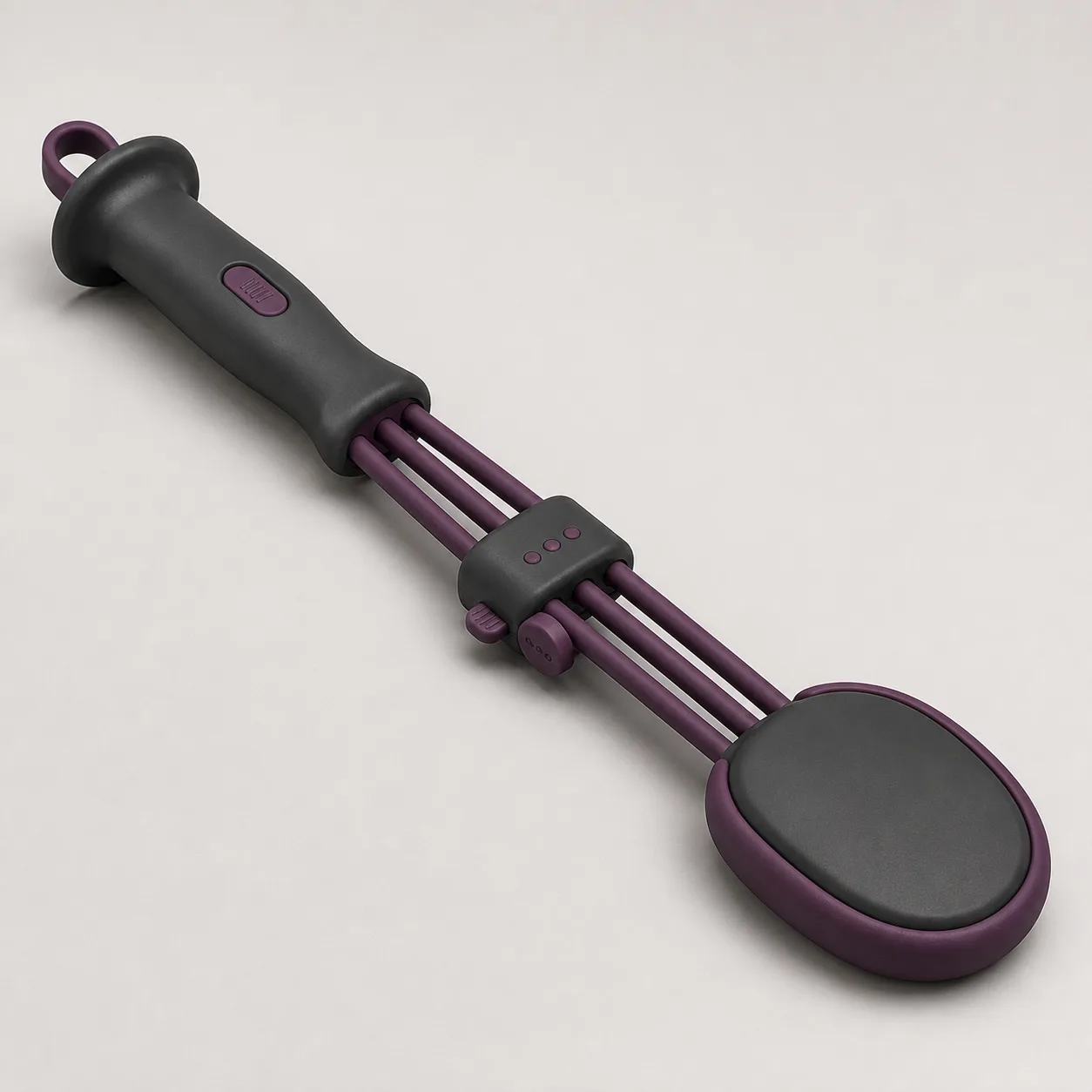
Three-Spine Differential-Flex Sensory Baton with Preload Bridge
A BDSM sensory impact baton concept with three parallel flex spines, a lockable three-stop preload bridge and one broad guarded oval pad.
39,99 $
200 in stock
Combine three flex paths behind one guarded pad
This three-spine differential-flex sensory baton concept carries one broad rounded impact pad on three parallel plum spines of visibly different section. A movable charcoal preload bridge with a three-stop dial changes the unsupported length, while a flared handle and wrist-loop eye define the grip end.

The image does not prove stiffness, preload range, impact level, dimensions, materials, bond strength, durability, safety or production availability.
Inventory handle bridge spines and pad
Request an exploded bill of materials for the grip shell, internal core, flared stop, wrist-loop eye, service latch, spines S1 through S3, root anchors, movable bridge, three-position dial, detents, lock tab, bushings, alignment dots, pad backing, cushioned face, perimeter guard, end anchors, pigments, coatings, adhesives and concealed fasteners.
Trace every part to drawings, tolerances, batch records and the approved sample.
Establish complete baton geometry
Measure total length, grip axes, flared-stop span, loop opening, spine spacing, each spine width and thickness, bridge travel, unsupported lengths at all stops, pad axes, pad thickness, guard projection, mass and center of gravity.
Record straightness, pad alignment and bridge squareness before and after conditioning.
Verify grip retention and wrist-loop eye
Measure grip texture, torsional slip, flared-stop effectiveness, core movement and loop-eye dimensions. Apply conservative axial and off-axis fixture loads to the eye and handle while monitoring cracks, separation and permanent set.
The loop material, supplied tether and load rating remain pending until confirmed in writing and tested.
Characterize spines S1 S2 and S3
For each spine, measure free shape, section, hardness, bending stiffness, torsional stiffness, damping, fatigue response and root/end attachment. Inspect seams, voids, thin spots, hard inclusions, pigment transfer and surface damage.
Do not average the three results; differential flex depends on their measured differences.
Map preload bridge positions
Measure bridge location, guide clearance and unsupported length at minimum, middle and maximum settings. Approach each stop from both directions and inspect whether the bridge scuffs, pinches or locally crushes any spine.
No setting should leave one spine outside its guide or place the bridge against a damaged surface.
Calibrate the dial and lock tab
Record dial angle, detent torque, hysteresis, repeatability, lock engagement and resistance to accidental contact. Apply bounded flex and vibration while locked and verify that the bridge cannot creep between marks.
Tactile marks need documented settings and must remain legible after cleaning and wear.
Inspect the broad pad and perimeter guard
Measure face contour, compliance, backing stiffness, edge radius, guard thickness, projection, bond area and alignment with all three spines. Map surface pressure under a slow instrumented compression fixture.
The guard must remain continuous without exposing backing, anchors or a hard corner during flex.
Measure static bend and twist response
At each bridge stop, apply calibrated force in face, edge and diagonal directions. Record pad displacement, spine curvature, load sharing, torsion, hysteresis and permanent set.
Stop before spine inversion, bridge contact, root overload or pad rotation beyond the declared limit.
Characterize dynamic impact on test media
Use standardized instrumented test media and controlled swing energy to record peak force, impulse, contact time, pressure footprint, rebound and sound at each bridge stop. Maintain consistent handle path and pad orientation.
No human testing is needed to compare settings; publish measured fixture ranges only after verification.
Map rebound and off-axis stability
Track pad trajectory after centered and intentionally offset fixture contact. Measure yaw, roll, secondary contact, spine crossing and bridge movement with high-speed imaging.
An offset strike must not make a spine contact the test surface or let the pad guard fold away.
Verify service latch and captive construction
Identify the recessed handle latch function and measure travel, force, false closure and retention. If it opens service access, confirm that spines, anchors, fasteners and loop eye remain captive and that no sharp core is exposed.
Consumer service instructions and authorized replacement parts remain pending.
Verify materials surfaces and cleaning
Obtain composition, hardness, pigment, coating, restricted-substance and skin-contact evidence for handle, spines, bridge, pad and guard. Test cleaner compatibility, swelling, abrasion, odor, color transfer, drying time and residue at guides and anchors.
Marketing labels cannot replace batch-linked documents and sample results.
Challenge one weakened spine and cycle adjustment
Reduce stiffness in one protected fault specimen while monitoring load sharing, pad tilt, bridge alignment, rebound and root strain. Stop before failure and quarantine any baton with cracking, delamination, spine crossing, bridge drift or exposed reinforcement.
Cycle flex, bridge adjustment, locking, controlled fixture impacts, cleaning, measured drying and storage. Recheck dimensions, stiffness, detents, guard bonds, anchors, grip, loop eye and surface condition.
Build landed price after flex testing
An Alibaba BDSM-paddle page currently shows a PU leather crop and paddle category example at USD 0.87-3.33 with MOQ one. It is a benchmark only and does not confirm this three-spine adjustable baton, preload bridge, guarded pad or an approved supplier.
The procurement reference supports an EUR 39.99 planning price after allowing for China-origin freight, exact-model sourcing, three-spine metrology, bridge and lock calibration, pad and guard inspection, static and dynamic fixture tests, rebound analysis, material evidence, fault and cycle review, protective packing and discreet fulfillment. Exact quotation, MOQ, materials, load ratings, packed size, weight, freight, duty, tax, insurance, payment fees, certifications and delivery terms remain pending.
Frequently asked questions
Why use three different spines?
The concept combines three measured stiffness paths; their individual values and load sharing remain pending.
What does the bridge change?
It changes unsupported spine length at three indexed stops, subject to calibration and fixture testing.
Does the dial lock during movement?
The tab must hold the bridge against bounded flex and vibration without creeping between marks.
How are settings compared safely?
Use controlled swing energy and standardized instrumented test media, not human testing.
Can the pad edge expose a hard backing?
The continuous perimeter guard and bond need compression, flex, abrasion and cycle inspection.
Which faults require retirement?
Cracked or crossed spines, loose roots, bridge drift, failed locking, pad delamination, exposed backing, damaged loop eye or persistent residue.
Reviews
There are no reviews yet.