



LilyLouhome Black Lace-Trim Wrap Robe: S-2XL
August 14, 2026
Three-Spine Differential-Flex Sensory Baton with Preload Bridge
August 14, 2026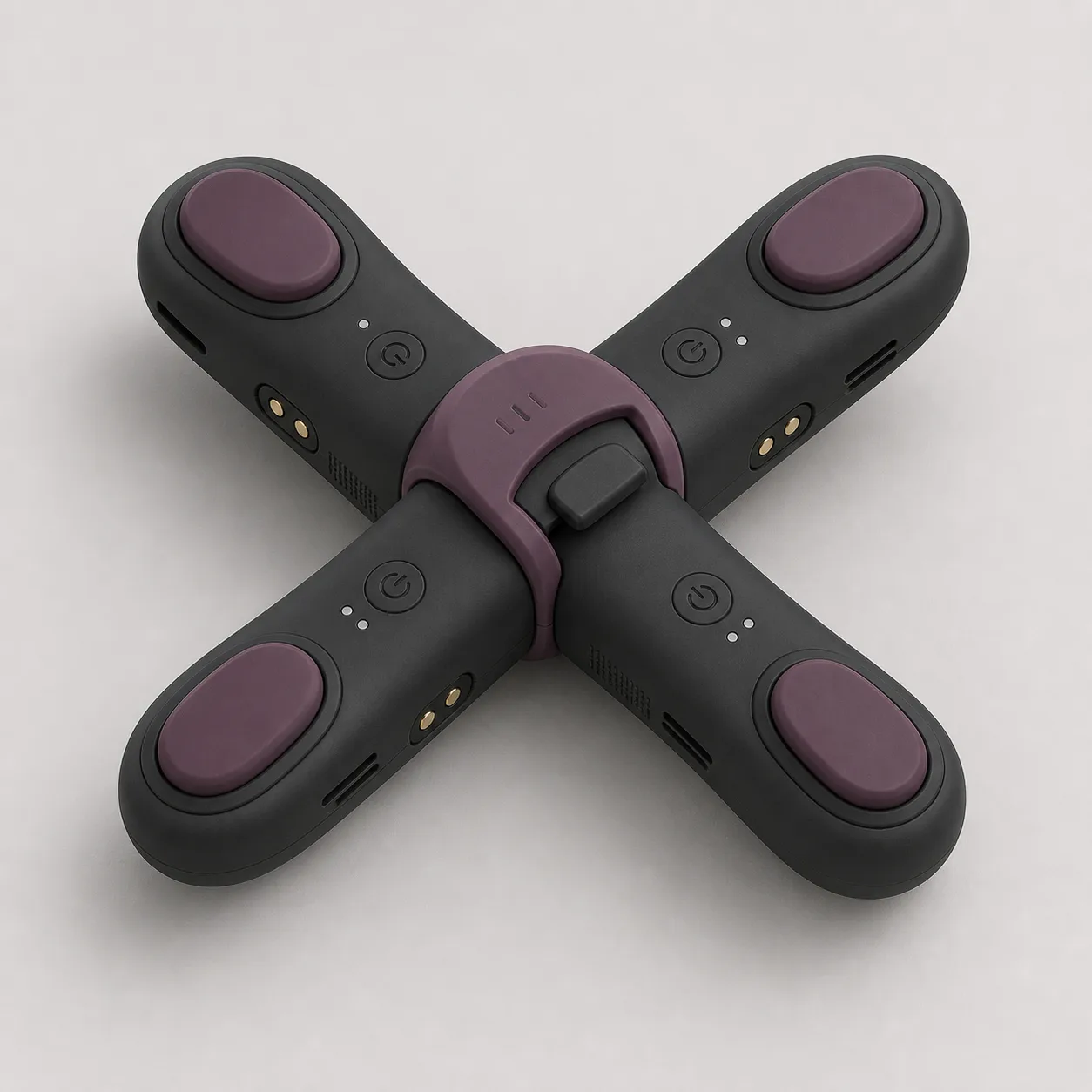
Cross-Lock Twin-Bar Couples Vibrator with Four Contact Pads
A detachable couples vibrator concept with two arched bars, four guarded contact pads and a central quarter-turn cross-lock with local release.
79,99 $
200 in stock
Cross-lock two bars into one four-pad assembly
This cross-lock twin-bar couples vibrator concept combines exactly two gently arched charcoal bars at a guarded right-angle hub. Each bar carries one plum oval contact pad near each end, making exactly four guarded faces, while a plum quarter-turn lock and broad release tab are intended to secure or separate the assembly.

The image does not prove bar continuity, detachment, lock strength, pad output, synchronization, dimensions, materials, sealing, charging safety or production availability.
Inventory both modules and the center lock
Request an exploded bill of materials for bars A and B, four pad skins, pad carriers, guard rims, actuators, moving masses, module frames, keying notches, central lock shell, quarter-turn cam, three indices, capture lugs, hard stops, release tab, springs, local buttons, indicators, controllers, cells, charging contacts, vents, conductors, seals, pigments, lubricants and adhesives.
Map every component to drawing revision, tolerance, batch and approved matched-set sample.
Measure both arched bar geometries
Record bar length, width, thickness, arch height, pad center spacing, end radii, central key dimensions, control positions, contact recesses, vent areas, mass and center of gravity. Compare A and B for symmetry and deliberate keying differences.
Measure the assembled X span, included angle, face planes, overall thickness and hub projection after repeated assembly.
Characterize all four contact pads
For pads A1, A2, B1 and B2, measure major and minor axes, crown, edge blend, skin hardness, compression curve, recovery, friction and local thickness. Inspect guard-rim height, seams, voids, thin regions, hard inclusions and pigment transfer.
Keep all four identities through output and pressure testing rather than averaging a nominal pad result.
Calibrate the quarter-turn cross-lock
Measure insertion orientation, engagement depth, rotation angle, cam torque, three index positions, hard-stop contact, axial play, radial play and resistance to accidental reverse rotation. Approach each index from both directions.
Confirm whether only one position is fully locked and make partially engaged states visibly and tactually distinct.
Verify the release tab and center gaps
Record tab direction, force, travel, response time and reset sequence under no load and bounded asymmetric bar loads. Test dry and damp access without covering local controls.
Use articulated probes and soft-film screening around cam lugs, bar keys, release, hub seam, stops and bar crossings throughout assembly and release.
Establish module identity pairing and local stop
Document physical keying, electronic identifiers, pairing sequence, maximum linked modules, reconnect behavior and the meaning of every local indicator. Verify a distinct local stop path from each bar end that does not depend on wireless communication.
Challenge crossed identifiers, one depleted module, one unpaired module and commands issued during lock engagement or separation.
Map output at every pad and control station
Measure three-axis acceleration, displacement, frequency, harmonics, rise, decay, sound and current at A1, A2, B1 and B2 for each confirmed local program. Repeat assembled and separated if both states are permitted.
Map vibration at the four nearby controls and central hub to identify unintended actuator coupling or misleading indicator response.
Resolve synchronization phase and drift
Synchronize the four pad traces to measure command latency, startup skew, relative phase, beat frequency, drift, dropped commands and program transitions. Repeat across range, interference, battery and temperature conditions.
Confirm the safe local state after link loss, lock release, unexpected module separation or one controller reset.
Map four-pad pressure in the X configuration
Use four independent compliant fixtures to record contact area, peak pressure, load sharing, bar deflection and hub movement under symmetric, one-pad, two-pad and diagonal loads. Avoid assigning unverified body-fit claims.
Reject guard-rim contact, progressive lock rotation, one-pad overload, hub pinch exposure, unstable rocking or bar separation under the accepted low-load envelope.
Compare assembled and separated handling
Measure grip friction, control reach, balance, bar flex and accidental release contact in both confirmed configurations. Verify that separation does not expose sharp keys, live contacts, loose magnets, conductor ends or residue traps.
Define storage orientation and protective caps if exposed lock surfaces or charging contacts require them; included accessories remain pending.
Verify charging power loss and shutdown
Document each cell chemistry and capacity, charging polarity, specified lead, input limit, protection circuits, charge time, runtime, low-voltage behavior and simultaneous-charge rules. Confirm that bar A cannot back-feed bar B through the mechanical lock.
Interrupt power in every mode and lock state and confirm predictable shutdown. Ingress claims remain pending until pad, hub, release, control, contact and vent boundaries pass appropriate tests.
Log current sound and temperature
Measure current, accessible temperature, actuator, hub, controller, cell and charging-contact hot spots and A-weighted sound at a stated distance for each module alone and assembled. Repeat under asymmetric load and low battery.
Investigate current imbalance, hub chatter, bar resonance, loose-lock noise, thermal interaction, intermittent indicators or one module heating the other.
Challenge lock and link faults then cycle and clean
Simulate false lock seating, worn lugs, tab obstruction, one pad restrained, one depleted cell, dropped synchronization and unexpected separation in protected samples. Stop before damage and quarantine units with delayed release, exposed parts or failed local shutdown.
Cycle module keying, quarter-turn lock, release, output programs, synchronization, controlled loading, charging, defined cleaning, measured drying and storage. Recheck geometry, four pads, cam torque, play, gaps, releases, pairing, output balance, pressure, contacts, heat and seams.
Build landed price after cross-lock proof
An Alibaba wireless couples-vibrator page currently shows a category example at USD 2.85-3.56 with MOQ one. It is a benchmark only and does not confirm this two-module cross-lock set, four-pad layout, paired electronics or an approved supplier.
The procurement reference supports an EUR 79.99 planning price after allowing for China-origin freight, exact-set sourcing, two-bar and four-pad metrology, lock and release calibration, pairing, output and phase tests, assembled pressure mapping, electrical, charging, current, sound and heat review, protected fault and cycle work, protective packing and discreet fulfillment. Exact quotation, MOQ, materials, batteries, software support, packed size, weight, freight, duty, tax, insurance, payment fees, certifications and delivery terms remain pending.
Frequently asked questions
Are there two modules or four?
The concept shows two crossed bars with two pads each; physical continuity and internal architecture require teardown confirmation.
Can the bars operate separately?
Separated operation is unconfirmed until controls, identifiers, exposed surfaces and local shutdown are tested in that state.
What do the three lock marks mean?
Index mapping is pending; only a measured fully engaged position should be treated as secure.
Can the center lock pinch?
All lugs, keys, cam surfaces, seams and release paths need articulated-probe and soft-film testing under load.
Is the set waterproof?
No ingress claim is confirmed; pad rims, hub, release, buttons, contacts and vents require evidence.
Which faults require retirement?
Cracked bars, loose pads, worn lock lugs, growing hub play, delayed release, exposed keys or contacts, unstable pairing, abnormal heat, cell swelling or persistent residue.
Reviews
There are no reviews yet.