



Tri-Fan Contact-Head Couples Vibrator with Offset U-Bridge, Twin Inner Ridges and Three-Stop Collar
August 14, 2026
Three-Cuff Folding Tri-Hub Restraint with Independent Cam Straps
August 14, 2026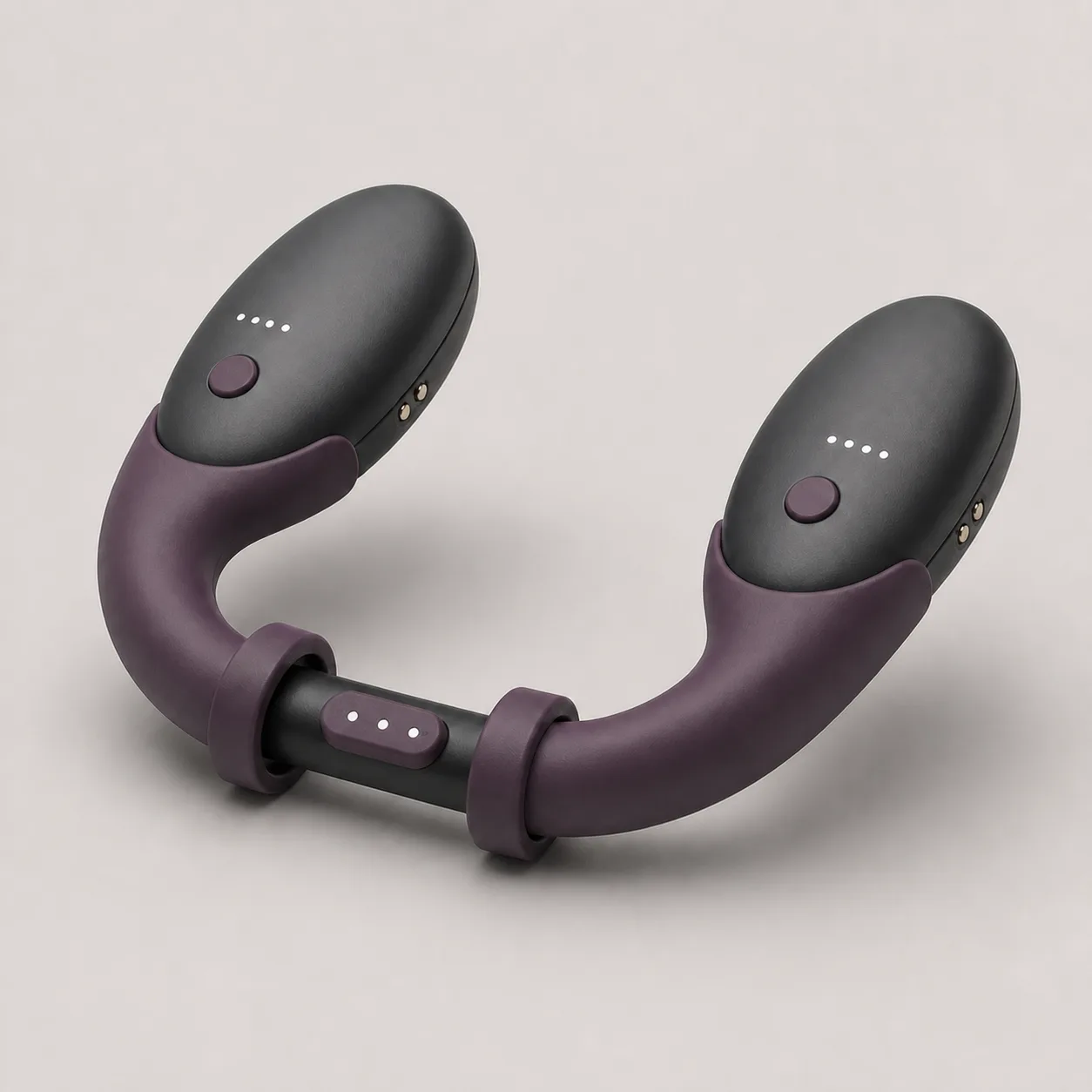
Twin-Hinge Three-Angle U-Bridge Couples Vibrator
A wearable couples vibrator concept with two oval contact pods, a flexible U bridge, two guarded hinges and a three-state central angle lock.
72,99 $
200 in stock
Set bridge angle with two guarded hinges
This twin-hinge three-angle U-bridge couples vibrator concept joins exactly two separate charcoal oval contact pods through a smoky-plum U-shaped bridge. Two guarded hinge collars meet one short central spine, where a plum slider with three white dots proposes three repeatable bridge-angle states.

The image establishes an evaluation layout and does not prove fit, angle range, output, materials, battery or production status.
Name every load electrical and control path
Label bridge arms A1-A2; pods P1-P2; hinges H1-H2; collars C1-C2; spine S0; slider L0; detents D1-D3; controls B1-B2; indicators I1-I2; charging contacts J1-J4; actuators; mounts; controllers; cells; seals; pigments and adhesives.
Require exact-sample drawings and firmware identity before channel claims.
Measure both U-bridge arms independently
Record arm length, curve radius, cross-section, hardness, bend stiffness, torsion, rebound and surface friction for A1 and A2. Compare unloaded symmetry with standardized offset loading.
Reject cracks, permanent lean, whitening, thin zones, tack or pod socket movement.
Calibrate hinge H1 and hinge H2
Measure rotation range, torque, backlash, axial play, collar clearance and guarded gap for each hinge. Approach every state from opening and closing directions under no load and controlled preload.
Reject one-sided binding, skipped engagement, scraping, collar lift or accessible closing gaps.
Inspect the short central spine
Measure S0 length, diameter, straightness, surface finish, hinge spacing and attachment. Trace bridge bending and pod reaction through the spine rather than assuming the silicone arms carry all load.
Check for hard edges and stress concentration at both collar transitions.
Verify three angle-lock states
Map L0 travel, D1-D3 carrier position, resulting pod angle, bridge span and left-right symmetry. Record detent force, reset behavior and drift under centered, offset and torsional loads.
Three visible dots are not three verified angles until both hinges hold the measured geometry.
Characterize pod P1 and pod P2
Measure pod length, width, thickness, edge radius, mass, contact-surface hardness, mount stiffness and shell seams separately. Confirm the two pods are interchangeable only if drawings and tests support it.
Reject shell separation, loose mounts, sharp seams, control movement or exposed hard structure.
Document dual controls and indicators
Map B1-B2 startup, program selection, intensity, synchronization, stop priority and lock behavior. Decode I1-I2 states for power, program, battery, pairing and fault conditions.
No independent-channel claim is accepted from duplicate buttons alone.
Verify both charging interfaces
Identify whether J1-J2 and J3-J4 charge separate cells or one shared circuit. Measure polarity, input limits, charge time, operating time, contact temperature, protection behavior and low-voltage response.
Exact electrical values require supplier documents, teardown and direct measurement.
Build pressure maps at every bridge angle
Use instrumented compliant forms to record engaged area, local pressure, pod tilt, bridge span, hinge torque and slider drift at D1-D3. Test centered and offset placements across bounded fixture geometries.
Do not translate fixture results into universal-fit or hands-free promises.
Separate pod output and cross-coupling
Record acceleration, frequency, harmonics and phase at P1, P2, both arms, H1-H2, S0 and L0 for every confirmed channel combination and angle state.
Compare independent, synchronized and loaded cases only when the exact electronics support those modes.
Log sound heat current and fault response
Measure current, A-weighted sound and temperatures at both pods, actuators, mounts, hinges, spine, controls, cells and contacts. Challenge one-pod restraint, both-pod restraint, partial angle engagement, low voltage and power loss in guarded fixtures.
Reject abnormal heat, delayed stop, unexpected restart, hinge rattle or cell swelling.
Probe pinch gaps seams and cleaning traps
Inspect pod seams, sockets, bridge folds, H1-H2 gaps, collars, spine ends, slider track, detents, buttons, lights and contacts under all angle states. Challenge these areas with visible test soil.
No waterproof or immersion claim is made without exact-model ingress evidence.
Cycle angle changes output and cleaning
Cycle D1-D3 changes, centered and offset loading, output programs, stop, lock, charging, wiping, drying and storage. Remeasure hinge play, detent force, bridge set, pod mounts, sound, heat and contact condition.
Retire test units for cracks, loose hinges, angle drift, pod separation, control faults, heat, charging faults or cell swelling.
Build landed price after both hinges pass
An Alibaba wearable-vibrator category page showed one example starting at USD 7.99 with a one-piece minimum. It is a broad benchmark only and does not identify this twin-hinge U-bridge design or an approved supplier.
The procurement benchmark supports an EUR 72.99 planning price after provisional allowance for China-origin freight, exact samples, bridge and hinge metrology, three-angle calibration, dual-pod pressure and output maps, controls, charging, sound, heat, faults, cleaning and fatigue work, protective packing and discreet fulfilment. Exact quote, MOQ, dimensions, materials, cells, packed weight, freight, duty, tax, certification, payment terms and lead time remain pending.
Frequently asked questions
How many bridge angles are proposed?
Three indexed states D1-D3 require direct geometry and lock testing.
Do the two pods run independently?
Channel independence requires teardown, control mapping and output measurement.
Can one hinge unlock by itself?
Partial engagement and single-hinge failure behavior are mandatory test cases.
What do the four indicator dots show?
Meanings for each pod remain pending supplier documents and functional tests.
Is the device waterproof?
No ingress rating is claimed for pods, hinges, controls or charging contacts.
Which defects require retirement?
Cracks, loose hinges, angle drift, pod separation, heat, charging faults or cell swelling.
Reviews
There are no reviews yet.