


Rounded-Tooth Sensory Pinwheel with Guard Cap
August 14, 2026
Yaofei wl-02 Pink Floor-Length Lace Butterfly-Sleeve Robe
August 14, 2026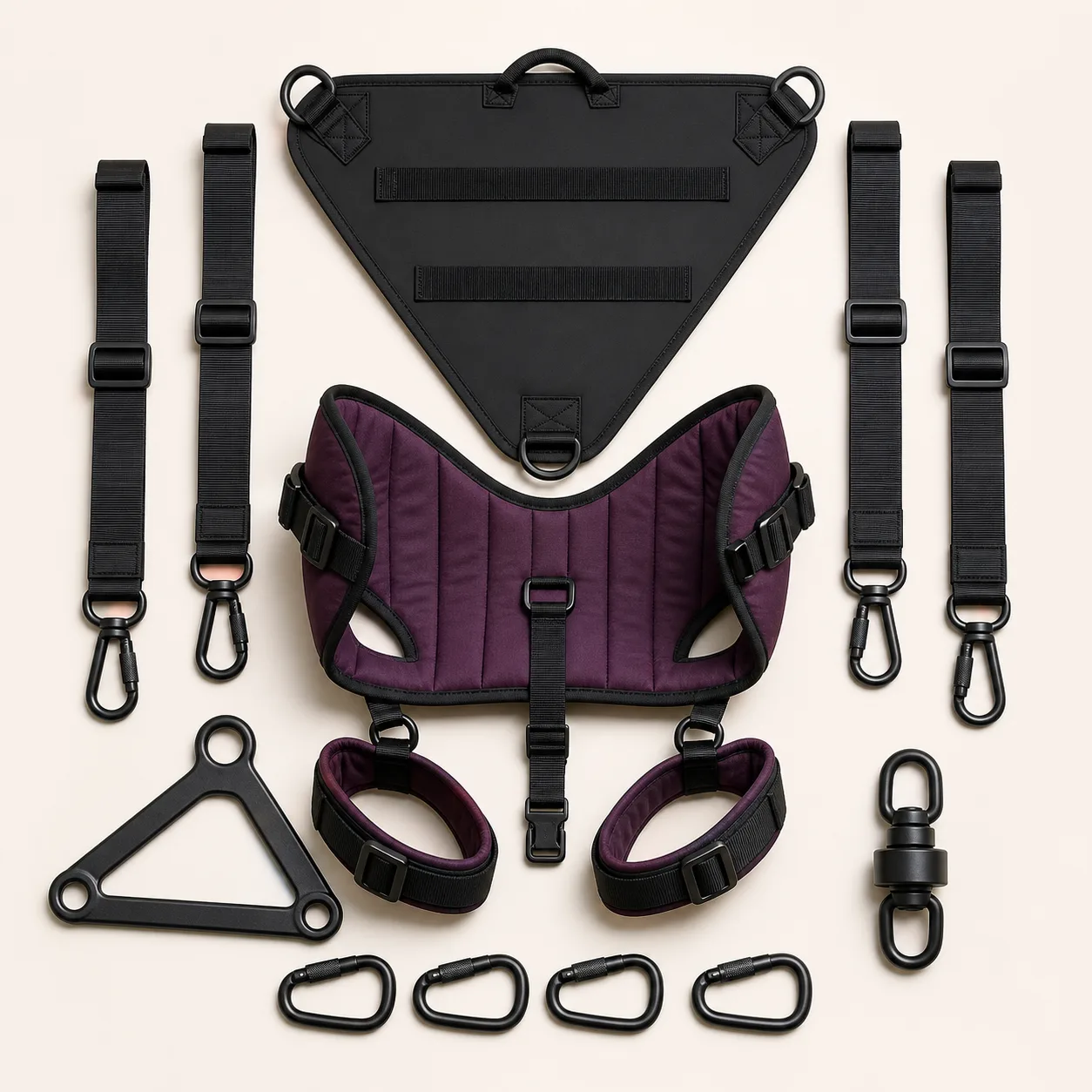
Adjustable Padded Suspension Positioning Sling
A low-height suspension positioning concept with padded support, separately inspected load paths, locking connectors and rehearsed emergency lowering.
59,99 $
200 in stock
A suspension sling is a load system, not a collection of straps
This positioning concept combines a padded seat, leg loops, adjustable webbing, triangle spreader, locking connectors and swivel. Every component sits in one load path, so the lowest verified rating governs the complete assembly.
No working-load limit is accepted from marketplace artwork. The sling remains a preview concept until the anchor, textiles, hardware and finished system pass documented static and dynamic tests.

The building anchor is outside the product box
A qualified professional must assess the ceiling, beam, stand or other support and specify compatible rated hardware. Decorative hooks, curtain rails, door trim, furniture and unknown fasteners are excluded.
Do not assume that a strong-looking carabiner makes an unrated structure safe. Record the anchor location, substrate, fastener specification, installation date and inspection result.
Working load needs margin for movement
Body mass is only the starting load. Swinging, sitting down abruptly, bouncing and uneven strap tension create higher forces, so approval needs a defined working load and dynamic test protocol.
Never exceed the lowest documented limit across anchor, fastener, swivel, spreader, carabiners, rings, webbing, stitching, seat and leg loops.
Keep the setup close to the floor
Adjust the unloaded sling so the supported person remains only as high as necessary, with a cleared padded area below. Remove hard furniture, sharp edges, glass, heat sources and trip hazards from the movement envelope.
This concept is not for inversion, acrobatics, standing swings or unsupervised suspension.
The seat supports the pelvis without compressing the abdomen
Position the broad padded section under the intended weight-bearing area and verify even contact before lifting. The edge should not fold, cut into skin or migrate toward the waist.
Pressure over the abdomen, ribs, spine, neck or throat is not part of the approved configuration.
Leg loops must remain broad and observable
Set both loops symmetrically and keep buckles away from sensitive tissue. Padding should stay flat rather than rolling into a narrow band under load.
Lower the person immediately for numbness, tingling, coldness, color change, swelling, cramping, pain or a loop that slides toward a joint.
Carabiners are checked gate by gate
Inspect each body, nose, hinge and locking sleeve. Connect only in the intended major-axis orientation, close every gate and confirm that no strap or ring can cross-load the gate.
Mixed, bent, unlabeled, corroded or self-opening connectors reject the set. Cosmetic finish is not a load rating.
The swivel needs its own rating and freedom test
A swivel may reduce strap twisting, but it adds another load-bearing joint. Confirm its axial rating, material, bearing movement and compatibility with adjacent connectors.
Rotate the empty assembly through its expected travel and check for binding, unscrewing, metal-on-webbing abrasion or contact with the supported person.
Strap adjusters must not creep
Mark the accepted strap positions, apply a progressive test load and measure movement at each adjuster. Repeat after flexing, moisture exposure and multiple adjustment cycles.
A tail that slips, a bar that tilts or webbing that bunches under load is a failure, even if the sling remains off the floor.
Stitch inspection follows every load path
Trace each strap from the supported panel to the top connector. Count intact rows, examine bar tacks and look for pulled thread, cut fibers, glazing, frayed edges or holes near hardware.
Loose stitching cannot be repaired casually. The affected component must be evaluated against the original manufacturing specification.
First occupancy uses a spotter and staged loading
Practice assembly and emergency lowering while empty. Add load gradually near floor level, pause at each stage and listen for stitching noise, hardware clicks or structural movement.
A sober attentive spotter remains within reach of the lowering controls and supported person. Never leave an occupied sling unattended.
Quick lowering must not depend on one jammed buckle
Define a primary and backup method to lower the sling without cutting load-bearing webbing. Both methods should work with one hand occupied and without moving beneath an unstable load.
Keep an appropriate rescue cutting tool accessible only as a last-resort plan, positioned so it cannot injure the person or sever the wrong strap.
Restraints are not suspension points
Accessory loops, cuffs and decorative rings must never carry body weight unless separately engineered and labeled for that exact purpose. Nothing is attached to the neck, throat or head.
Breathing, speech, circulation, hand movement and rapid release must remain available throughout any supported position.
Cleaning must not weaken textile evidence
Remove detachable padding and follow verified care instructions for its cover and fill. Clean webbing and stitched panels without bleach, high heat or solvents unless the manufacturer explicitly validates them.
Dry the assembly fully open. Mold odor, stiffness, dye transfer, corrosion, swollen padding or hidden dampness ends use until inspected.
Storage separates soft goods from metal hardware
Coil dry straps loosely and keep connectors in a divided pouch so edges cannot abrade webbing. Do not store the sling hanging from its installation point or under continuous tension.
Maintain an inspection log for load events, cleaning, hardware changes and any unusual noise or movement.
Questions about a suspension positioning sling
Can it hang from a decorative ceiling hook?
No. The structure and anchor require professional assessment and documented ratings.
Is body weight the only force to consider?
No. Movement and uneven loading can create substantially higher forces.
Can a cuff or accessory ring support weight?
No, unless it is independently engineered and labeled for that exact load.
Is inversion included?
No. This concept excludes inversion and acrobatic use.
Why keep the sling near the floor?
Minimal height reduces fall distance and makes staged loading and lowering easier.
What ends use immediately?
Anchor movement, strap creep, gate opening, torn stitching, hardware deformation, pain, numbness, color change or breathing difficulty.
Supplier reference and planned price
Alibaba product 1601247778448 is presented as an upgraded restraint and positioning swing. The matched marketplace result names Shenzhen I Like Health Technology Co., Ltd.; exact seller-page association remains pending. The product-introduction page displayed USD 5.98 for 1–29 sets, USD 5.78 for 30–299, USD 5.58 for 300–2,999 and USD 4.98 from 3,000 sets. Leather and general certification wording appears on the page, but no reliable complete-system load rating, anchor specification or test report was verified.
The planned EUR 59.99 display price provisionally covers a China-origin sample, freight planning, component identification, anchor consultation, static and dynamic load tests, strap-creep and stitching review, connector and swivel checks, emergency-lowering rehearsal, discreet packing, handling and delivery. Exchange rate, freight, duty, tax, exact supplier, materials, ratings, certification, package mass and commercial terms remain pending.
Approval binds the complete load chain
The accepted specification freezes the seat, padding, leg loops, panels, webbing, thread, stitch patterns, adjusters, rings, spreader, carabiners, swivel, markings, manual, package and every stated limit.
Changing one connector, strap, seam, swivel or anchor instruction voids the system review and requires fresh testing before stocking.
Reviews
There are no reviews yet.