


Three-Vent Quick-Release Ball Gag
August 14, 2026
Three-Stop Split-Pad Vent Gag with Guarded Width Slider
August 14, 2026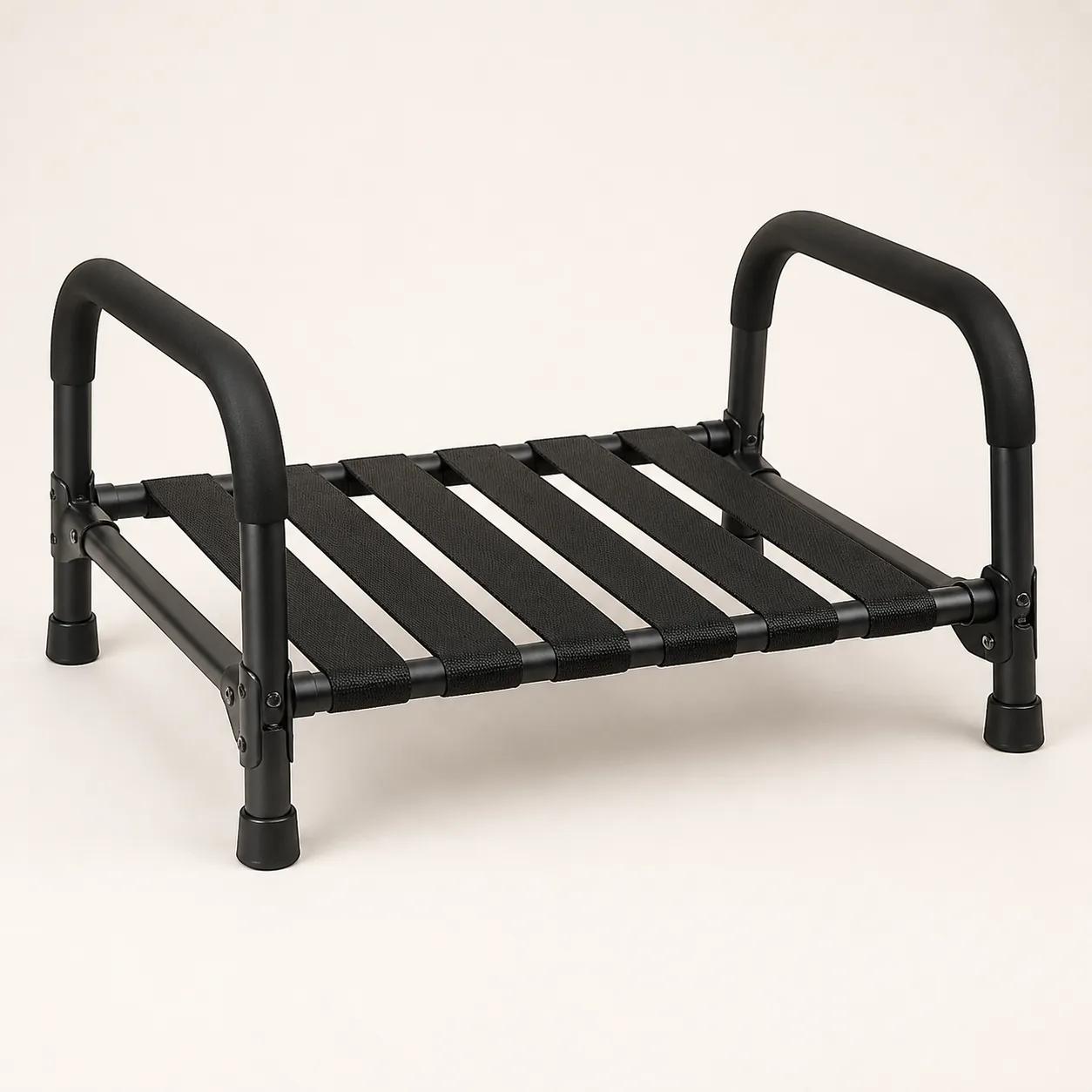
Elastic-Deck Dual-Rail Positioning Chair
A low positioning chair concept with six elastic support bands, padded dual rails, a tubular frame and rubber-capped feet.
79,99 $
200 in stock
A suspended elastic deck defines this low support chair
The elastic-deck dual-rail positioning chair concept combines a low rectangular tubular frame, six parallel support bands, two padded rails and four rubber-capped feet. The open construction emphasizes controllable support and accessible handholds without adding powered parts.

It is positioning furniture, not mobility, rehabilitation or medical equipment.
Overall geometry should match the intended floor space
Publish assembled length, width, deck height, rail height, folded size and product mass. Check clearance around walls, bed frames and nearby furniture so every entry and exit path remains open.
Use only on a level floor with enough space for a supervising partner to move around all four sides.
Six elastic bands need consistent preload
Measure band width, free length, installed tension, stretch curve and spacing. Uneven preload can tilt the deck, create gaps or concentrate pressure even when the frame itself remains square.
Replace the complete matched band set if one strip stretches permanently or shows edge damage.
The deck should recover without a sudden rebound
Cycle the empty chair through representative deflection and record hysteresis, heat build-up and residual sag. Dynamic testing must determine whether the response stays controlled rather than snapping upward after unloading.
Begin with slow weight transfer and stop if the deck oscillates unpredictably.
Dual rails provide hand placement, not lifting points
Verify rail spacing, usable grip length, padding thickness and tube attachment. Foam sleeves should not twist or slide into a joint, and the rail geometry should keep wrists away from pinch zones.
Never use the rails to carry the occupied chair or to support standing body weight.
Every frame joint needs visible load-path inspection
Identify welded, bolted and hinged connections, then inspect alignment, fastener engagement, weld continuity and corrosion protection. Test diagonal racking because rectangular frames can loosen even when vertical loading appears stable.
Stop use for clicking, tube movement, cracked coating, bent brackets or loosening fasteners.
Rubber feet should resist sliding and floor marking
Confirm foot diameter, hardness, retention and compatibility with tile, wood, laminate and low-pile carpet. A non-slip claim needs surface-specific testing under both static and repeated movement.
Do not place the chair on rugs, wet floors, stairs, platforms or soft mattresses.
Folding hardware must lock beyond casual contact
If the selected variant folds, document hinge location, lock sequence, indicator position and finger clearances. A partial latch can look assembled while still collapsing under off-axis movement.
Verify every lock by sight and touch before loading, keeping hands clear during folding.
Load ratings need both static and dynamic evidence
Request a declared working load supported by fixture-based tests, safety factor and cycle count. The highest marketplace range must not be assumed to apply to every price tier or frame configuration.
Do not exceed the lower of the verified user limit and the combined load expected during planned use.
Transfers should stay slow and partner-assisted
Approach from the most stable side, hold both rails evenly and place weight near the deck center. Agree on a simple pause signal so movement stops before either partner loses balance.
Anyone with balance, joint, back or circulation concerns should seek qualified advice before considering low positioning furniture.
Frame and textile materials require exact records
Identify tube alloy, wall thickness, coating, weld process, elastic fiber, stitching thread, grip foam, fasteners and foot compound. Request restricted-substance, corrosion and fatigue evidence linked to the offered production model.
Marketplace steel, PVC, non-toxic or hypoallergenic wording is not treated as proof.
Cleaning separates the deck from the frame checks
Wipe the frame within coating limits and clean bands according to verified fiber guidance. Reach beneath every wrap and around hinge plates, then dry metal joints, rail seams and foot sockets completely.
Do not soak the frame, use solvent cleaners or apply oils that could reach the deck or floor feet.
Storage should not deform the elastic bands
Store the chair unloaded in a dry area, either fully locked open or folded exactly as instructed. Keep sharp objects, heat and heavy boxes away from the deck and padded rails.
Recheck band tension and joint locking after any extended folded storage period.
The exact Alibaba set still needs variant reconciliation
Alibaba product 1600289006309 displays USD 4.99-38.99 per set with MOQ 1. Supplier identity, exact unbranded variant, frame dimensions, tube and joint construction, deck bands, padding, feet, folding details, load ratings and certifications remain pending.
The procurement reference supports sample inquiry only; generated marketplace claims are not approved specifications.
The EUR 79.99 plan reserves budget for freight and structural checks
The planned price accounts for China-origin bulky freight, a complete sample, dimensional mapping, band preload and fatigue tests, frame racking, rail inspection, hinge and lock cycling, foot slip checks, coating review, cleaning and packaging validation. Freight, duty, tax, insurance, payment fees and destination terms remain pending.
The stock setting of 200 is a catalog planning quantity only.
Frequently asked questions
What load can the chair support?
No working load is approved yet. Static, dynamic and off-axis test records are required for the exact frame variant.
Does the elastic deck bounce?
The bands flex, but rebound rate, deflection and recovery remain pending controlled cycle tests.
Can the chair be folded?
The concept includes folding joints, but lock design, folded dimensions and instructions must be confirmed on the received sample.
What surfaces are suitable?
Only level, dry floors shown compatible with the verified foot compound should be used.
Are the side rails for standing support?
No. They are hand-placement rails and must never be used to lift an occupied chair or support standing body weight.
Which materials are used?
Tube grade, coating, band fiber, foam, fasteners and rubber feet remain unconfirmed pending exact-model documentation.
Reviews
There are no reviews yet.