


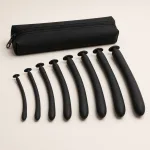
Eight-Step Flexible Silicone Sound Set
August 14, 2026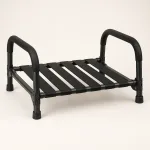
Elastic-Deck Dual-Rail Positioning Chair
August 14, 2026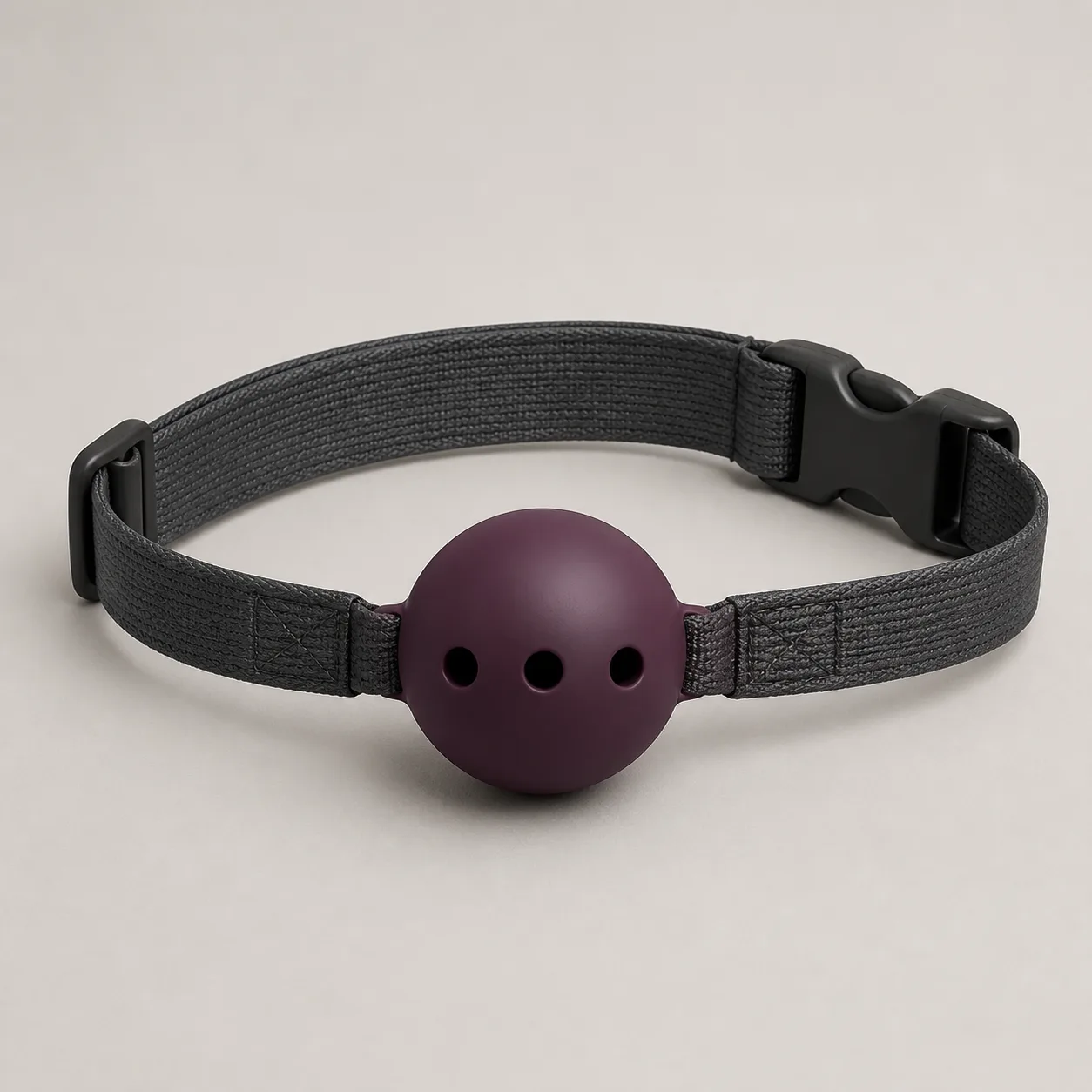
Three-Vent Quick-Release Ball Gag
A three-vent ball gag built around upright fit testing, dual nonverbal signals, continuous observation and immediate buckle access.
19,99 $
200 in stock
Three open vents are a backup, not a breathing guarantee
This deep-plum ball gag is designed for short, consensual sensory-restraint practice with a directly supervised partner. The three front-to-back openings provide additional air paths only when every bore is clear. Saliva, tongue position, strap angle or facial pressure can obstruct them, so the wearer must have an unobstructed nose and must remain upright, awake and continuously observed.
Do not use the gag during nasal congestion, respiratory difficulty, nausea, vomiting, coughing illness, dental pain, jaw disorder, reduced facial sensation, intoxication or drowsiness. A person who cannot freely understand, signal and withdraw consent cannot use this product.

Start with the buckle, while no one is wearing it
Before a fit test, inspect how the two buckle halves align, lock and separate. The responsible partner should be able to open the side-release buckle with one hand while the strap is slack and without searching behind hair. A buckle that sticks, needs excessive force or can be confused with an adjustment slider is unsuitable.
Do not add a padlock, carabiner, knot, tape or decorative cover to the closure. Quick access to the release is part of the use plan. Keep a second route to loosen the strap visible, and remove necklaces, earrings and hair accessories that could catch around the webbing.
Fit begins upright, sober and completely unrestrained
The first trial is a sizing check, not a scene. Seat or stand the wearer upright on a stable surface. They keep both hands free, place the ball themselves if preferred, and confirm that the nose is clear before the strap is brought around the head. The strap should stabilize the ball without pulling the jaw backward or forcing the mouth wider.
Keep the initial interval very brief. Release, speak normally and assess the lips, mouth corners, teeth, gums, tongue and jaw before any later trial. There is no universal wear time: jaw fatigue, saliva, anxiety and fit vary too much for an unverified duration claim.
Ball size must be measured, not guessed from a photograph
The production ball diameter, distance between the strap exits and usable adjustment range are pending. Measure them on the received sample. A ball that requires force to pass the teeth, stretches the mouth corners sharply, presses on dental work or causes the jaw to tremble is not an acceptable fit.
Never select a larger ball as a progression target. Comfort, stable positioning and rapid removal matter more than visual fullness. Braces, loose teeth, implants, recent oral work, temporomandibular-joint symptoms or unexplained jaw clicking require exclusion until a qualified clinician has advised on the individual situation.
A nonverbal stop system needs two independent signals
Agree on one deliberate hand signal and one object the wearer can drop. Test both signals before the gag approaches the mouth, then test them again after fitting. The responsible partner watches the signals, breathing pattern, posture, facial colour and level of alertness rather than waiting for an audible sound.
Ordinary movement can resemble a signal, so define it precisely. If a signal is uncertain, treat it as a stop. Release first and discuss later. The wearer never has to justify ending the activity.
Observation cannot be delegated to the vents
Stay within arm’s reach with a clear view of the nose, chest movement, eyes, hands and buckle. Never leave the wearer alone, close a door between partners or rely on a camera, timer or remote conversation. Do not use the gag during sleep or in a prone, face-down or reclined position where saliva or vomit could compromise the airway.
Release immediately for laboured or irregular breathing, coughing, repeated gagging, panic, dizziness, confusion, unusual quietness, colour change, vomiting, jaw spasm, tooth pain, lip numbness or swelling. If normal breathing or responsiveness does not resume promptly after removal, seek emergency assistance.
Do not combine restrictions during the learning stage
A new gag should be learned on its own. Tied hands, blindfolds, hoods, posture collars, chest compression and furniture attachment add separate communication and release problems. Do not introduce another restraint until both partners can fit, monitor and remove this product reliably in calm practice.
The wearer should be able to reach the buckle during early trials. Self-gagging while alone is excluded because sudden nausea, panic, jaw cramp or buckle failure can make assistance necessary.
Inspect each vent as a full tunnel
Hold the clean, dry ball toward a bright light and confirm that all three bores are open from front to back. Check inside each tunnel for molding flash, tears, tacky residue, embedded particles and narrow sections. A circular opening at the surface does not prove that the internal path is clear.
Repeat the inspection after cleaning and before every use. Remove the product from service if any vent cannot be fully examined and cleaned, if the ball becomes sticky, cracked, swollen, permanently indented or develops an odour that persists after the approved cleaning process.
Strap position should not load the ears or throat
Route the strap around the back of the head, away from the front and sides of the neck. Keep it flat, with no twists and no pressure on the ears. Hair must not be trapped inside the buckle or adjustment path. Recheck position after every movement because smooth webbing can migrate.
Do not pull the loose tail while the ball is in the mouth. Adjust in small steps while supporting the buckle, then stop as soon as the ball is stable. Marking a setting may help repeat a verified fit, but it does not replace a fresh check each session.
Oral-contact cleaning depends on verified materials
The listing uses silicone language, but the exact ball polymer, pigments, strap fiber and buckle resin remain pending. Obtain written composition and oral-contact documentation before choosing disinfectants or temperature limits. Soft feel alone cannot identify silicone or establish compatibility with a cleaner.
Until the manufacturer approves a method, use only mild unscented soap, lukewarm water and thorough rinsing on the ball, keeping detachable textile and buckle parts within their separate care limits. Work a soft brush through each vent without enlarging it. Dry every bore completely in open air before storage.
This is a single-person hygiene product
Saliva reaches the ball, vents and nearby strap. Assign the product to one person and do not share it. Store it fully dry in a clean, ventilated pouch away from lint, sharp objects, direct sun, high heat and oils that have not been checked for material compatibility.
Clean before first use and after every session. If the ball or strap cannot be separated as the listing suggests, the junction must be evaluated for trapped moisture and residue. A seam that cannot be inspected is a procurement concern, not something to hide in the product copy.
What procurement must prove before final approval
Freeze one model and record ball diameter, bore diameter, unobstructed bore length, strap dimensions, adjustment range, buckle operating force, mass and colour. Review deformation under realistic bite pressure, buckle release under slack, strap slippage, vent integrity after repeated cleaning and the security of every ball-to-strap connection.
Require traceable material declarations, pigment information, restricted-substance evidence, oral-contact assessment, cleaning limits, batch identification and destination-market labeling. Generic certificates, unrelated test reports and photographs of another model are not evidence for this exact item.
Questions buyers should answer before choosing a vented gag
Do the three holes make it safe for someone with a blocked nose?
No. The nose must already be unobstructed. The vents are only additional paths and can themselves become blocked.
Can it be locked so the buckle cannot open?
No. Locks and modifications that delay access to the buckle are outside this product concept.
How tight should the strap be?
Only tight enough to stabilize a correctly sized ball without pulling the jaw, cutting the mouth corners or compressing the head. Exact fit depends on verified dimensions and the individual wearer.
Can it be used with wrist restraints immediately?
Not during learning. Practice fit, signals, observation and one-handed release while the wearer remains unrestrained.
Is the ball confirmed as silicone?
No. The marketplace wording is unverified; polymer composition and supporting documents remain pending.
What happens if a vent looks partly blocked?
Do not use the product. Clean and inspect the full bore; retire the sample if it cannot be restored and verified.
Supplier reference and provisional EU display price
An indexed Alibaba showroom result described a detachable three-hole ball gag at USD 1.80–2.50 with a two-piece minimum order. The planned EUR 19.99 display price provisionally allows for China-origin freight planning, sample purchase, dimensional and vent checks, buckle-release testing, cleaning validation, material-document review, safety labeling, discreet neutral packaging, payment processing and destination delivery. Supplier identity, material composition, certification, freight, duty, tax, insurance, lead time and all purchasing conditions remain pending written confirmation.
Approval is conditional on the exact sample
The final sales specification must match the photographed and tested production model. Any change to ball diameter, vent bore, polymer, strap, buckle, attachment method or pigment starts a new review. Until the records are complete, present dimensions, materials, airflow performance and compliance as pending rather than assumptions.
Reviews
There are no reviews yet.