


Rotating-Thrust Curved Prostate Massager
August 14, 2026
Seahorse-Curve Illuminated Glass Bead Plug
August 14, 2026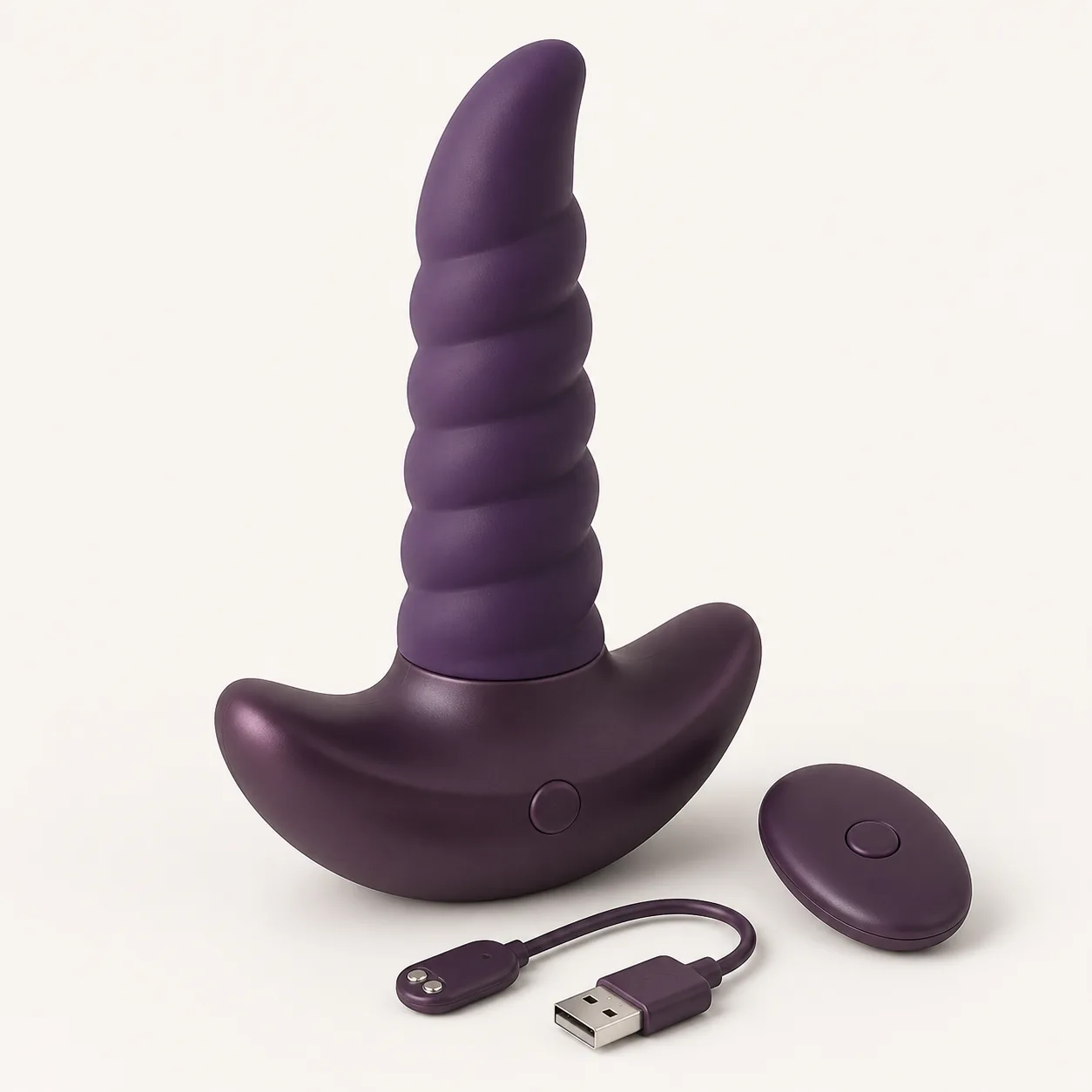
Spiral-Ridge Remote Rotating Anal Plug
A compact midnight-purple rotating anal plug concept with seven rounded spiral ridges, broad crescent retrieval base, local stop and oval remote.
49,99 $
200 in stock
A spiral profile makes motion verification essential
The spiral-ridge remote rotating anal plug concept combines a short tapered shaft, seven rounded diagonal bands, a curved tip and a crescent-shaped retrieval base. The product image also shows one local button, a separate oval remote and magnetic charging lead.

The broad base is a non-negotiable safety element; the fantasy styling does not replace dimensional evidence.
Usable geometry must be measured from tip to base
Record total length, insertable length, diameter at every ridge crest and valley, taper rate, tip radius, neck diameter and the base’s widest span and thickness. Confirm that the base cannot pass through a gauge larger than the maximum shaft profile under the approved compressive load.
Do not use the device if its base is cracked, flexible enough to fold inward or difficult to hold during an immediate stop.
Seven diagonal bands require seven edge inspections
Measure ridge height, pitch, flank angle, rounding and surface continuity from the curved tip downward. The bands should be smooth transitions rather than sharp threads, and no valley should expose a thin skin over a hard rotating core.
Reject mold flash, bubbles, splits, uneven cover, lifted edges or a hard point that appears when the shaft bends.
Rotation must be described by direction, speed and torque
Confirm clockwise and counterclockwise options, revolutions per minute, acceleration, stopping time and motor torque at each setting. Test free-running output and a defined compliant load while observing whether the shaft wobbles, stalls or winds the outer layer.
No 360-degree, continuous or reversible claim is approved until the exact sample demonstrates that behavior without surface distortion.
Vibration is a separate actuator map
Measure dominant frequency and acceleration at the tip, mid-shaft and base for every verified program. A supplier title that mentions seven rotation and seven vibration modes does not establish independent control or a fourteen-state sequence.
Document vibration alone before combining it with any rotating state.
Combined motion can magnify friction and torsional load
Run rotation and vibration together against a lubricated compliant fixture while logging current draw, temperature, noise and ridge deformation. Confirm whether rotation slows under vibration and whether the outer layer twists relative to the rigid base.
Use generous compatible lubricant and stop for pain, numbness, bleeding, swelling, unexpected resistance or loss of control.
The wireless remote needs a bounded pairing test
Identify radio type, pairing sequence, range, indicator behavior, battery type and response after signal loss. Test whether a nearby second unit can trigger the device and whether pairing survives charging, power cycling and a depleted remote cell.
The wearer must keep physical access to the base and local stop; a remote is never the only acceptable shutdown path.
Local control should remain readable by touch
Map long press, short press and any double press for power, rotation, vibration and direction. Confirm lowest-setting startup, memory, transport lock and the behavior after a stall or low-battery event.
A complete stop command should halt every actuator promptly without requiring the remote, an app or repeated mode cycling.
Compound records must cover the shaft, base and seam
Marketplace silicone wording does not identify the exact elastomer, hardness, colorants, rotating-core cover, base shell, button membrane, adhesives or magnetic-contact surround. Request lot-linked composition and restricted-substance documentation for the ordered purple configuration.
Inspect odor, tack, oil bleed, dye transfer, swelling and delamination after lubricant, cleanser, heat and torsion conditioning.
Cleaning the spiral valleys needs a validated method
Switch off, disconnect the dry charging lead and clean only within the approved water-exposure boundary. Work along each rounded groove with a soft validated cloth or brush without forcing the shaft to rotate by hand or prying at the base seam.
Rinse only if the final instructions allow it, then dry every valley, the button rim and magnetic contacts before storage or charging.
Ingress evidence must include a moving shaft seal
A stationary enclosure test can miss water paths that open while the internal carrier rotates. Test the complete device before and after motion cycling, with particular attention to the shaft-to-base joint, button, housing seam and charging contacts.
Until model-specific evidence is accepted, exclude baths and showers and keep the powered base away from running water.
Charging and runtime need the highest combined load
Verify cell chemistry, capacity, protection circuit, input rating, full charge time, runtime and low-power behavior. Run the highest approved rotation-and-vibration combination on a fixture while logging case temperature and automatic shutdown.
Charge only when fully dry on a hard ventilated surface, and stop for swelling, odor, unusual heat, corrosion or unstable connector alignment.
Noise can expose gear wear before the surface changes
Measure rotation, vibration and combined sound at a fixed distance. Clicking at one shaft angle, grinding under light load or a rising tonal whine can indicate gear eccentricity, bearing wear, loosened core or a rubbing seal.
Compare measurements after fatigue cycling and quarantine any sample with new wobble, noise, heat or delayed stop.
Incoming inspection should use a transparent compliant fixture
A clear test sleeve can show ridge travel, wobble, lubricant movement and base clearance without body testing. Inspect each ridge and seam, verify the local control and remote, run every separate and combined program, and confirm magnetic charging and low-battery shutdown.
Batch sampling, allowable defect limits, motor-life target, remote-interference plan and traceability format remain pending supplier agreement.
The supplier price leaves room for rotation validation
An Alibaba rotating-head prostate massager showroom lists a monster tentacle plug from Shenzhen Aixile Technology Co., Ltd. at USD 8.92-10.45 with MOQ 3, described with seven rotation and seven vibration modes. Exact model, dimensions, base, ridge geometry, actuator map, remote, compounds, ingress protection, battery, charger, packaging and compliance evidence remain pending.
The procurement reference supports inquiry only. The EUR 49.99 plan includes a China-origin freight allowance plus sample purchase, dimensional, torque, stall, remote, material, ingress, charging, thermal and fatigue review; actual freight, duty, tax, insurance, payment fees and destination terms remain pending.
Frequently asked questions
Does the shaft rotate continuously?
That is not approved until direction, speed, travel and stall behavior are measured on the exact sample.
Are there seven rotation and seven vibration modes?
Those counts appear in supplier wording, while the real sequence and independent-control logic require complete mapping.
Why must the base be wider than the shaft?
A clearly flared retrieval base helps prevent over-insertion and must remain accessible throughout use.
Can the remote stop every function?
It should, but the local button must also provide a prompt complete stop if the remote fails or loses connection.
Can the device be submerged?
No immersion guidance is approved without ingress evidence for the rotating joint, controls, seams and contacts.
What should be inspected before each use?
Check the tip, every spiral ridge, shaft cover, base, button, seams and contacts, then test low rotation, low vibration and the complete stop away from the body.
Reviews
There are no reviews yet.