


Spiral-Ridge Remote Rotating Anal Plug
August 14, 2026
Low-Profile T-Grip Tapered Anal Plug
August 14, 2026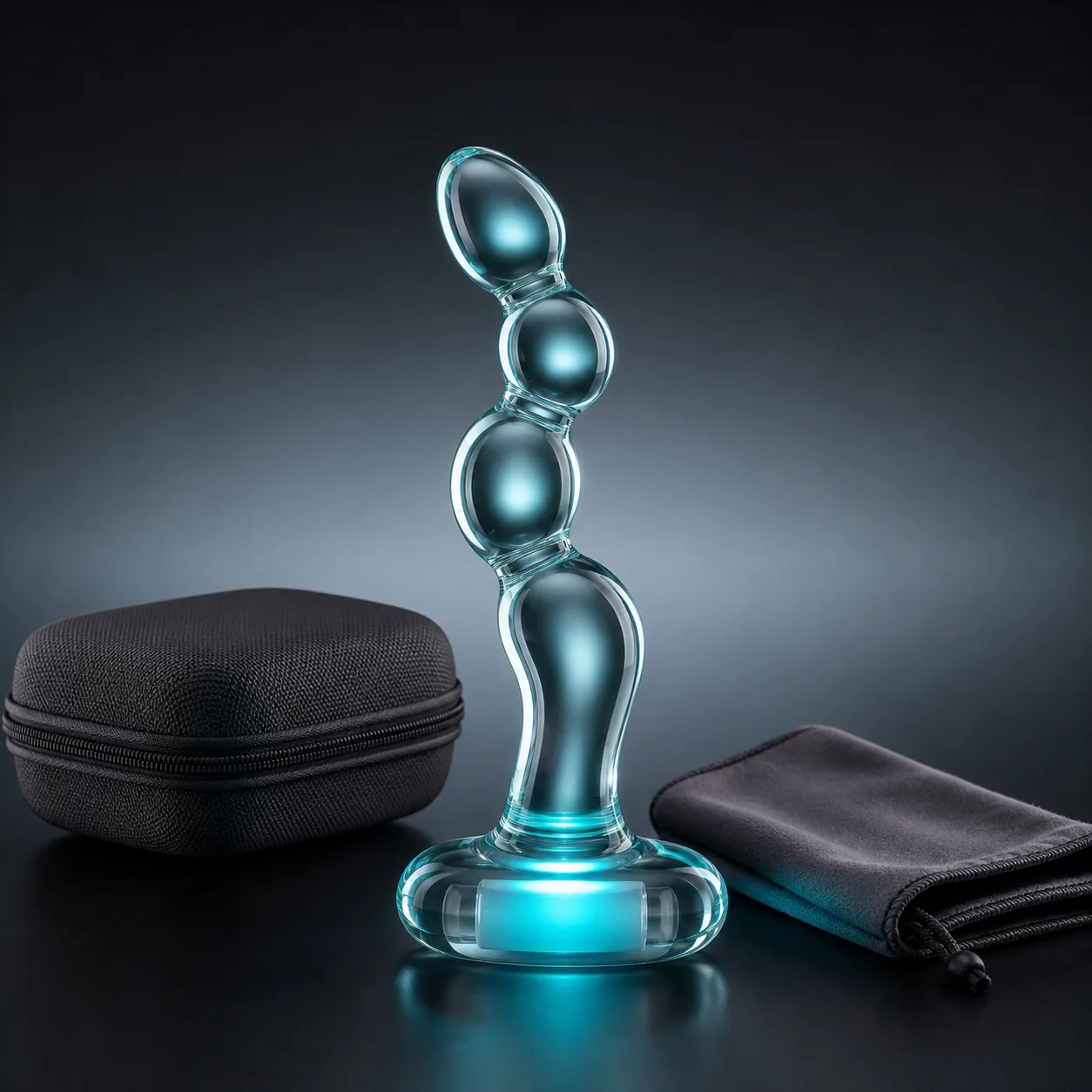
Seahorse-Curve Illuminated Glass Bead Plug
An aqua-tinted seahorse-curve glass bead plug concept with four graduated contours, broad illuminated cyan base, protective case and microfiber sleeve.
39,99 $
200 in stock
The seahorse curve is a profile, not a size claim
The seahorse-curve illuminated glass bead plug concept uses an aqua-tinted transparent S profile with four graduated rounded contours and a broad oval external base. A restrained cyan light module, protective case and microfiber sleeve complete the presentation.

The image demonstrates form and lighting only; it does not confirm scale, glass type, annealing, power system or placement.
Every contour needs a measured diameter and neck
Record usable length, tip radius, maximum diameter of each rounded section, neck diameters, centerline curve and distance to the base. The narrowest transition can govern stress as well as insertion progression.
Choose from actual measurements and stop for pain, bleeding, numbness or unexpected resistance.
The base must stay external without relying on the light module
Compare oval base width and length with the largest insertable diameter and the neck. The glass flange itself must provide a broad, graspable stop; an electronic insert, glow panel or removable cover is not a substitute.
Reject any sample with a loose base insert or a flange that can rotate through the test opening.
Glass identity needs documentation beyond the word crystal
Obtain composition, coefficient of thermal expansion, annealing schedule, forming method and batch traceability. Supplier terms such as Pyrex, borosilicate or crystal require model-linked evidence rather than appearance.
Do not sell or use a sample whose composition and annealing status cannot be established.
Optical inspection should cover the full curved centerline
View the clean dry piece under bright diffuse light and rotate it slowly. Inspect the tip, every bead shoulder, narrow necks, inner and outer S curves, base junction and the area surrounding the light insert.
Reject chips, cracks, star fractures, sharp seams, deep scratches, trapped debris or bubbles that the glass specification does not permit.
The cyan glow must remain a visual feature
Document light source, output, modes, switching, heat, power supply and access to any cell or connector. The light does not establish disinfection, treatment, sensing or any physiological effect.
Stop using the module for flicker, overheating, swelling, corrosion, liquid ingress or a cover that shifts under hand pressure.
The power module belongs entirely outside the body
Mark the insertable boundary at the neck above the broad base. Buttons, cell doors, connectors, seams and illuminated electronics must remain external and reachable at all times.
Do not cover the base with clothing or bedding if that prevents heat checks or immediate grasp.
Curved rigid glass changes leverage during movement
Use slow, controlled hand movement aligned with the validated curve. Do not rock, twist or apply lateral force against the body; a small motion at the external base can produce a larger change along a rigid S profile.
Keep the base supported and avoid sitting, walking or sleeping with the product in place.
Temperature play requires gradual verified limits
Bring the glass toward a mild target temperature using the approved method and verify it with a suitable thermometer. Account for the electronic base, which may have a narrower allowable range than the glass body.
Avoid freezers, boiling water, flames, ovens, microwaves and rapid hot-to-cold transitions that can cause thermal shock.
Cleaning must protect both glass and electronics
Follow the exact assembly instructions before exposing any part to liquid. Clean the glass surface from tip to base with a non-scratching method, paying attention to every neck and the base junction.
Keep an unverified light module dry, prevent cleanser from entering its seam and dry the glass completely before refitting any external component.
Ingress testing should include temperature cycling
Evaluate the base seam, switch and power access after mild thermal cycles, cleaning exposure and controlled handling drops. Different expansion rates between glass and a polymer or metal insert can open a leak path.
No immersion claim is approved until the complete assembled production unit passes model-matched testing.
The case must immobilize the curve
Confirm the case supports the widest bead and base without point-loading a narrow neck. The microfiber sleeve should be clean, non-abrasive and large enough to avoid forcing the product into a bend.
Store the piece alone, dry and protected from hard objects, loose batteries and temperature extremes.
Any impact triggers a full reinspection
If the product strikes a sink, tile, metal fixture or another glass object, stop using it. Clean it, examine every surface under bright light and use an appropriate inspection method before considering further handling.
Discard a piece with damage or uncertain integrity; polishing cannot repair a structural crack.
Incoming inspection needs profile gauges and light-module checks
Use a silhouette gauge for the S curve, calipers for all diameters and necks, a base-ratio fixture and optical inspection under controlled light. Sample module temperature, switch behavior, runtime, seam integrity, case fit and post-drop condition.
Glass specification, annealing acceptance, dimensional tolerances, base minimum, light output and carton testing remain pending supplier agreement.
The novelty quote excludes glass and electronic validation
An Alibaba glass product page lists a hippocampus-shaped illuminated bead plug from Hefei Jiaang E-Commerce Co., Ltd. at USD 2.22-5.56 with MOQ 1 piece. Exact model, geometry, glass composition, annealing, power system and compliance evidence remain pending.
The procurement reference supports sample inquiry only. The EUR 39.99 plan includes a China-origin freight allowance plus profile, base, glass, optical, light, power, temperature, ingress, cleaning and impact review; actual freight, duty, tax, insurance, payment fees and destination terms remain pending.
Frequently asked questions
Is the pictured glass borosilicate?
The image is an original concept; production glass composition and annealing evidence remain pending.
Does the light have multiple colors?
No mode or color count is confirmed. Light output, controls, runtime and heat require sample testing.
Can the illuminated base be inserted?
No. The entire broad base and its electronics must remain external and reachable.
Can the product be submerged?
No immersion guidance is approved without complete-unit testing after temperature and drop cycles.
Can it be placed in a freezer?
No. Extreme cold and rapid temperature changes are not approved because of thermal shock and electronics risk.
What should be inspected before use?
Check the tip, every contour and neck, both S curves, base junction, flange, light insert and seam for chips, cracks, scratches, looseness or corrosion.
Reviews
There are no reviews yet.