



Twin-Rocker Wide-Base Prostate Vibrator with Guarded Flex Stem
August 14, 2026
Four-Petal Torque-Limit Expanding Anal Plug with Wide Cross Base
August 14, 2026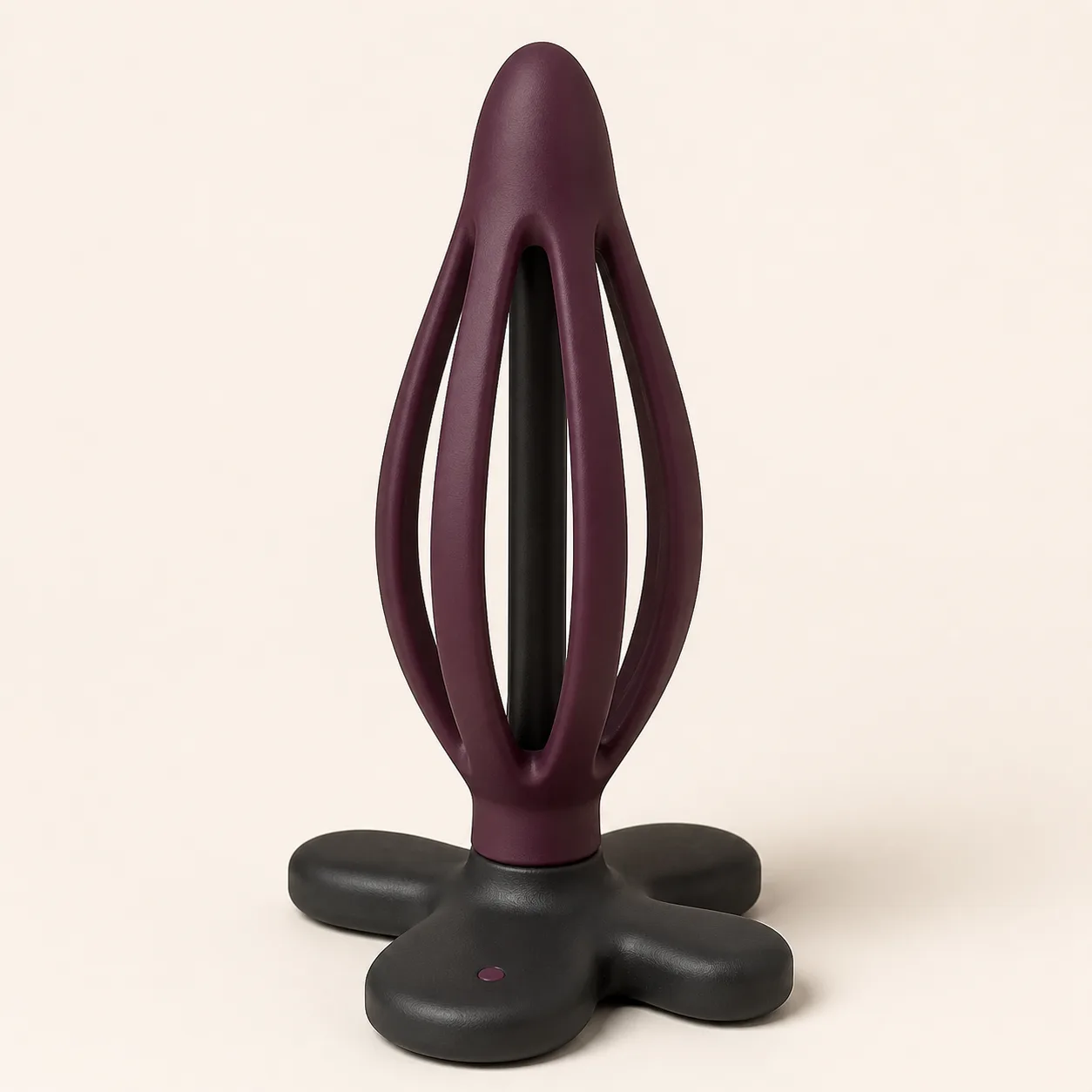
Four-Rib Flex-Cage Anal Plug with Oversized Cross Base
A fixed non-powered anal wellness concept with four longitudinal cage ribs, one guarded center spine and an oversized four-arm base for separately testable compression, recovery and retention geometry.
26,99 $
200 in stock
Use four exterior ribs around one guarded core
This flex cage anal plug concept forms a tapered profile from four broad longitudinal ribs around a slim center spine. Deep open channels separate the ribs, while an oversized four-arm cross base is intended to remain external and accessible.

The image does not prove insertable dimensions, rib flexibility, core material, load capacity, skin-contact composition or supplier approval.
Confirm a fixed intact construction
Request an exploded or sectional drawing and bill of materials for the rounded tip, four ribs, rib roots, center spine, upper and lower joins, neck, cross base, orientation dot, pigments, coatings, lubricants and adhesives.
Determine whether the spine is a structural insert, overmolded core or only a contrasting surface. No removable or adjustable element should be assumed.
Map the complete geometry
Record total and insertable length, tip radius, maximum profile, neck diameter and length, rib width and thickness, channel width and depth, spine diameter, lower transition, base span, arm width, arm thickness, edge radius, asymmetry and mass.
Use one consistent centerline and record each rib separately instead of averaging the cage.
Measure every rib profile
Scan or gauge the four longitudinal curves from upper join to lower root. Compare radial position, bow height, wall thickness, edge radius and spacing to neighboring ribs.
Inspect for mold mismatch, thin sections, sharp flash or a rib that approaches the center spine more closely than the others.
Test rib compression and recovery
Apply small calibrated radial loads at the upper, middle and lower thirds of each rib. Measure displacement, force, local strain, contact with the spine, recovery time and residual set.
Repeat in perpendicular directions and at planned cycle intervals. Stop before any supplier-defined deformation limit.
Quantify coupling across the cage
Load one rib while measuring motion in the other three, the tip, spine and neck. Then apply balanced opposing loads and a four-point radial load.
Document whether the structure narrows symmetrically, twists, buckles, snaps through or transfers force into one lower root.
Inspect center-spine containment
Check the spine along every open channel for seams, exposed hard edges, movement, end visibility and bonding gaps. Use imaging or sectioned samples to locate both endpoints.
The spine must not migrate toward the tip, neck or base under verified compression and torsion cycles.
Verify the neck transition
Measure the neck at several heights and inspect the junction between rib roots, spine, neck and base. Apply low controlled bending and torsion while monitoring strain concentration and permanent set.
Reject cracks, whitening, delamination, exposed core or a lower rib root that peels away from the neck.
Measure base stop geometry
Record clear span across opposing arms, total stop area, arm thickness, curvature, underside profile and distance from neck center to every edge. Test axial and off-axis deformation under low calibrated loads.
Confirm that no arm curls enough to reduce effective external reach below the documented safety limit.
Apply guarded retention tests
Use a purpose-built compliant fixture, never a person, to measure how the neck and base interact under small axial and off-axis forces. Record base rotation, arm lift, neck stretch, rib deformation and release force.
This is not a suspension, body-weight, medical or long-duration device. Keep the entire base external and accessible.
Screen openings and channels for entrapment
Inspect all rib gaps and spine clearances with calibrated probes across the verified load range. Check whether channels close abruptly or create shear points as one rib deflects.
Stop testing for a gap that can trap film, hair or soft material, or for any exposed internal edge.
Validate external accessibility and orientation
Confirm that all four base arms can be located and grasped at every approved orientation on a fixture. Verify the small dot is only an orientation reference unless exact documentation defines another function.
Do not use unattended or during sleep, and stop immediately for pain, numbness, pressure, bleeding, unexpected resistance or difficulty removing the device.
Cycle compression, torsion and the base
Run repeated four-direction compression, opposing-rib loading, low-angle torsion, neck bend, base deformation, guarded retention and cleaning cycles. At planned checkpoints measure profile, force, recovery, spine movement, root integrity, base span and surface change.
Retire a sample after a torn rib, exposed spine, permanent cage collapse, cracked root, stretched neck, curled arm, tacky surface or unexplained discoloration.
Validate cleaning through the open cage
Obtain exact material and cleaner compatibility data. Apply measured soil to rib edges, deep channels, spine surfaces, upper and lower joins, neck root, base-arm junctions and orientation dot.
Clean only by the verified method, then inspect all four channels and measure drying by mass. Open geometry does not prove that every recess sheds residue or moisture.
Price only after rib symmetry is proven
An Alibaba silicone anal trainer listing currently shows USD 0.51-2.99 with an MOQ of one. It is a category benchmark only and does not confirm this four-rib cage, center spine, cross base or approved supplier.
The procurement reference supports an EUR 26.99 planning price after allowing for China-origin freight, complete part inventory, four-rib metrology, compression and recovery maps, cross-rib coupling, spine containment, neck-strain inspection, base stop and guarded retention testing, entrapment review, cycle life, material evidence, cleaning validation, protective packing and discreet fulfillment. Exact quotation, packed dimensions, weight, freight, duty, tax, insurance, payment fees and delivery terms remain pending.
Frequently asked questions
Are the four ribs equally flexible?
That requires individual force and recovery maps from production samples.
Is the center spine removable?
No removable element is assumed; construction and containment need sectional evidence.
Do the open channels make cleaning easier?
They improve visual access, but deep joins and spine clearances still require validated cleaning and drying.
Can the base fold for storage?
No folding function is claimed, and permanent arm deformation is a retirement fault.
Can it be used unattended?
No. The full base must remain external, reachable and monitored.
Which faults require immediate retirement?
A split rib, exposed spine, collapsed cage, cracked root, stretched neck, curled base arm, tackiness, sharp edge or residue that cannot be removed.

Reviews
There are no reviews yet.